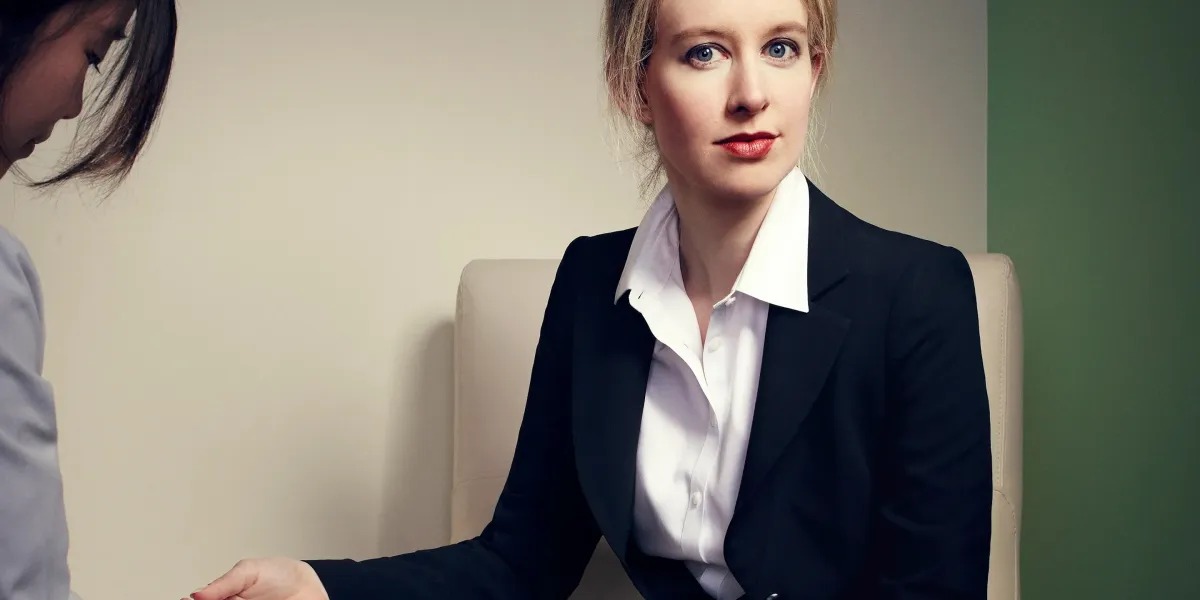


On the cover of Fortune magazine in June 2014, Elizabeth Holmes's portrait, with her eyes wide open and gazing forward, was striking and prominent: the young founder was dressed in her signature black high-neck sweater and had dark red lipstick on. The caption beside her read, "This CEO came for blood" ( out for blood ). In a feature about the founder of this highly sought-after health tech startup, Roger Palov described what the company claimed its devices could do. Palov reported that these devices could perform over 200 tests using just a few drops of blood collected from a finger, rather than through needle pricks, and that these tests were fast and significantly less costly than those conducted in established laboratories.
Holmes's admirers are just as dazzling as these claims. Her professor at Stanford University, Channing Robertson, said to Palov, "I realized that the look in her eyes could very well be the same as that of Steve Jobs or Bill Gates." Henry Kissinger, who was a member of the Theranos board of directors at the time, also testified to her integrity: "There is no trace of pretense in her. I saw no signs that financial interests held any appeal for her. She is like a monkess."
If all of this sounds incredibly good, then – as you undoubtedly already know – that’s indeed the case. In January 2022, a jury found Holmes guilty of four charges of defrauding investors. She was sentenced to 11 years in prison and began serving her sentence in May 2023.
Holmes and Theranos have once again become news figures because of the documentary " You Can See Everything " filmed by Nathan Field and Lance Oberhaim. This film documents the life of Holmes and her family in the last few weeks before she lost her freedom. The film was a huge success, recently breaking the $100 million global box office mark, and is widely regarded as a contender for an Oscar.
The cover of Fortune also appears in the film, serving as a shorthand symbol to demonstrate how high Holmes rose in the business world during his peak period. Indeed, Palov’s feature article on him almost crowned Holmes as a new business mogul. He wrote, “Although Theranos is virtually unknown even in Silicon Valley, that is about to change.” He also revealed for the first time the company’s scale, financing situation, and a valuation of approximately $9 billion.
After John Carrelo of The Wall Street Journal exposed Holmes' fraudulent activities, Pavlov admitted that he made a mistake due to his trust in her. In his lengthy clarification article titled "How Theranos Misled Me," he wrote bluntly, "I messed up." He detailed the "huge and obvious red flags" that he missed, the confusing moments when Holmes evaded direct answers, and how she explained these ambiguities on the grounds of "trade secrets." "I regret this mistake," he wrote.
In this nearly 3-hour film by Field, this frustrating avoidance is quite evident. During a conversation, Holmes and Field repeatedly argue over the term “can”: whether this term describes what her machine “will be able to” do at some point in the future, or what she previously claimed it “is actually doing” at that time.
Pavlov’s cover story in Fortune helped Holmes become a star. His correction is now also part of historical records, and it sets an example for how to respond to errors in the “first drafts of history” provided by the journalism industry: quickly, completely, and openly. Then continue with the reporting.