

I Play Rocky expanded its release on November 20th, reaching 2,477 theaters in the United States and Canada. It grossed approximately 9.3 million dollars over the weekend, ranking second in weekend box office sales, which is enough to push its North American cumulative box office past 10 million dollars, according to preliminary weekend estimates. The first group of viewers even gave this film a rare A+ rating. CinemaScore
This film, directed by Peter Farrelly, tells the true story of young and yet-to-be-famous Sylvester Stallone who wrote the script for "Rocky" in the 1970s. When the studio insisted on choosing a more well-known actor for the lead role, Stallone insisted on playing it himself. This story has now become a Hollywood legend: "Rocky" became the highest-grossing movie of 1976, won an Oscar for Best Picture, and also marked the rapid rise of Stallone's acting career.
This story has always carried a certain sense of “meta-narrative.” Rocky Balboa is a weak man who dares to fight to the end in the ring, and Sylvester Stallone also dares to believe that he can become an actor. For this reason, even 50 years later, “I Play Rocky” remains an engaging story.
Just like the material it is adapted from, the path to the big screen for “I Play Rocky” has not been easy either. Amazon MGM Studios is responsible for distributing this film, and the company holds the copyright to the “Rocky” series through a joint venture with Artists Company, which is the distributor of the original “Rocky” films. However, “I Play Rocky” was initially an independent screenplay completed by screenwriter Peter Gambell without any involvement from a film studio.
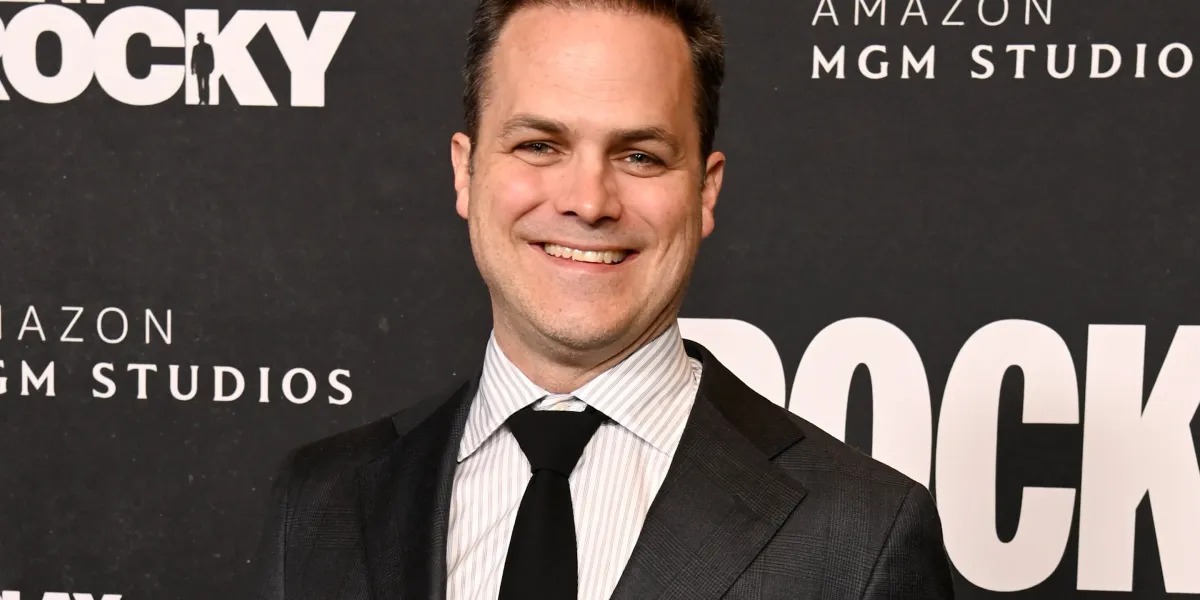
Gambrel is not an actor, but like Sylvester Stallone, his early career credentials were not impressive. However, his journey into the screenwriting industry is in itself a story of continuously overcoming adversity.
"I'm a person with dyslexia, but I'm also a writer, and these two things don't usually go hand in hand," Gumbel told Fortune magazine. "My parents sought help for me when I was young, and computers have given me my freedom. I could never complete such a work by hand like Sylvester Stallone could; that would kill me."
Despite these obstacles, Gumbel still enrolled in the School of Film Arts at the University of Southern California to hone his screenwriting skills, and later he even taught there. After graduation, he worked as a script reader and editor for a high-ranking executive. Although his early uncredited revisions and developments were not credited in the end credits, Gumbel saw his contributions finally appear on the screen, which also allowed him to envision his future as a storyteller.
Breakthroughs without individual signatures
However, as many screenwriters can attest, talent and experience are just two of the variables in Hollywood's formula for success; this complex multi-variable equation can only lead to success when one is sufficiently lucky. Nowadays, it may be even more difficult for an original film script to stand out than it was for Steven Spielberg to write "Rocky" back in the day. Currently, only a few studios have the authority to approve projects, and most of their projects are either adaptations by IP or star-driven initiatives.
Before I Play Rocky, Gambell had been collaborating with other screenwriters for over a decade, continuously honing his skills and expanding his network, but he never received credit as the sole screenwriter for a feature film. According to his IMDb page, his previous works include the short video Pitching Lucas, the series Trenches, and the independent horror action comedy Office Uprising, which he co-wrote with Ian Shaw. He also sold a pilot episode to Fox and pitched the horror screenplay "10/31" to Orion Pictures.
In order to be noticed, Gamble decided to write a story that was completely his own and submit it to Hollywood’s annual “blacklist” of unproduced screenplays ( The Black List ). For a long time, this platform has been a pathway for aspiring screenwriters to get their work seen by the industry.
Even being on the list doesn’t mean success. In previous years, the list was filled with original scripts that never saw further development, or projects that were selected by producers but remained stuck in the development stage. A colleague of Gambrel suggested that he write a biographical film to increase his chances of success.
“Biographical films in themselves are a kind of IP,” Gumbel recalled saying to his agent John Zaozny. This subgenre is not common on the “blacklist,” yet it has real potential. Zaozny advised Gumbel to explore how Stallone made “Rocky.” In Gumbel’s words, “As soon as he mentioned it, I knew that was the story I had to write. It’s the ultimate story about being ‘ignored.’ Stallone had partial paralysis on his face and speech difficulties. But he wanted to be an actor; people only saw his face, while he knew they should see his inner self. He knew he could offer more, so he poured all his heart and soul into the ‘Rocky’ screenplay. With the power of this belief, he convinced the producers that he was the actor they were looking for.”
Gambrel completed the screenplay based on interviews Stalone has given over the years, as well as this actor and screenwriter's behind-the-scenes diary “The Official Rocky Scrapbook”. Producer Christian Baha noticed this screenplay, purchased the rights, and continued to develop it together with Gambrel.
The late producer Thomas Augsberg later read this script and passed it on to Toby Emmerich, who was formerly in charge of Warner Bros. films, and Emmerich then shared the script with Sylvester Stallone himself.
"Stallone is very friendly and very gracious," Gumbel said, "He said, 'I think this is a great script. There's no problem for me, but I can't make a movie about myself. That would be strange and it would look like a work of self-aggrandizement.'"
Why is it that only one film studio is capable of making it?
Emmerich eventually brought the script to Fellini. Fellini is perhaps best known for the comedies he directed alongside his brother Bob in the 1990s; in recent years, he has incorporated his sense of humor into more prestigious and uplifting stories. The 2018 Oscar-winning film "Green Book" is full of emotion, while his 2022 film "The Greatest Beer Run Ever" blends humor, warmth, and high-energy positivity together.
“I Play Rocky” was a project that came naturally to Ferrari, but even with the participation of an Oscar-winning director, the film still faced numerous difficulties. In 2024, the team, like independent producers at all levels, took the project to the Cannes Film Festival to seek funding from the March é du Film markets. Without the support of a film studio, they followed the traditional route of international pre-sales and equity financing, exchanging distribution rights and backend profit-sharing points for mezzanine financing in order to piece together a budget.
The team has also approached several major studios, but only one seriously considered making a film about the origins of "Rocky." "The problem for the studios is, 'If we make this story, it's as if we're promoting other studios' series brands,'" Gambur explained, "They were kind of saying, 'We’re not sure if this is a risk we’re willing to take, because most of the profits would go to others. This is actually more like a project for Amazon and MGM.'"
In 2022, Amazon completed its $8.45 billion acquisition of MGM, which also included the rights to the "Rocky" franchise. Since then, Amazon has risen to number one on the 2026 Fortune 500 list. However, the only "Rocky"-related work released by Amazon after acquiring the rights was " Creed III " in 2023, and that film was actually already in production at the time of the transaction. Therefore, there is no guarantee as to whether Amazon will be involved in " I Play Rocky ".
While these discussions were taking place, Ferrari and the producers began to look for the right actors to portray a younger version of Stallone. In the early stages of casting, director Rick Montgomery received an audition video that was not solicited, sent in by 27-year-old Italian-American actor Anthony Ipolito. In the video, he recited lines from "Rocky" against a wall in the basement of his grandmother's house in Long Island. After watching it, Montgomery immediately called Ferrari and said they had found the person to play Stallone.
Ipolito's most well-known role prior to this was playing a younger version of Al Pacino in the Paramount+ series “The Offer”, which tells the story of the filming of “The Godfather”. To portray this character, he built muscle and imitated Steve Stallone's voice. Nevertheless, he is not a household name as a star; his co-stars such as Annasofia Robb, Stephen James, P.J Bourne, Toby Kebel, Jay Duplass, Matt Dillon, and Tracy Letz may have increased their recognition to some extent, but none of them can be said to have brought in substantial box office appeal.
Gambur said that Ferrari promoted this story with great enthusiasm and sincerity, ultimately convincing Amazon to join in, thus opening up new possibilities for the film. Since Stallone is a public figure, the team was able to legally tell his story without the authorization of a studio, Gambur said. However, with the support of MGM, they were able to recreate the scenes, lines of dialogue, and music from the original movie without having to worry about copyright infringement.
The screenwriter sits next to the director.
The film was shot at the end of 2025 in New York, New Jersey, Los Angeles, and Philadelphia. The atmosphere on set was very collaborative; Farrelly welcomed suggestions from the cast and crew, and kept Gambol seated next to him throughout the production period, which is extremely rare in the film-making process, as screenwriters are often marginalized once shooting begins. Gambol recalled that throughout the entire shooting period, he kept thinking, “It’s not healthy to be this happy for six consecutive weeks.”
The film premiered at the Toronto International Film Festival in September and won the runner-up award for Audience Choice. After the festival tour, it was released on a small scale in 7 theaters on November 6th, and two weeks later its distribution was expanded across the United States. As Hollywood entered the award season, the film gradually gained popularity.
As for Gambrel, he hinted to Fortune magazine that he might be working on another biographical film in collaboration with Ferrari and a production studio on a series of projects, but the details are still unclear. What is certain is that he is very grateful for “I Play Rocky” and its team.
“I don’t agree with the author’s perspective,” he said, “I prefer to call it ‘our perspective.’ Because even though my name is credited at the end for writing this film, I know that someone gave me this or that suggestion, some actor’s idea came from somewhere, and the people on set improved it even further. By the time it finally appears on the screen, it’s like a chorus sung by a group of people. It’s the combined voices of everyone telling that story.”