

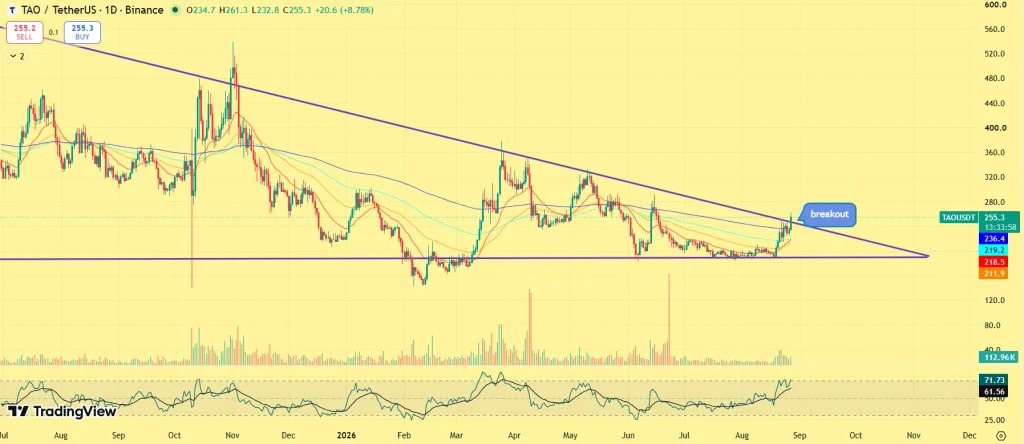
TAO has shown a clear strengthening recently, with prices rising above $255, breaking through the downward trend line that has been suppressing rebounds since early 2026. At the same time, the activity in the futures market has also increased, indicating that this round of gains is not driven solely by the spot market.
Futures trading volume and open interest increase simultaneously.
The latest data shows that the futures trading volume of TAO has increased to 519.32 million US dollars, a growth of 48.57% from before; the number of open contracts has risen to 393.86 million US dollars, with an increase of 14.63%. This indicates that new positions are entering the market, and the upward movement in prices is accompanied by an increase in leveraged funds.
From the trend perspective, TAO has once again reclaimed the range of $218 to $236. This range previously served as a significant resistance level. The current focus of the market has shifted to whether the $250 to $255 range can become a short-term support level.
The upper limit of 21 million coins is mentioned again by the market.
A core factor that has fueled this round of discussion is the issuance mechanism of Bittensor. The total supply of TAO is capped at 21 million coins, and the protocol also includes a halving mechanism. After the first halving in December 2025, the base issuance per block was reduced from 1 TAO coin per block to 0.5 coins per block.
This setting has once again led the market to compare TAO with Bitcoin. However, the narratives of the two are not entirely the same. The scarcity of Bitcoin mainly stems from its decentralized currency attributes, whereas TAO is the core token within the decentralized AI network, serving the functions of network incentives and value distribution.
Subnet rewards adjusted to tighten and increase supply
In addition to the halving, Bittensor is also adjusting the token release method. V440 Emission Gate has introduced a more selective subnet reward distribution mechanism, where rewards are no longer evenly distributed to subnets with weaker performance, but rather tilted more towards subnets with greater demand and stronger performance.
For holders, this means that the efficiency of token distribution is improving. If rewards continue to concentrate in more active subnets, the economic weight obtained by weaker networks will be reduced, and the supply narrative of TAO will also become further tightened.
250 USD level serves as a short-term observation point
In terms of price structure, the range of $250 to $255 has become a key area for short-term trading. If this range can be stabilized, the market's attention will then shift to the $270 to $275 range, followed by the integer level of $300.
However, while derivative data indicates support for an upward trend, it also suggests that the risk of volatility is increasing. As the number of open contracts and trading volume rise in tandem, a breach in support could lead to a larger retracement for leveraged positions. The original text mentions that the TAO daily RSI is close to 72, indicating strong momentum, but the market has also entered a relatively overheated state.