

U.S. chip manufacturer Supermicro Semiconductor ( AMD.O ) announced on Monday that it will acquire artificial intelligence startup World Labs in a all-stock deal worth approximately $8.2 billion.
This transaction is expected to be completed by the end of 2026 and still requires regulatory approval. Once the transaction is completed, Li Feifei, co-founder and CEO of World Labs, will join AMD as Executive Vice President and Chief Scientist, reporting directly to Su Zifeng, Chairman and CEO of AMD.
World Labs has been established for only about two years, with its core research directions being "world models" and spatial intelligence. The goal is to enable artificial intelligence to understand, generate, and simulate three-dimensional environments and the physical interactions within them. AMD has this time acquired the entire team, extending its presence in the field of artificial intelligence from GPU, software, and data center infrastructure to the development of fundamental models.
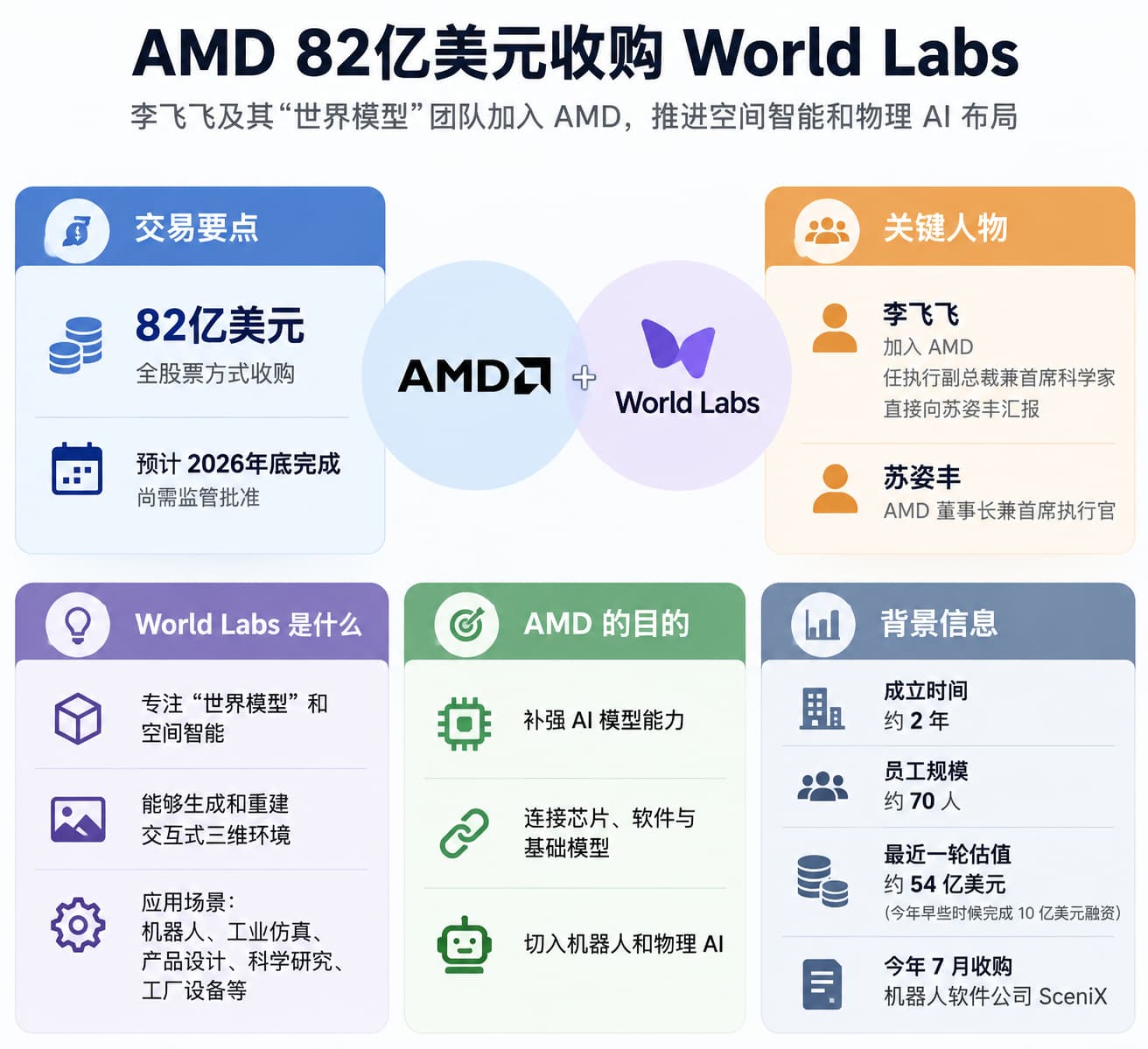
The model developed by World Labs is capable of generating and reconstructing interactive 3D environments, which is different from the generative AI models that mainly handle 2D data such as text and images. Its potential technical applications include scenarios that require an understanding of the physical world, such as robotics, industrial simulation, product design, scientific research, and factory equipment.
In an interview with Bloomberg TV, Su Zifeng stated that the deeper the understanding of artificial intelligence from end to end, the better the systems that can be built. This is also the reason why AMD acquired World Labs. She mentioned that AMD hopes to combine the research team established by Li Feifei with its own capabilities in the fields of hardware, software, and systems.
AMD indicates that the research conducted under World Labs will help the company gain a deeper understanding of future AI workloads, and accordingly adjust the technical pathways for hardware, software, and systems. Compared to simply adding another AI model product, another value of this transaction lies in the fact that AMD allows for direct observation of the new demands placed on computing power, memory, interconnectivity, and the software stack by model development, which can then be fed back into the design of the next generation of chips and systems.
The two parties had previously established a cooperative relationship. Li Feifei stated that World Labs began inlast year to engage in in-depth technical cooperation with AMD, initially focusing on model training and inference optimization on AMD GPU. As the cooperation progressed, both parties realized that integrating software and hardware ecosystems, basic models, and applications together offered even greater potential for synergy.
World Labs completed a $1 billion financing earlier this year, and AMD is also one of the investors. According to data cited by The Information from PitchBook, the company's valuation after its most recent round of financing was approximately $5.4 billion. Based on this, the $8.2 billion acquisition price by AMD is significantly higher than the company's valuation from its most recent financing round.
World Labs currently has about 70 employees. In July this year, the company also acquired the robotics software startup SceniX, which specializes in developing software for training robots in realistic virtual worlds. This move has further brought World Labs's technology closer to robotics and physical AI.
For AMD, this transaction occurred at a time when the company was rapidly expanding the business boundaries of AI. Over the past few years, AMD has continuously strengthened its computing infrastructure and system capabilities through acquisitions. In 2022, it acquired Xilinx for approximately $50 billion, and in 2024, it agreed to acquire computing infrastructure company ZT Systems for nearly $5 billion. This June, it also acquired memory optimization company MEXT.
However, in the artificial intelligence accelerator market, AMD is still catching up with NVIDIA. NVIDIA has for a long time built a complete platform through GPU, networking devices, software, and development tools, and has gradually expanded its business scope to include model and application ecosystems. With this acquisition of World Labs, AMD has also obtained teams and products that allow it to directly participate in cutting-edge model research.
Su Zifeng stated that after World Labs joins, AMD will be able to provide customers with more AI models, which include both open models and proprietary models. The company's goal is to further expand its investment in the open AI ecosystem and to integrate model development with hardware, software, and system development.
Li Feifei also stated that as the scale and goals of World Labs expand, the company's demand for computing power is also increasing. Joining AMD can accelerate the cycle of co-evolution of software and hardware, allowing model development needs to more directly enter the design process of the underlying computing platform.
This transaction also brings Li Feifei into the highest-level R&D system of AMD. She has long been engaged in research in computer vision and artificial intelligence, has worked at Google, and has conducted computer science research at Stanford University. After the acquisition is completed, she will participate in the formulation of the overall AI technical direction of AMD in the role of Chief Scientist.
The immediate reaction of the capital market to the announcement of the transaction was relatively limited; the stock price of AMD remained virtually unchanged during after-hours trading on Monday. Over the past 12 months, the company's stock price has risen by approximately 277%, and its recent market value is close to one trillion dollars.