

A coded letter written for a general under Napoleon Bonaparte remained sealed for 217 years until an engineer named AI decided to use a GPT-6 code and a AI model to decipher it for testing purposes. AI, an engineer at the cybersecurity company SentinelOne, uploaded a scanned image of the coded letter along with a hint requesting interpretation of the information. According to a report by Tom, this model managed to decipher the entire text in about 6 hours.
Six hours, one chart, one clue word
Tom quotes Church as saying that this result is less of a demonstration of cryptographic techniques and more of a display of how far a general model can be extended. Church writes, "What is truly impressive is not the decryption of the code itself, but Astra's ability to complete the entire multimodal workflow in about 6 hours, using only one image and one target." According to Calcalist, at the top of the document there is a line of standard French, followed by 24 lines of numbers, letters, and self-made symbols, totaling about 1300 cryptographic units, using 155 different symbols.
Previous researchers were only able to identify the known meanings of 33 of these symbols; the majority of the remaining content remains unexplained. The operation of Astra has changed this, as it treats transcription and password analysis as a continuous process, rather than dividing them into two separate specialized steps.
What exactly was written in this letter from the Marmon era?
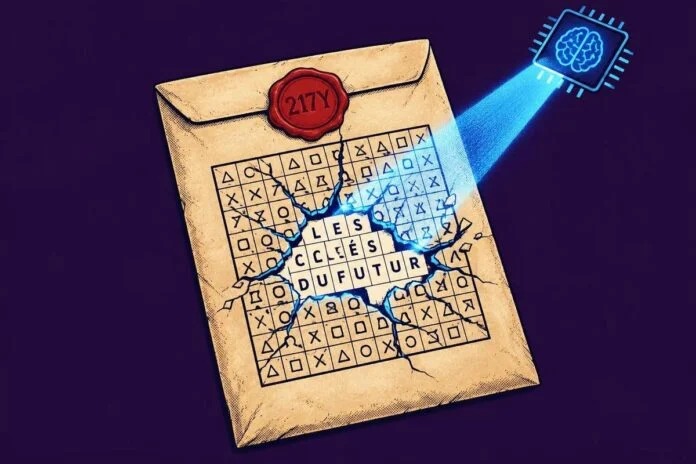
The decoded text is actually a military briefing, originating from the headquarters of Eugène de Beauharnais, the Vice King of Italy and Napoleon's stepson, dated March 1809. At that time, Austria was on the verge of going to war with France. On March 16, Napoleon instructed Eugène to deliver a coded letter to General Auguste de Malmaison through a "clever officer," conveying the Emperor's orders, as well as detailing the troop deployments in Bavaria, Poland, Saxony, and Italy, as well as the Russian forces advancing towards Austria. Malmaison was stationed in Dalmatia, on the opposite side of the Adriatic Sea, far from Napoleon's main forces; at that time, he needed his own military codebook to understand this letter. Once that key disappeared, the possibility of direct decryption became hopeless.
It is worth noting that the restored paragraphs complete the wording that was missing in the printed version of Napoleon's memoirs from 1865. In that version, a sentence about Marmon abruptly ends at “a handful of …”. The interpreted letter completes it as “a gathering of rabble”.
Church How to verify the answer of AI
Behind the scenes, the process of cracking the AI code using the GPT-6 method involved splitting the scanned page into multiple parts, identifying repeated symbols, and then applying a simulated annealing approach—essentially a large-scale trial-and-error search—to test the correspondence between letters and words. According to reports from Calcalist, Astra would compare the candidate French pronunciations with the writing styles of Alexandre Dumas, Victor Hugo, and Monsieur Malmaison himself from their respective texts, and it would also mark those symbols that represented entire words rather than individual letters. Subsequently, Church ran the analysis again after removing all materials related to Napoleon and Malmaison from the model's available reference text; it is claimed that the system produced the same interpretation. This check was intended to rule out the possibility that the model had simply memorized information from elsewhere, rather than truly deciphering the code.
Maintaining the Satoshi Tomokiyo table of the Cryptiana database indicates that this code has been listed among unsolved historical passwords for many years, and now it has been marked as cracked, according to Calcalist. The complete solution package and the script that can regenerate this decryption are available for download on the blog at Carter Church.
This article was generated with the assistance of artificial intelligence and has been reviewed by an editorial team.