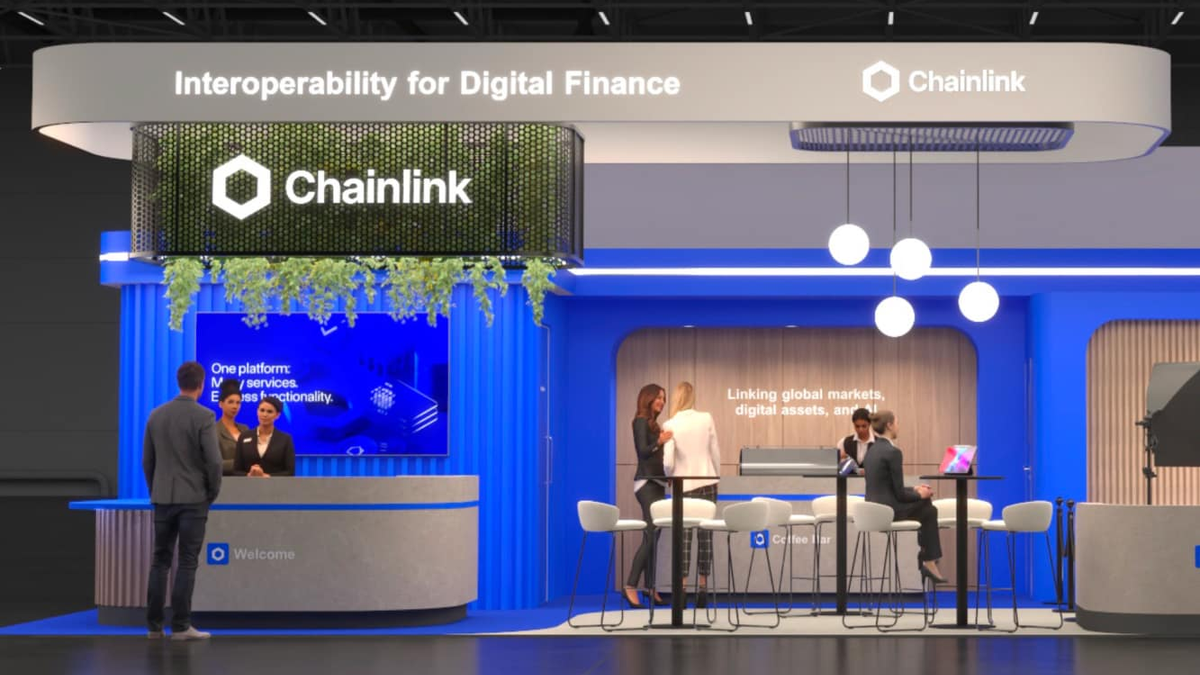


On September 30th, Chainlink introduced a financing and collateral management solution named Fulcrum, and during the Sibos meeting, they showcased cross-chain collateral work related to DTCC. The issue they aim to address is not merely about getting more assets onto the blockchain, but whether these assets can be recognized as valid collateral across different networks and financial institutions once they are on the chain. Chainlink described Fulcrum as a workflow that connects the venues where financing agreements are made with the chains where collateral is stored. The announcement also stated that integrations with multiple traditional financial environments are still in progress; one demonstration and product introduction should not be taken as an indication that the inter-bank repurchase market has been fully migrated onto the blockchain.
In traditional repurchase transactions, one party uses securities as collateral to obtain short-term funds and agrees to repurchase them later. Agreeing on the price is just the first step; both parties in the transaction also need to verify the qualifications of the collateral, the discount rate, the delivery of cash and securities, and how to add or release collateral in response to market changes. If cash is on one network and securities are on another, a single-chain smart contract cannot directly coordinate all these aspects. The value proposition of Fulcrum is to put the protocol terms, asset verification, and cross-chain settlement into a repeatable process, rather than locking each trading counterpart in the same place.
What is being addressed is cross-site coordination, not creating liquidity out of thin air.
According to Chainlink, counterparties can select qualified assets, financing amounts, interest rates, mortgage discounts, and other conditions through a single entry point. They can also set restrictions such as prohibiting the re-pledge of collateral. The protocol is executed and governed by the financing venues that are connected to it. Fulcrum itself does not hold assets, does not act as a counterparty, nor does it operate any trading venues. These limitations are very important: it serves as a layer of connection and orchestration infrastructure, and it is not a fund pool that promises unconditional loans to banks.
Technically, Chainlink Runtime Environment is responsible for orchestrating steps such as protocol creation, collateral verification, and fund release; CCIP handles message and asset transfers between public and private chains. The company claims to support its operating environment as well as the EVM networks covered by CCIP, as well as non-EVM networks. The term "support" here should be understood as architectural coverage and specific network capabilities, and it cannot be assumed that every bank has already initiated collateral transactions on all of these chains. The actual launch of a financial market involves additional processes such as custody, legal documentation, risk limits, accounting, and regulatory approval, which are far more complex than a single cross-chain transfer.
Why do institutions care whether "collateral can be moved"? Even if a bond has been tokenized, if it can only be used on the original issuance platform, it may still be considered as dormant assets when dealing with another borrower or funding party. Separating the financing agreement from asset registration theoretically provides an opportunity to expand the range of available collateral, shorten cross-location verification times, and maintain monitoring even when markets are closed. However, this is just potential efficiency; how much actual cost savings can be achieved depends on whether counterparties accept the valuation, liquidation, and legal rights of the same asset. Technical interoperability cannot automatically create market depth, nor can it eliminate credit risks.
Chainlink cited Citibank's estimates of idle collateral held by institutions in its announcement to illustrate the scale of the problem; such industry estimates serve as a backdrop, not the profits that Fulcrum has already achieved for its clients. Reports must not misinterpret "potential idle costs" as "how much money each institution can save after the product is launched." Between a conceptual demonstration and measurable revenue, there must also be evidence of actual transaction volumes, repeatable settlements, fault handling, and independent audits.
After displaying Sibos, what needs to be observed is not how many more chains are connected.
Chainlink mentioned that DTCC and Sibos demonstrate a 24-hour mortgage management approach. The coordination capabilities of DTCC's mortgage application chain and other infrastructure with Chainlink can form an experimental scenario. However, the demonstration does not equate to all settlement services having been switched over, nor does it mean that institutions no longer need their existing custody and clearing frameworks. Traditional institutions' requirements for 'final delivery' involve consistency between on-chain status and legal ownership. In the event of network disruptions, sudden changes in collateral prices, or counterparty defaults, it is essential to clearly define who has the authority to dispose of the assets in advance.
Reliable indicators for measuring the progress of Fulcrum include: how many financing platforms have completed production integration, how many regulated institutions are conducting continuous transactions with real assets, how the time taken for collateral verification and settlement has changed, and whether the same ledger state can be maintained across different networks in the event of anomalies. Relying solely on the number of supported networks or the list of partners can lead to an overestimation of the actual level of business implementation. The more institutional-level the solution, the more compliance, governance, data alignment, and responsibility attribution become an integral part of the product itself.
This also explains why cross-chain financial projects are often slower than ordinary DeFi applications. Banks can tolerate technical trials, but they cannot risk their customers' assets on automated processes that are unable to resolve disputes. If Fulcrum helps different entities to share a set of verifiable collateral rules, it may increase the practical use of tokenized assets; however, if the participants still cannot unify valuation and rights, even the smoothest technical layer is just a faster connection line.
As of now, what has been officially confirmed is the release of the plan, the demonstration of Sibos, and the advancement of integration, rather than a large-scale amount of financing. This raises a question worth tracking: in the next phase of tokenized assets, will the focus of competition shift from the number of tokens issued to the availability of collateral, financing, and settlement? The answer requires real production data and will not be automatically provided by the simple statement "assets on-chain."
Source: Chainlink " Introducing Chainlink Fulcrum ", September 30, 2026, https :// chain.link / blog / introducing-chainlink-fulcrum