


According to The Wall Street Journal, Ripple has become a notable participant in the leveraged ETF financing market. Leveraged ETF uses derivatives to amplify exposure to individual stocks or indices, a market that has traditionally been dominated by large Wall Street banks.
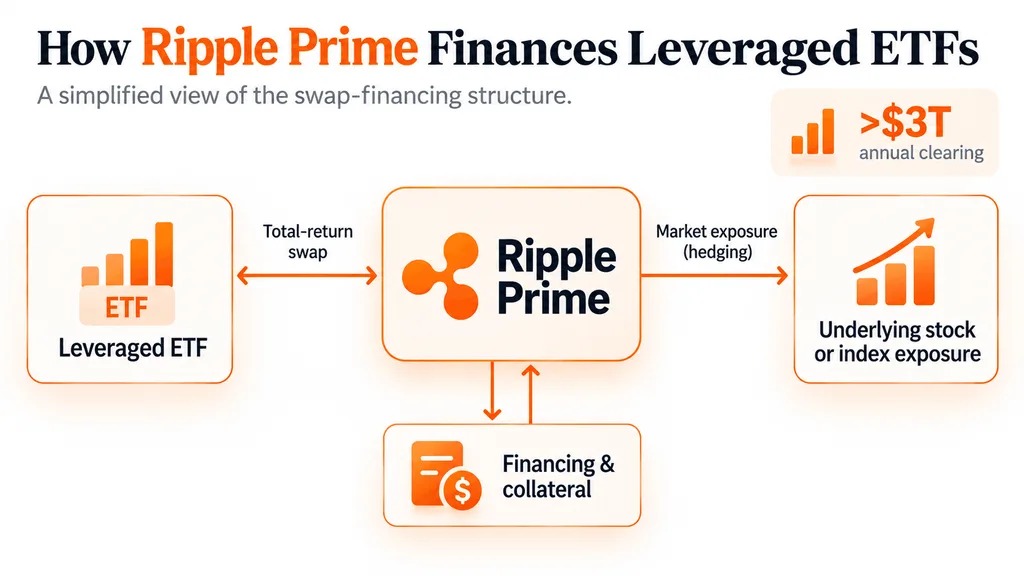
Ripple indicates that Ripple Prime currently has a clearing volume of over $3 trillion per year across various markets and serves more than 300 institutional clients.
Ripple is entering a market dominated by banks.
Leverage ETF often involves the use of total return swaps, rather than simply buying more underlying securities.
Prime brokers can provide financing, collateral management, and access to channels for obtaining these derivatives, enabling ETF to achieve returns that are twice or three times the daily performance of a certain index or stock, without directly holding an equivalent amount of exposure.
Ripple acquired Hidden Road for $1.25 billion in 2025, thereby obtaining this infrastructure. This transaction transformed the company from a firm that primarily provided encrypted payment services into the first crypto company to have a global multi-asset principal broker.
As Ripple Prime continues to expand in the institutional market, the importance of this acquisition becomes even more apparent.
Delta One provides a path for Ripple to enter the stock derivatives market.
Ripple Prime launched Delta One services in August, providing institutional clients with total return swap products linked to U.S.-listed stocks and indices, while also covering digital assets.
According to Ripple, the platform currently covers stocks, foreign exchange, derivatives, fixed income, and crypto assets through a single institutional counterparty. The company also disclosed that this business has regulatory net capital of over $1 billion.
This expansion is built on the acquisition of Hidden Road, and that transaction initially prompted Ripple to enter the principal brokerage business.
Marcus Hale
Marcus Hale is a journalist specializing in the crypto and financial markets, covering topics such as Bitcoin, Ethereum, digital assets, regulation, ETF, and the adoption by institutions. His work focuses on influencing market dynamics, investor trends, and the broader forces that shape the crypto economy.