

This interview, “as told to”, is based on a conversation with Chalet, co-founder and marketing director of a short-term rental property management company in Quebec, Canada, Samuel S é vigny. Sé vigny is 32 years old. Chalet was founded by him and four friends in 2022 and has now expanded to manage over 500 chalets and apartments. The following content has been edited for length and clarity.
It all started with six friends who had just graduated from university. Each of us had our own jobs. It was in 2016, and we wanted to invest in real estate to diversify our risks and start our own lives.
One of our co-founders already owned an apartment in the downtown area of Quebec at that time, so he came up with an idea: let's all invest together to build our own little cabin, and we would manage it ourselves. And that's exactly what we did.
We launched our first little cabin in 2019, and the second one in 2020, right in the midst of the pandemic.
By 2022, we already owned and managed 4 different units, and we hoped to hand over the management process to others. However, we couldn't find anyone who was professional enough and met our standards. So, just like in most startup stories, our starting point was a problem that we tried to solve.
At the same time, our neighbors began to keep urging us, asking if we could help them manage their properties, as they noticed that our properties were almost always rented throughout the year. We initially said no, but they kept asking. Later on, at some point, we decided to agree. It started with just our neighbor, then it was the neighbor's neighbors, and soon it extended to the entire street.
By 2022, we were already managing 10 properties.
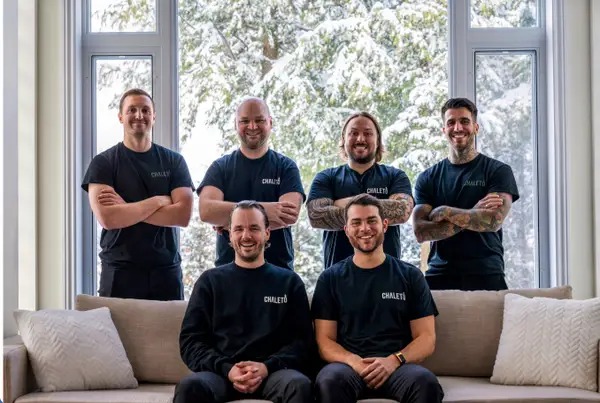
The six of us had no choice but to sit down and discuss: “Hey, what should we do next? Things have become serious now.” We either need to turn this into a serious and formal business, or we need to stop, because there’s no third way in between.
So in 2022, we decided to register and establish Chalet. Over the course of four years, we grew from 10 units to more than 500 units. We decided to truly commit to it and devote all our efforts.
As our business scale expands, so do our profits.
The biggest difference between individual landlords and property management companies actually lies in their optimization capabilities after scaling up.
When you are a professional landlord, you have to deal with your own cleaning staff, and all the technical tools are also in your hands. Moreover, you only have one or two properties for rent. The prices you pay for all these tools are often at a higher level.
You might decide to cut back on some tools because you may not have the resources, the time, or the adequate training to make good use of them. I'm thinking of dynamic pricing tools, as well as the AI automation in operations, and many similar things, since these are not part of your core responsibilities.
When you turn this into a full-time job, into a full-time business, then you can generate profits on a larger scale.
You will also gain more leverage through industry relationships. For example, it becomes easier for you to negotiate contracts with cleaning teams. This is the benefit of professional management and also a major advantage of scaled operations.

In addition, you will also be able to attract talents for certain specific positions in the business, which would not be possible if you were working alone. If you manage just one or two properties, there is no need to hire a full-time person dedicated to income management – someone who is trained, professional, and educated. However, when you manage 50 or 100 properties, that becomes interesting, because you can then optimize every aspect of the property management process.
When you're expanding, it's easy to get distracted. You can see this in almost every industry: real estate, services, and technology sectors are no exception. It's like when something starts to go smoothly and everything seems to be working in your favor, I think the easiest shortcut for entrepreneurs is to jump into every opportunity that comes their way.
It’s easy for us to say, “We will continue to invest in real estate because we also provide corresponding services to support it.” But that’s another matter. Investing and providing services to property owners are completely different. Now you’ll find yourself distracted between two different businesses: on one hand, trying to expand one business, and on the other hand, attempting to expand another.
Another problem we face is that the development speed of AI is too fast, and this is true not only for our industry but for everyone.
At what stage does it need to be mature enough to be truly applied to our business? And where should we focus our efforts? It seems that every week, a new tool, a new “cool gadget,” is created by the next engineer.
One of our constant challenges is: should we continue to recruit and train employees to maintain a high standard of hotel service, or should we use AI for optimization? Is AI mature enough to support such optimization, or is it just a fancy new gimmick and a gamble?
So far, I would say that we don't have a 100% correct answer yet. Right now, our focus is more on recruiting and building up our team, and while everyone is striving towards AI, we continue to ensure that our services are of the highest quality.
We also prefer to hire local employees from Quebec. French is their first language, and English is their second language. Moreover, they are capable of handling various customer service issues because they live here and understand the local market, regional conditions, and related experiences.
We use technology to support our business, but every few months, you find yourself having to challenge yourself again: Is this still the right technology? Have you paid too much for it? Because the advancement of AI is really too fast.
as told to
Short - Term Rental
AirBnB
More
Canada
Entrepreneur