

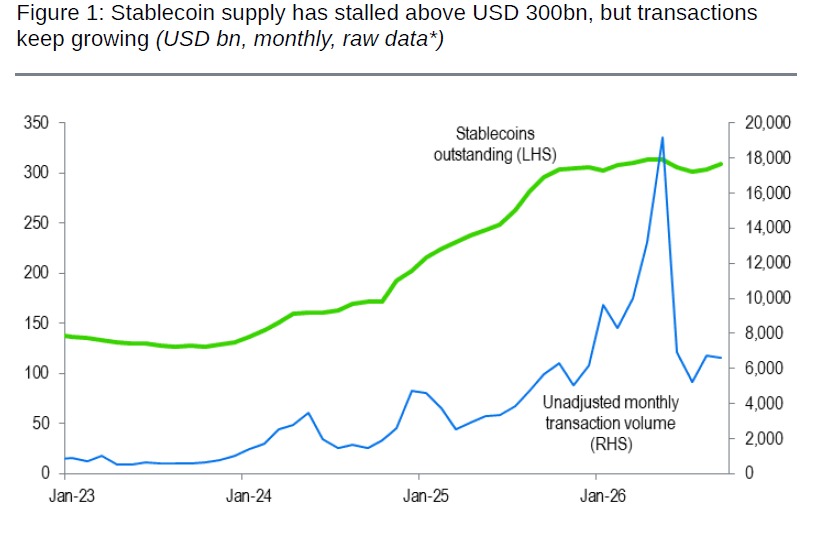
Standard Chartered Bank stated that although the overall value of the stablecoin market has stagnated, stablecoin trading activity continues to grow. This indicates that what drives market expansion is not the increase in new supply, but rather an increase in the circulation frequency of existing stablecoins.
Chase's head of digital assets research, Geoffrey Kendrick, stated that despite the slowdown in supply growth, the use of stablecoins continues to expand; as use cases become increasingly diverse, existing stablecoins are being traded more frequently.
Kendrick points out that there are currently four distinct markets, each with its own unique competitive landscape. USDt of Tether ( USDT ) dominates the savings scenarios in emerging markets, while USDC of Circle ( USDC ) leads in payments in developed markets. USDC and Ethena's USDe have established a strong position in the field of cryptocurrency trading, and in the much smaller AI agency trading market, USDC also holds a leading position.
This line predicts that the most competitive area will be the payment sector in developed markets. In this market, challengers such as USDG, M^0, and multi-bank stablecoin networks are seeking to replace the existing payment infrastructure.
According to Kendrick, how the issuer and the payment network allocate the profits generated from stablecoin reserves may ultimately determine which competitors will be able to gain market share.
Regulatory and accounting changes in the United States may affect the use of stablecoins
As Standard Chartered revises its forecasts this time, regulatory and accounting developments in the United States may affect how companies use stablecoins.
Since the passage of the GENIUS Act in 2025, U.S. regulatory authorities have proposed rules regarding the issuance of stablecoins, reserve requirements, and consumer protection. Some measures have further clarified the boundaries of these protections, including a proposal put forward by the Federal Deposit Insurance Corporation of the United States (FDIC): excluding stablecoin holders from "penetrating" deposit insurance.
The U.S. Treasury Department is also advancing the implementation of this bill. In August, the Treasury Department proposed rules that would limit the issuance of stablecoins within the United States to issuers authorized by the federal government or states, and the relevant licensing requirements are expected to take effect in January 2027.
In addition, also in August, the Financial Accounting Standards Board (BJWKEEP) which sets U.S. accounting standards proposed an update that could affect how companies report certain stablecoins on their balance sheets.
Blockchain payment company Tempo stated that the proposed changes may make it easier for businesses to use stablecoins for payments and settlements without introducing additional accounting complexities.