

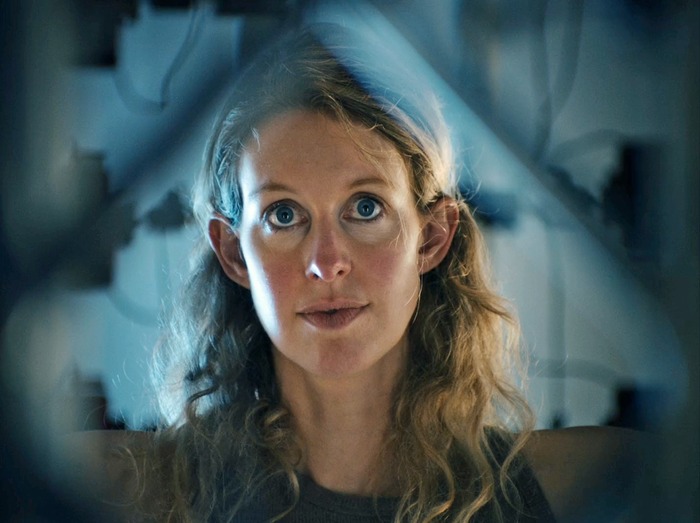
Elizabeth Holmes is known for barely blinking, whether she is pitching to investors or, in her own words, flirting with a man.
Is her hazy gaze unsettling or fascinating? A carefully crafted performance, or a sign of innocence and ignorance? In the new documentary “You Can See Everything” by A24, I find myself wavering between these different interpretations.
A large part of this film, featuring Nathan Fielder and Lance Oppenheim, can be seen as a provocative confrontation of stares: in the weeks before Holmes went to prison to serve her sentence, the film delves into her life and the downfall of the company she founded, Theranos. Holmes began serving her 11-year sentence in May 2023.
The answers obtained from Holmes by Fielder are almost never satisfying. (On one occasion, she insisted that she had never lied since reaching adulthood; despite being convicted of fraud, she maintained her innocence throughout the entire film.) However, it is precisely the questions raised by the gaps between her words that give the film its power, as the camera focuses intently on every subtle change in Holmes's expression and the caking of her mascara.
In these extremely bizarre scenarios, I found myself sometimes frightened by Holmes’ empty gaze and emotionless expression, and at other times, unexpectedly feeling pity for her. But I quickly returned to a state of fear again, because what if pity was exactly the reaction Holmes—a talented but convicted fraudster—wanted to evoke? If she could adjust her voice to sound more authoritative in the workplace, then surely she could also make her face appear more compassionate on screen.
Facts have proved that even if you can see everything, it doesn't mean you know anything. At least not for sure.
“You Can See Everything” is not the movie it seems to be.

Like its protagonist, “You Can See Everything” is also a film that is seamless and akin to a psychological trickery – it is both a study of characters, a psychological thriller, and a surrealistic thought experiment. Although the protagonist is Holmes, it is not a film about a technology company.
From being named by Forbes as the youngest self-made female billionaire to being convicted of deceiving investors as the founder and CEO of a blood testing startup Theranos, Holmes' story is now widely known. She had previously been the subject of another, more traditional documentary: Alex Gibney's The Inventor: Out for Blood in Sil Token Issuance n Valley, which detailed various inconsistencies within Theranos; she also appeared in the Hulu episode The Dropout, which reenacted her beginnings through storytelling and attempted to explain how her ambition surpassed her capabilities.
Both of these works follow the mainstream narrative about Holmes. She is often portrayed as "the next Steve Jobs" and is particularly adept at gaining the support of powerful men to advocate for her.
“You wanted it to come true so badly,” said Tyler Shultz, a former employee who later became a whistleblower, when discussing Holmes’s vision in a documentary on Gibney. “I deal with these devices every day, yet she was still able to convince me to some extent. When I recall those conversations, all I can think is, ‘How on earth did she do that?’”
The Holmes we saw in “You Can See Everything” is much more mild and gentle than what many headlines depict; at times, she even appears more compliant. However, even “Fielder” was not immune to her peculiar charm.
Not long into the film, Fielder admits to Holmes that she has done a great deal of research on her experiences in Theranos. He questions her answers to questions and at one point says to Holmes, "I don't think anyone will believe you again in the future."
However, as time passed, Fielder sometimes found this once-prodigy child interesting, and at other times felt uneasy—but never to the point of disgust. On the contrary, Holmes seemed to bring Fielder closer and closer to her, like a close-up magician who holds a deck of cards in one hand while hiding tricks in the other sleeve.
Towards the end of the film, Fielder's memories were called into question. A friend asked him whether, as he began to care more about Holmes, he unconsciously embellished their interactions afterwards to make them seem better. Perhaps he wanted to protect her.
Fielder seemed a bit taken aback and replied, 'I'm not putting my own feelings into it. I just want to be as accurate as possible.'
It's one thing to be told that someone is a master manipulator; both “The Inventor” and “The Dropout” make this point very clear. However, experiencing such manipulation firsthand is a completely different matter. “You Can See Everything” allows the audience to experience the latter.
During a Q&A session after an early screening of “You Can See Everything” in New York, Oppenheim described that once the cameras were turned off, he, Fielder, and the crew would exchange different interpretations of what they had just seen and heard. “The disagreements were very lively,” Oppenheim recalled.
It has been over three years since they had close contact with Holmes. Fielder said that he is still working hard to process the feelings he had at that time when he was by her side.
“I really want to hear what others think, how they would interpret certain things,” said Fielder, “I feel that it will actually help me understand.”
You Can See Everything is currently being shown in theaters.