Indonesian stock market tumbles to six-year low due to concerns over downgrade of MSCI
CNBC
1h ago
Ai Focus
Indonesian benchmark stock index fell more than 5% on Monday, hitting a six-year low, with markets concerned that MSCI may reclassify Indonesia from an emerging market to an independent market, which could lead to further outflows of foreign capital. Goldman Sachs estimates that if Indonesia is removed from the MSCI Emerging Markets Index, related passive funds could flow out by up to $5.6 billion.
Helpful
No.Help

Indonesia's benchmark stock index tumbled more than 5% on Monday, falling to its lowest level in six years, due to growing concerns in the market about a possible downgrade of MSCI, which further triggered panic about the outflow of foreign capital.

The Jakarta Composite Index fell to its lowest point since early October 2020, continuing the continuous selling in Indonesia's stock market. MSCI , an index provider, proposed last Friday to reclassify Indonesia from an emerging market to an independent market, which means that the country may be removed from major global stock benchmark indices.

MSCI is expected to make a final decision in June, and whether to reclassify will depend on whether Indonesian authorities can demonstrate substantial improvements in market governance and transparency.

In a report on Sunday, Goldman Sachs warned that if Indonesia were to be completely removed from the MSCI Emerging Markets Index, it could trigger an outflow of approximately $5.6 billion from passive funds, which is equivalent to the average trading volume of the constituent stocks in the MSCI Indonesia Investable Market Index over 18 trading days.

The same line states that if FTSE Russell takes similar actions subsequently, another $2.7 billion in funds could be at risk. However, Goldman Sachs emphasizes that this would be an independent scenario.

Goldman Sachs estimates that active funds tracking MSCI and the FTSE index hold more than $8 billion in Indonesian stocks, but whether such investors will sell will depend on their own decisions, and not be automatically triggered by a downgrade in ratings.

Goldman Sachs maintains a low rating for Indonesian stocks, citing uncertain index prospects, weak corporate earnings, and the persistent presence of macroeconomic headwinds.

Goldman Sachs strategists led by Alvin So wrote: "Valuations have been significantly compressed, but they are still above historical lows; indices, earnings, and macro risks limit revaluation of valuations."

Data provided by Goldman Sachs shows that as of last Friday, the MSCI Indonesian index had fallen by 47% this year, and during the same period, foreign capital net flowed out of Indonesian stocks by $5.1 billion.

The proportion of foreign capital holding Indonesian stocks has dropped from 27% in January to 25% in October, while the market value of foreign-held shares has almost halved from $250 billion to about $130 billion, according to Goldman Sachs.

Despite the heavy decline, Goldman Sachs still warns that Indonesian stocks may not have hit bottom yet. The expected price-earnings ratio for the Indonesian index over the next 12 months has dropped to 7.3 times, the lowest level since the global financial crisis, but it is still higher than historical lows. MSCI

These strategists also expect that the Bank of Indonesia will raise interest rates by 25 basis points in each of the fourth quarter of 2026 and the first quarter of 2027, for a total of two more rate hikes, which could further put pressure on economic growth and stock market valuations.

Tip
$0
Like
0
Save
0
Views 28
HQYC reminds readers to view blockchain rationally, stay aware of risks, and beware of virtual token issuance and speculation. All content on this site represents market information or related viewpoints only and does not constitute any form of investment advice. If you find sensitive content, please click“Report”,and we will handle it promptly。
Submit
Comment 0
Hot
Latest
No comments yet. Be the first!
Related
EU tourism stays increase to 3.1 billion nights: The popularity is back, but revenue distribution is uneven
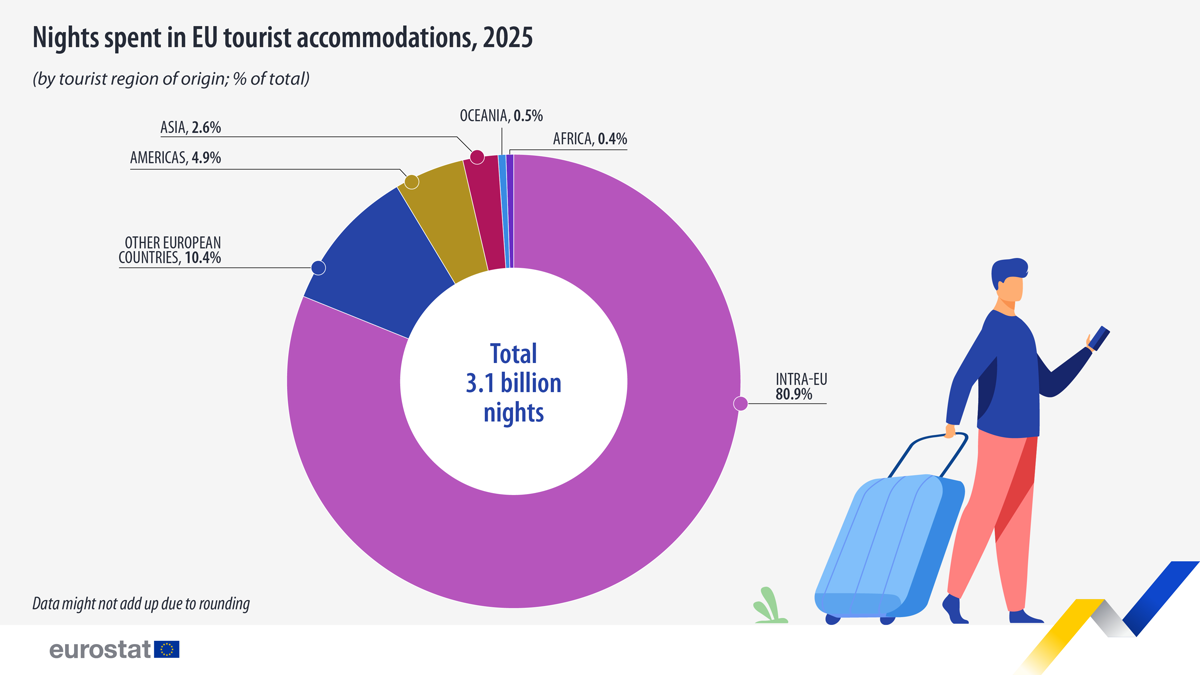
The recovery of the tourism industry is often simplified to increased numbers of people at airports and rising hotel prices, but a more reliable measure in statistics is the number of overnight stays. On October 16, the European Union Statistics Office announced that in 2025, EU tourism accommodation establishments recorded approximately 3.1 billion overnight stays, an increase of 4.1% compared to 2024 and 26.5% compared to 2015. The "number of nights" mentioned here refers to the total number of nights that guests stayed at the accommodations, not the number of individual travelers; if the same person stays for five nights in a row, it is counted as five overnight stays. The data shows that the overall demand for accommodation continues to grow, but it does not directly indicate the profits of each hotel, the feelings of residents in each tourist city, or whether tourists' actual spending has also increased accordingly.
币百科
·2026-10-19 12:33:05
13
Google added three learning tools to Gemini Notebook: Can a one-minute video truly replace in-depth understanding?
A lecture notes document of dozens of pages is often not something students can finish reading; rather, they don't know where to start. On October 16th, the Google education team introduced three new learning features recently added to Gemini Notebook: a brief 60-second video overview, an interactive overview that connects note materials into a learning path, and quizzes in the form of short-answer, multiple-choice, and fill-in-the-blank questions. This official article serves as a guide for using these “recently launched features” and does not indicate that all three functions were made available for the first time on that day. It is important to clarify this time limit, as product introductions can easily present old features as if they represent a sudden educational revolution.
CoinMeta
·2026-10-19 12:33:02
14
Brazilian giants bring AI into everyday banking services: 300,000 users give it a try, but the challenge lies not in the chat box
It's no longer news for banks to integrate generative AI into their customer service channels. The real challenge lies in ensuring that this technology remains consistent and controllable when it comes to bill viewing, credit card inquiries, insurance processing, and customer transfers to human representatives, without allowing costs to get out of control. On October 16th, OpenAI released a case study of Itaú Bank in Brazil, detailing the phased progress of its conversational service ia.i and its internal governance platform IARA. In the first phase, the service reached approximately 300,000 customers, and the bank aims to cover all its customers by the end of 2026. These two initiatives should not be confused as the same thing. What makes this case study particularly noteworthy is not so much the fact that the bank used a large model, but rather how a major financial institution integrated the model with its customer services.
CoinMeta
·2026-10-19 12:32:59
13
Hon Hai and Mitsubishi Electric to jointly operate automotive equipment business, collaborating to create an electric vehicle platform
Hon Hai announced on October 16 that it will officially sign a strategic alliance with Mitsubishi Electric to jointly operate the automotive equipment business. According to the agreement, Mitsubishi Electric Mobility Corporation will become a joint venture in which Hon Hai indirectly holds a 50% stake. The transaction amount is estimated to be 115 billion yen, and completion is expected to occur on October 1, 2027.
The Block
·2026-10-19 12:09:58
12
View More