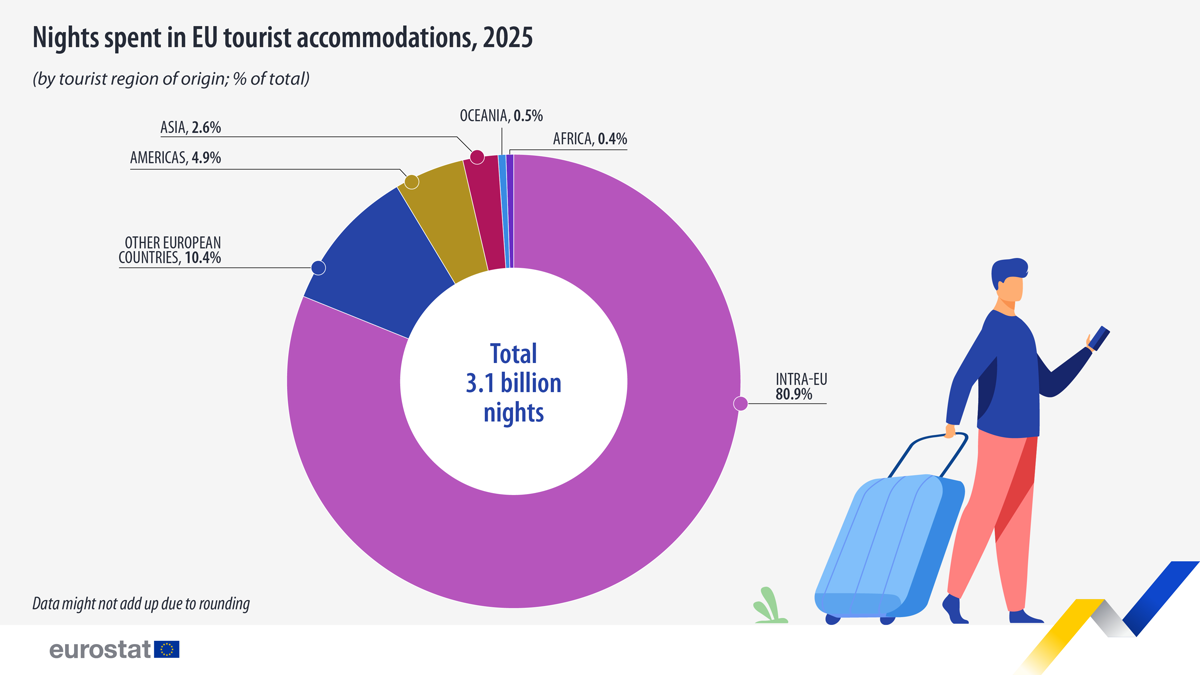


The recovery of the tourism industry is often simplified to increased crowds at airports and rising hotel prices, but a more reliable measure in statistics is the number of overnight stays. On October 16, the European Union Statistics Office announced that in 2025, EU tourism accommodation establishments recorded approximately 3.1 billion overnight stays, a 4.1% increase from 2024 and a 26.5% increase from 2015. The "number of nights" mentioned here refers to the total number of nights that guests stayed at the accommodations, not the number of individual travelers; if the same person stays for five consecutive nights, it is counted as five overnight stays. The data shows that the overall demand for accommodation continues to grow, but it does not directly indicate the profits of each hotel, the feelings of residents in each tourist city, or whether tourists' actual spending has also increased accordingly.
Tourists within the EU – including residents of that country and residents from other member states – contributed approximately 2.5 billion nights, accounting for 80.9%; tourists from other European countries contributed 10.4%. Tourists from the Americas accounted for 4.9%, corresponding to about 155.5 million nights; Asian tourists accounted for 2.6%, about 81.6 million nights. Although the proportion may not seem high, the growth rate is worth noting: compared to 2024, the number of nights spent by Asian tourists increased by 15.4%, and by 13.7% for African tourists. This reflects an expansion in tourist sources from distant regions, but since the base is relatively small, it cannot be concluded that they have already dominated the European hospitality market just because of the high growth rates. Internal travel within the EU remains the main pillar of the total volume.
In addition to the overall increase, let's first look at the source location and the statistical criteria.
An increase in the number of overnight stays may stem from more people traveling, or it could be due to an extended average stay time; it may also be related to the reporting scope of accommodation providers, the way short-term rentals are included, and annual data revisions. A single growth rate cannot distinguish between these factors. Moreover, it is not equivalent to tourism revenue: hotel prices, dining, transportation, and exchange rates all affect the economic benefits generated per night. For example, a business traveler staying for one night and a family on vacation staying for one night may have the same number of overnight stays, but their spending patterns are completely different. Therefore, when macroeconomic readers look at this data, they should consider it as an indicator of demand volume and then use accommodation prices, employment, and service exports to verify its contribution to the economy.
The source structure also affects risk resistance. If growth relies too heavily on a few remote markets, changes in routes, visas, or exchange rates could suddenly weaken demand during peak seasons; if the market is mainly composed of tourists within the EU, it has a wider coverage, but it is also affected by residents' actual income and vacation arrangements. Different European destinations have different product combinations, and coastal vacations, short city trips, and business conferences cannot be interpreted using the same pricing strategy. The regional and national data provided by the statistical bureau are ideally suited for further breakdown, rather than using just “3.1 billion nights” to tell a unified story about Europe.
It is also important to note the ten-year comparison: in 2025, the number of nights is 26.5% higher than in 2015, despite experiencing the impact of the pandemic and subsequent recovery in between. Connecting these two endpoints into a smooth growth line would erase the industry's periods of shutdown, staff loss, and supply reorganization that occurred during that time. The level in 2025 indicates that total demand is now at a relatively high position, but it does not mean that every operator has recovered the losses incurred in those years, nor can the changes from 2015 to 2025 be directly extrapolated as the annual growth rate for the next decade.
Per capita intensity reveals different pressures during the same round of recovery
The European Union Statistics Office also measures “tourism intensity” by the number of nights of accommodation per permanent resident. In 2025, the average in the EU was about 7.0 nights, higher than 6.7 nights in 2024; Croatia reached 24.5 nights, Malta 21.7 nights, and Cyprus 19.4 nights. On the other end, Romania had only 1.6 nights, Latvia 2.7 nights, and both Poland and Slovakia around 2.9 nights. This indicator is not about how many nights locals travel themselves, but rather the ratio of the number of nights accommodated by local tourism facilities to the population. Island economies with smaller populations may face greater pressure on public services, even if they do not have the highest number of tourists overall.
Regions with high intensity generate income from accommodation, catering, and transportation, but at the same time, they face greater pressures during peak seasons in terms of housing rents, traffic congestion, and increased consumption of water and energy. Low intensity does not necessarily mean a "backward tourism industry"; it may be related to the industrial structure, urban functions, and the forms of tourist accommodation. The policy approach should not be to force all regions to reach the same standard, but rather to improve the capacity during peak seasons, disperse the peaks in time and space, and allow local residents to share more tangible benefits.
These indicators have clear boundaries. According to the European Statistical Office, they only cover the flow of travelers staying in rental accommodations and do not include those staying in second homes, relatives' or friends' houses, or day visitors who do not stay overnight. They also do not fully account for very small accommodation establishments. In popular cities with a large number of day visitors, the statistics on tourism intensity may underestimate the actual congestion in streets and traffic; conversely, some coastal areas have a high number of overnight stays, but these areas also experience strong seasonal variations in employment. For local finances and corporate investment, it is best to consider factors such as the number of nights of accommodation, per capita intensity, local wages, housing prices, and the capacity of infrastructure together. 3.1 billion nights is a kind of “demand thermometer,” and the next challenge is to convert this heat into sustainable benefits that are not concentrated in just a few areas.
For hotel operators, more useful than the total number of nights for the whole year is to observe the monthly distribution and the structure of customer sources. If the same annual growth is concentrated in July and August, it will drive up prices during the peak season, but it may not be sufficient to support stable employment throughout the year; if there is also growth during the off-season, it is more likely to improve the utilization rate of facilities. Multinational groups can spread seasonal risks across multiple markets, whereas small independent hotels are more vulnerable to the impact of single routes, weather, and local events. Therefore, companies cannot simply apply the average growth rate of the European Union to their own room revenue forecasts.
For the public sector, an increase in the number of nights of accommodation does not necessarily equate to a corresponding increase in net fiscal revenue. Transportation maintenance, waste management, firefighting, and water supply must be built to accommodate peak demands, and costs often arise before taxes are collected. The design of tourism taxes, short-term rental regulations, and urban transportation investments needs to distinguish between overnight visitors and day visitors, to avoid charging only those who are visible in statistical figures. Only by evaluating data alongside resident satisfaction, annual employment rates, and ecological indicators can we truly determine whether such growth has genuinely improved local living standards.
Source: Eurostat, October 16, 2026 " Nights spent in tourist accommodations up 4% in 2025": https :// ec.europa.eu / eurostat / en / web / products-eurostat-news /w/ ddn-20261016-1