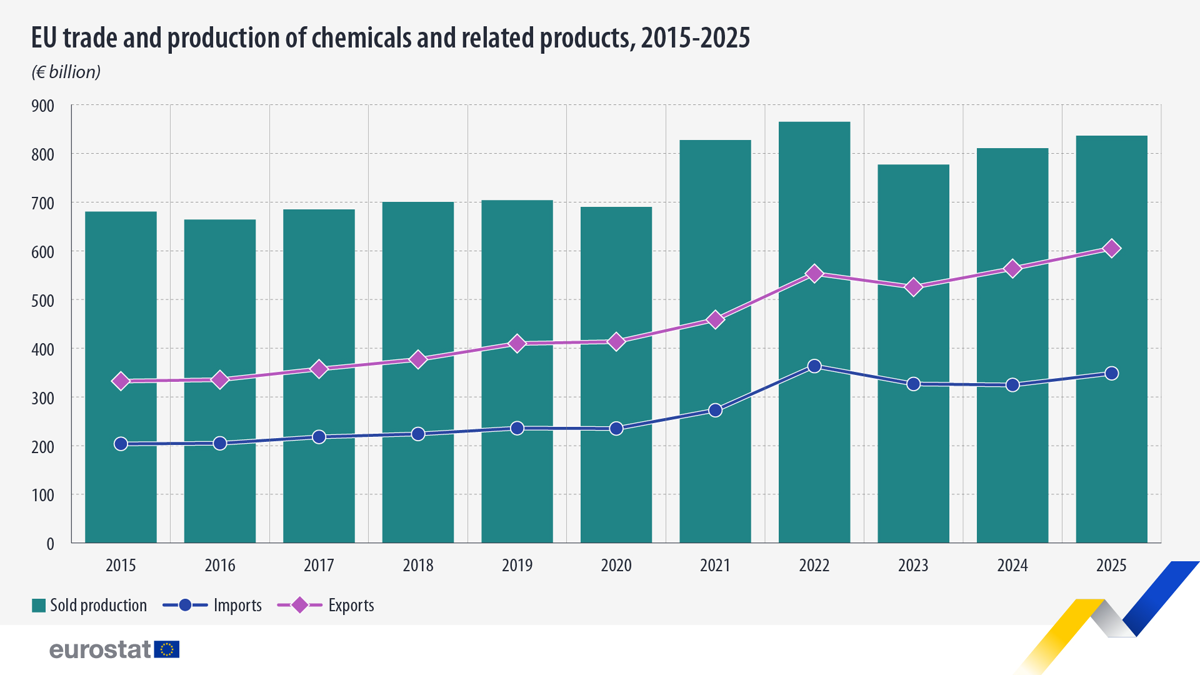


A trade surplus in one industry can indicate competitiveness, but it cannot represent the overall economic situation. On October 15th, the European Union Statistics Office revealed that in 2025, the EU imported chemicals and related products worth 348 billion euros from outside the region and exported 605 billion euros, resulting in a trade surplus of 257 billion euros. Export volumes increased by 7% compared to 563 billion euros in 2024, and import volumes also rose by 7%, from 324 billion euros. These are nominal figures calculated based on amount and are influenced by both quantity and the mix of products; they cannot be directly interpreted as a 7% increase in EU chemical production or actual profits.
The statistical office also reported that in 2025, the EU's sales and production value of chemicals and related products amounted to approximately 836 billion euros, compared to 680 billion euros in 2015. Export, import, and production figures belong to different statistical systems, so it is not appropriate to simply divide 605 billion by 836 billion to infer that "seventy percent of the products are exported outside the region." A portion of the output is traded within the EU, and some imported goods may be further processed or transshipped; moreover, these figures do not completely overlap. To assess the industry's contribution to employment and investment, data on production volume, added value, energy consumption, and corporate financial reports are also necessary. Although the trade surplus is notable, it does not represent the full picture of the health of the chemical industry.
Where the surplus comes from cannot be determined by just looking at one single factor.
The scope of "chemicals and related products" is very broad. According to international trade standards, it includes organic and inorganic chemicals, pharmaceuticals and medicines, fragrances, fertilizers, plastic raw materials, and products, etc. There are significant differences in the costs and pricing logic of high-value-added medicines, fine chemicals, and basic materials. The strong exports of one sub-industry may overshadow the pressures faced by another sub-industry due to energy costs and import competition. Therefore, stating that a surplus of 257 billion euros means that "all European chemical plants are making a lot of money" ignores both the differences among companies and the role of imported intermediates.
Since 2015, according to the statistical bureau, chemical imports have increased by 145 billion euros, and exports have increased by 273 billion euros, with an average annual growth of about 6% in both directions. This indicates that the global chemical industry chain is not simply "buying from outside rather than within": imports are also an important part of production and consumption. The expansion in export volumes may be due to demand for new drugs, exchange rate changes, price fluctuations, or adjustments in market share; it is impossible to determine which factor is dominant without further analysis. Moreover, one should not mistake a ten-year nominal increase in amounts for a ten-year increase in actual production volumes.
Among the member countries, in 2025, the export value of chemical products to outside the region was approximately 130 billion euros for Germany, 115 billion euros for Ireland, 60 billion euros for Belgium, 56 billion euros for Italy, and 54 billion euros for France. The figures mentioned here represent the value of goods exported from these countries to non-EU markets, not the net profits solely generated by those countries' enterprises. Ireland's position in the pharmaceutical industry chain, Belgium's ports and chemical clusters, and Germany's manufacturing foundation mean that the same "export value" encompasses different industrial stories. For macro observers, country rankings serve as a starting point for questions, not as answers.
After reaching new export highs, it is still necessary to observe the resilience of prices and supply.
The trade surplus is driven by exports as well as constrained by imports. In 2025, both imports and exports increased by 7% year-on-year, indicating simultaneous expansion on both sides; the change in the difference of 257 billion euros should not be attributed solely to exports. If there are significant fluctuations in the prices of chemical raw materials or energy, the nominal import bill will also change, which does not necessarily mean a structural change in import dependence. When studying policies and corporate investments, it is necessary to consider unit value, output, inventory, and end-demand as well, to avoid using the value of one set of goods to represent the entire supply chain.
The European chemical industry is facing energy costs, environmental constraints, and global competition simultaneously. A large trade surplus does not automatically alleviate these pressures, but it indicates that at least until 2025, the EU still has a strong sales capability in markets outside the region. What companies are more concerned about next is which products can maintain their technological and brand premiums, which basic materials will lose their advantages due to rising costs, and whether the import of intermediate goods is stable. Governments, on the other hand, need to balance industrial competitiveness with emission reduction targets, rather than using a trade surplus indicator to prove the success or failure of any policy.
The most valuable aspect of this statistic is that it breaks down the concept of “strong trade” into three different indicators: exports of 605 billion, imports of 348 billion, and production of 836 billion. If readers only remember the figure of 257 billion, they may miss more critical questions: on which products, which member countries, and under what price conditions does the surplus depend, and whether this can be maintained in the future. The industry data from the European Union Statistics Office provides a snapshot for the year 2025; as for the future direction, it will depend on continuous verification through monthly trade figures, corporate orders, and actual production levels.
There is another statistical issue that is easily overlooked: an increase in the value of goods can come from either an increase in quantity or an increase in unit price. For example, for the same amount of chemicals exported, a rise in price will result in a higher export value in euros; conversely, even if factory production remains stable when prices fall, the trade volume will decrease. Therefore, one cannot conclude that European factories are increasing production based solely on nominal export growth, nor can one infer that employment will increase in the same proportion. For buyers in the supply chain, factors such as quantity, delivery cycles, and inventory often reflect changes in supply and demand earlier than the value of individual goods.
Chemical products are still in the upstream of many downstream industries. Automobiles, pharmaceuticals, agriculture, and construction all consume different types of chemical intermediates. A slowdown in demand from any of these end industries could be transmitted upstream along the order chain. To analyze the resilience of a trade surplus of 257 billion euros, companies should first distinguish between basic chemicals and high-value-added specialty chemicals, and then consider whether the main export markets can absorb higher costs. If industrial policies only focus on total export volumes, they may overlook the costs and safety concerns of local small and medium-sized enterprises in obtaining raw materials. Statistical figures can indicate the outcomes for 2025, but they cannot replace the stress tests of future supply capacity.
Source: Eurostat, October 15, 2026 EU chemicals trade surplus at €257 billion in 2025: https :// ec.europa.eu / eurostat / web / products-eurostat-news /w/ ddn-20261015-1