Key Points
- Schwartz Envisions AI to Manage Daily Financial Tasks on Behalf of Others
- XRPL has recorded approximately 13.5 million automated payments.
- Consumer-oriented financial management is still just a possibility for the future.
Ripple, the Technical Director, believes that artificial intelligence agents may ultimately manage daily financial tasks, thereby changing the way ordinary consumers interact with blockchain-based payments and decentralized finance. David Schwartz
On October 18, during an interview with Thinking Crypto, Schwartz stated that in the future, autonomous software could handle financial decisions and transactions on behalf of users, reducing the significant complexity associated with cryptocurrency wallets and decentralized applications.
At the time these comments appeared, the automated payment ecosystem of XRP Ledger was expanding. Earlier this month, approximately 168 registered merchants recorded around 13.5 million proxy transactions. However, Schwartz has not announced any personal financial products, nor has it confirmed when such a feature will be launched.
David Schwartz believes that AI's agents are reshaping personal finance.
Schwartz indicates that blockchain finance may eventually become as accessible to ordinary consumers as mobile applications have become after their widespread adoption through Android and iOS.
In his view, the challenge lies in developing financial services that can be used without users needing to understand the underlying technology.
This may include automatic payments, comparative financial services, and executing transactions within preset limits, but Schwartz does not describe these as features of any upcoming Ripple product.
Schwartz also emphasizes that tokenization and the lowering of regulatory barriers may make blockchain finance more easily accepted by the general public.
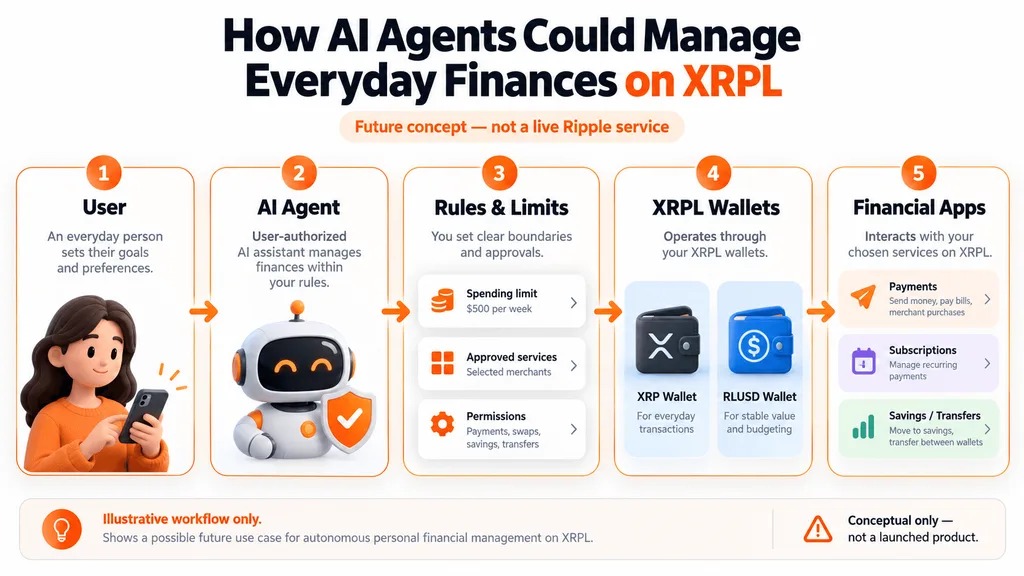
His remarks continued the previous discussions regarding the financial evolution of XRPL, which include tokenized securities, lending, and other services that go beyond traditional cryptocurrency transfers.
XRP Ledger has processed millions of AI payments.
Although autonomous personal financial management is still a hypothesis, machine-to-machine payments are already in operation on XRP Ledger.
Ripple launched AI Starter Kit in June, supporting applications that use the x402 payment protocol to purchase computing power, API, as well as other digital services.
This infrastructure allows software agents to send RLUSD stablecoins of XRP or Ripple, without the need for manual completion of each individual settlement.
According to previously disclosed payment data, as of October 11, XRPL AI Hub recorded approximately 13.49 million transactions among 168 registered merchants.
However, the same data also shows that the cumulative settlement amount is only approximately 6,982 XRP and 12,010 RLUSD, which indicates that most of these transactions involve small payments rather than large-scale financial transactions.
The difference between XRP and RLUSD is also important, as agents who purchase fixed-price services may prefer to be settled in US dollars rather than being exposed to the fluctuations of cryptocurrencies.
The wallet expansion of Ripple may help to bridge the gap.
A practical obstacle faced by consumers is how to make blockchain wallets simple enough for those who have never managed private keys before to use.
Ripple's recent collaboration with Privy aims to directly integrate the XRP Ledger wallet into the application, thereby reducing the need for standalone wallet software.
Meanwhile, XRPL developers are exploring licensed financial infrastructure, which could help regulatory authorities participate in decentralized markets.
However, none of these advancements can prove that the AI agent is already capable of managing retail investment portfolios or bank accounts through XRPL.
Such applications require reliable authorization, transaction limits, security controls, and safeguards to prevent unauthorized expenditures.
Community verifier Vet also indicates that 2027 may bring closer interactions between institutional and retail participants on XRPL.