

Stablecoin cross-border payments are often described as funds reaching the other end in just a few seconds, but what banks actually need to decide is whether to proceed with the payment, where the funds come from, and which addresses they will pass through on the blockchain. On October 19th, Mastercard announced at the Money20 /20 US conference a risk intelligence service that integrates traditional payment information with blockchain analysis into the same process. The first partners are Borderless.xyz and Keyrails; the product will be launched initially in North America, with global commercial availability expected by 2027. There are two important points to note: launching the service does not mean it has already covered the entire globe; and announcing partners does not mean that all banks have already integrated it and use it for every stablecoin payment.
Behind the messages lie breakpoints in the payment chains. Banks are familiar with account opening, transaction monitoring, and fraud identification, and can also access account and merchant information within traditional payment networks; however, transactions on the blockchain are public and transparent, yet they do not automatically disclose to banks the identity of the ultimate beneficiaries, the reasons why funds pass through intermediate wallets, or whether there are any signs of fraud before payment is made. Cross-border corporate payments often involve additional steps such as currency exchange, liquidity providers, and local cash withdrawals. It is difficult to reconstruct the entire business process based solely on a single blockchain hash. The solution proposed by Mastercard is to use platform-agnostic API to generate a risk score before the payment is completed, and to allow institutions to integrate this score into their existing fraud, compliance, and case management systems. This serves as an auxiliary intelligence layer for judgment, rather than a new “universal permit” that replaces financial institutions in assuming compliance responsibilities.
Placing the risk rating before the transfer addresses which blind spot?
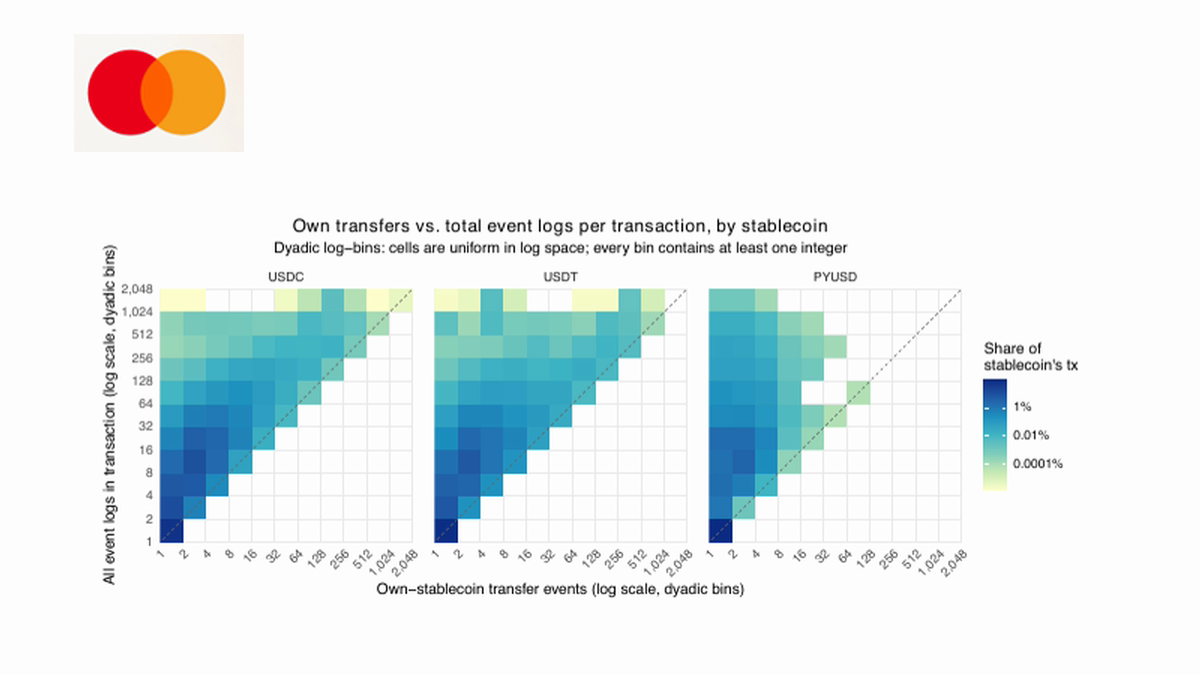
Mastercard Citing a study, researchers observed 141 million transactions and 593 million stablecoin transfer events on Ethereum in 2025, of which nearly 60% were complex multi-step transfers rather than one-to-one payments. The sample size and statistical definitions of this study cannot be directly extrapolated to imply that "60% of all stablecoin payments worldwide are suspicious." Multi-step transfers are a characteristic of the on-chain process and may correspond to routing, transactions, aggregation, or other normal business activities; however, they can also increase the difficulty of tracing. What this study truly indicates is that if banks only verify the payer and recipient accounts, they may miss risk clues related to intermediate parties. The more involved multiple parties are in a payment, the more necessary it is to align traditional customer information with on-chain transaction traces.
According to official statements, the new service will analyze the background of transactions, the source of funds, associations with restricted individuals, and signs of fraud, providing intelligence at multiple nodes for the conversion between fiat currencies and stablecoins. For institutions, the most critical time is before the funds are transferred: if the risk assessment comes too late, it can only be used for post-event tracking; however, if the assessment can be incorporated into the approval process before quoting, exchange conversion, and on-chain broadcasting, it may influence decision-making. Nevertheless, such assessments can also lead to false positives and missed detections. Who sets the scoring thresholds, how users can appeal, how cross-border data is handled, and which institutions have access to what data will all affect whether the product can truly be utilized in large-scale operations. The press release does not provide figures for false positive rates or the actual volume of customers processed, so it cannot be claimed that "analyzable" means "proven to eliminate risks."
Mastercard provided an example of a U.S. coffee shop making payments to Brazilian suppliers: the bank uses stablecoins for cross-border transfers facilitated by service providers, with risk analysis conducted before the payment, and the recipient then exchanges the funds for local currency. This is an example of the possible process, not an indication that a particular coffee shop has actually completed such transactions. When implementing these processes in real businesses, additional considerations such as exchange rate locking, liquidity, refunds, incorrect addresses, and local payment methods must also be addressed. Only when risk control products are integrated into these processes will they cease to be mere standalone dashboards that merely display scores.
The first batch of partners can access the scenarios, but scalability will still depend on 2027.
Keyrails focuses on high-value cross-border trade payments, while Borderless.xyz connects financial institutions with multiple licensed stablecoin service providers. Mastercard reveals that these service providers cover over 113 countries and 72 currencies; this describes the partner network, not that Stablecoin Security has already been approved for sale or implemented in 113 countries. Mastercard also mentions plans to expand coverage in 2027 through the previously acquired BVNK. These plans can indicate the product roadmap, but they should not be presented as the current scale of business that has already been achieved.
In the past, the stablecoin industry has discussed a lot about "speed of movement" and "settlement costs." Now, payment giants are beginning to transfer the risk workflows that existing financial institutions are familiar with to blockchain-based scenarios. New tools may reduce the operational barriers for banks to integrate stablecoin payments, but the ultimate success or failure still depends on whether three capabilities can be established simultaneously: effective identification before payment, traceability across cross-border multiple nodes, and a mechanism for handling risk events after they occur. Simply labeling on-chain transactions as high-risk without providing for manual review, freezing, and appeal pathways does not constitute a sustainable commercial product.
Therefore, this news should be understood as " Mastercard launches a new risk control service for stablecoin payments, starting in North America and in collaboration with two partners." It does not mean that "stablecoin payments are now secure," nor does it imply that "banks around the world have uniformly adopted this service." The most noteworthy aspects to monitor in the next phase include the actual number of institutions that adopt the service, the incidence of false positives and missed detections in real transactions, the availability of the service in different jurisdictions, and whether the global commercialization goal for 2027 will be achieved on time. Payment technology can accelerate the transfer of value, but trust still relies on verifiable systems and processes to be established.
Source: Mastercard, October 19, 2026, " Mastercard introduces risk intelligence to enable more secure stablecoin payments": https :// www.mastercard.com / us / en / news-and-trends / press /2026/ october / Mastercard-brings-risk-intelligence-to-stablecoin-payments.html