

Some of the largest banks in the UK are facing new scrutiny due to restrictions on cryptocurrency transfers, following reports from thousands of customers who encountered difficulties when trying to transfer funds to crypto platforms.
The encryption advocacy group Stand With Crypto stated that between May and August 2026, over a period of 90 days, a total of 9,803 people submitted 10,092 complaints regarding restrictions on transfers to cryptocurrency platforms to British banks through the organization's online tools. A report reviewed by Cointelegraph last week revealed the aforementioned data.
The report states that one of the largest banking groups in the UK, Lloyds Banking Group (Lloyds Banking Group), received the most complaints, with 2,297; followed by Barclays Bank (Barclays) with 1,569 complaints, and National Westminster Group (NatWest Group) with 1,278 complaints.
These complaints have raised questions about the accessibility of crypto services in the UK. The UK is preparing to introduce a new regulatory framework for digital assets in 2027.
British banks have varying limits on encrypted transfers
Barclays and HSBC UK ( HSBC UK ) are listed as imposing restrictions on encrypted transfers: a maximum of £2,500 (US$3,300) per transaction, and a cumulative maximum of £10,000 (US$13,300) within 30 days.
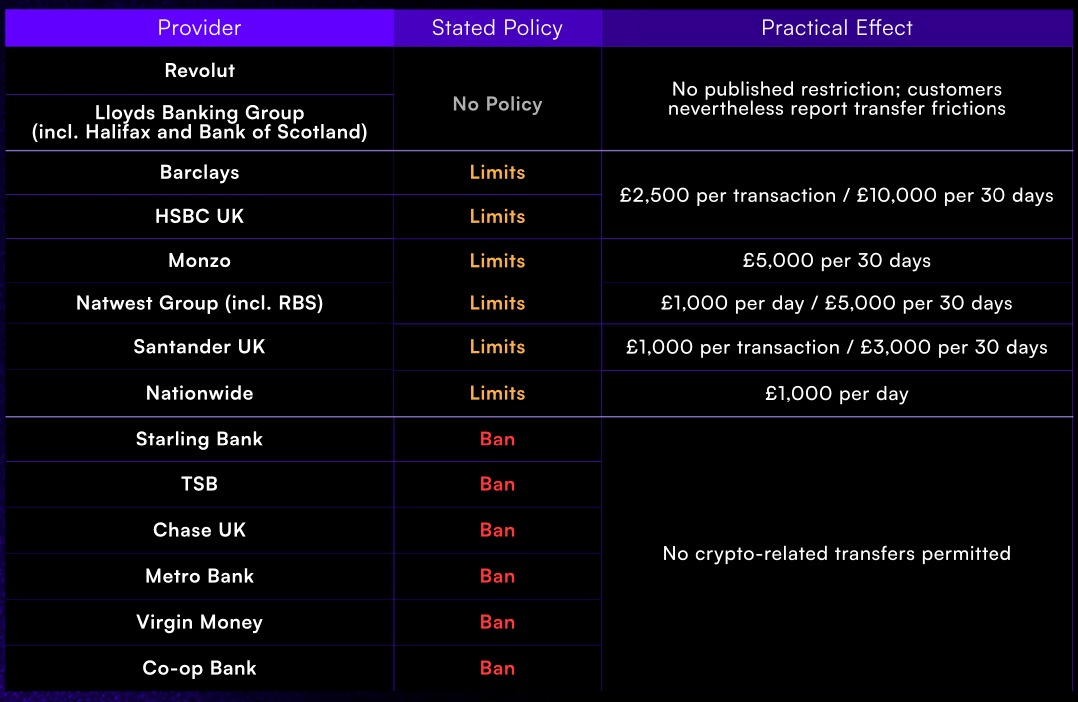
At the same time, Lloyds Banking Group and Revolut have been classified as not having announced any restrictions on encrypted transfers, despite receiving complaints from customers.
However, the official support page for Revolut states that transfers to “certain cryptocurrency exchanges” are not supported. A spokesperson for Stand With Crypto stated that this seems to be more of a technical issue rather than a clear policy.
Banks' restrictions threaten the ambitions of the UK's crypto hub
Zumo, the founder and CEO, told Cointelegraph that bank restrictions are a common issue faced by UK crypto pioneers and may undermine the UK's ambition to become a global center for crypto.
"This issue of restricted access to banking services needs to be resolved urgently so that British crypto companies can grow and expand in a fair environment," said Jones.
Jones also warned that the upcoming crypto regulatory framework in the UK may not necessarily solve this issue. He stated that although companies are preparing to obtain approval from the Financial Conduct Authority (FCA) of the UK starting from October 2027, obtaining corporate bank accounts is not within the scope of this framework.
Jones added that even if the company obtains full authorization, it may still be unable to open a corporate bank account in the UK without coordinated action.
Magazine: Made an "honest" mistake in encrypted taxation? New legislation offers a way out