

New research shows that Bitcoin ( BTC ) is currently facing resistance around $87,000, a level that has been further strengthened due to investors who bought BTC in the late 2025 period.
Analysis indicates that Bitcoin investors holding unrealized losses are restricting the price from rising above $87,700, while capital inflows into ETF have strengthened the support around $80,000.
Key points:
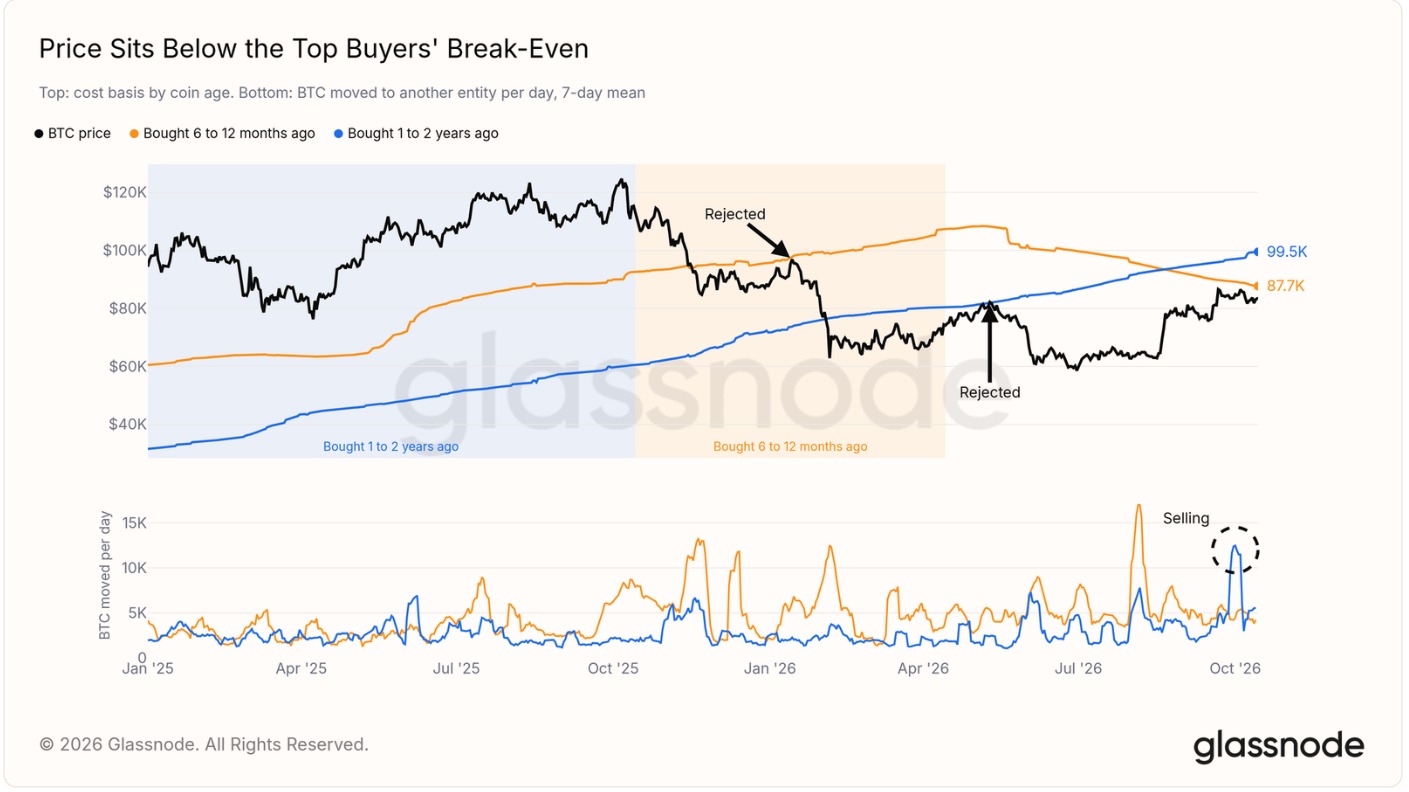
- Glassnode analysis shows that a group of new holders who bought BTC in the later period of 2025 have an average holding cost of approximately $87,700, and this level is currently acting as a resistance zone.
- Above the $87,000 range, there are several resistance levels, including the opening price of $87,490 in 2026, as well as the 20-month simple moving average of $87,165 for BTC / USD.
- As buying liquidity converges at this psychological level, Bitcoin's support at the price of $80,000 is strengthening.
In 2025, buyers will intensify the pressure on the $87,000 resistance zone.
The latest research from the on-chain analysis platform Glassnode shows that the break-even point for a group of new Bitcoin holders is currently acting as a resistance level.
Since the beginning of this year, two types of holders have been continuously preventing further price increases when the price reaches their purchase costs for BTC / USD.
In November 2025, prices fell below the cost basis for investors who had taken positions during the previous 6 to 12 months, which was at $94,000 at that time. When prices attempted to break through the trend line of $97,100 in January 2026, this level turned into resistance, triggering a price decline and further falls.
Another similar resistance trend line comes from the cost basis of investors who bought Bitcoin 1 to 2 years ago. In February of this year, as prices fell below the cost basis of $76,900, this group as a whole entered a state of floating losses. By May, this cost basis, at a level slightly above $82,000, prevented a price rebound.
In both of these situations, buyers who are in a state of floating losses and wish to exit their positions when they recover their costs have created a selling pressure wall, which new demand is unable to match. Glassnode mentioned in the comments that after encountering these two types of cost-based resistance levels, the pullback in Bitcoin prices was quite significant.
Glassnode indicates that "the cost basis for Bitcoin holders with a holding period of 6 to 12 months rose in January, followed by a decline of more than one-third. In May, it reached the cost basis for holders with a holding period of 1 to 2 years, after which it fell by about a quarter."
The institution also stated, "Holders who have held for 1 to 2 years also increased their selling pressure during this round of gains at the beginning of October."
Currently, the cost basis for holders with a holding period of 6 to 12 months is $87,700, and for those with a holding period of 1 to 2 years, it is $99,500.
The area above $87,000 also includes the opening price of $87,490 in 2026, as well as the 20-month simple moving average of BTC / USD at $87,165. Historically, once this moving average is re-conquered and turns into support, it often precedes the emergence of a new round of historical highs.
ETF cost base forms the new price support for BTC
Below the current spot price, the cost basis of the US spot Bitcoin exchange-traded funds ( ETF ) constitutes one of several noteworthy support levels around $80,000.
According to Glassnode, the cost basis for spot ETF is $81,500, whereas the true market average for Bitcoin – that is, the cost basis for all BTC obtained in the secondary market – is $77,500. Furthermore, the break-even point for short-term Bitcoin holders is at $74,600. Short-term holders refer to wallet entities that hold a certain quantity of BTC for up to six months without selling it.
As an important psychological barrier, $80,000 is currently becoming a convergence point for buying liquidity in the order books of various exchanges.
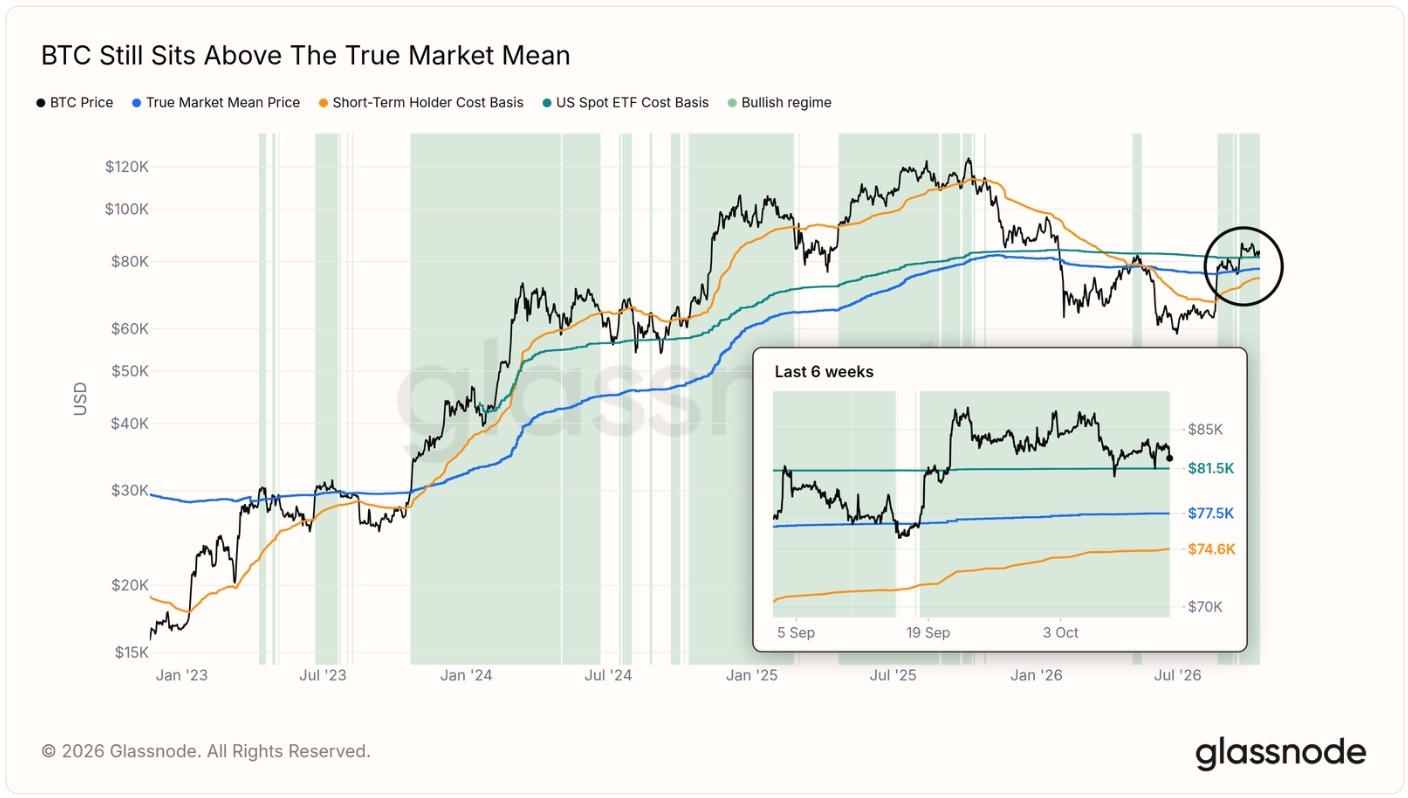
A comment with the identifier Glassnode states: 'This large-order placement area is located below the cost base of US spot ETF. Therefore, the range between $80,000 and $81,500 is where the support from the order book overlaps with the support on the blockchain. If this area is breached, the liquidation-intensive zone below $80,000, as well as the true market average near $78,000, will come into view.'