


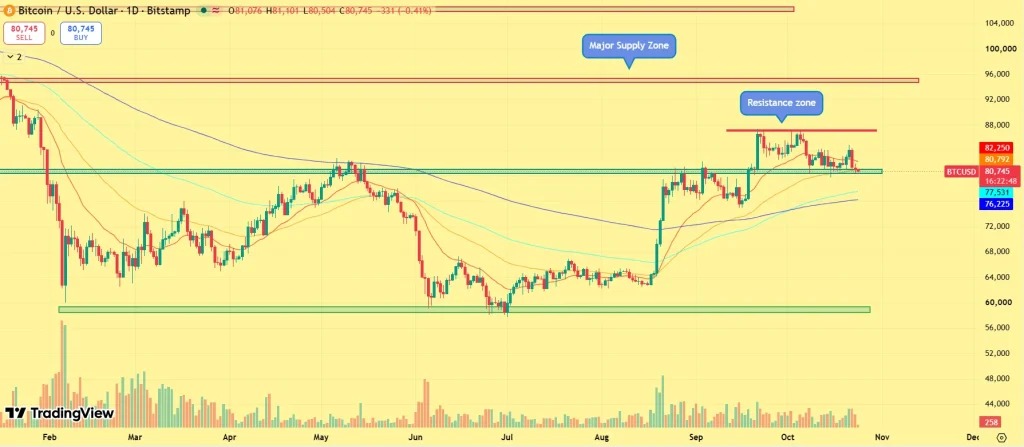
The price of Bitcoin fell to $80,400, due to a pullback after approaching $85,000, which led to increased selling pressure. With continuous capital outflows from US spot Bitcoin ETF and tech stocks under further pressure, market sentiment has been dampened. Bitcoin is currently testing a key psychological support level, and traders are watching whether buying orders can absorb the selling pressure, or whether the correction will extend further to lower support areas.
On October 22, the total amount of capital outflows reached $635.6 million, reversing the previous trading day's net inflow of $524.8 million and setting a new record for the largest single-day withdrawal since June. Data from October 23 also showed another net outflow of $137.9 million for ETF. Bitcoin ETF had attracted considerable capital inflows earlier this week, but on October 22 there was a sharp reversal, followed by another significant outflow the following day. This indicates that institutional demand is weakening.
The decline in Bitcoin is also in sync with a broader pullback in risk assets, particularly technology stocks. The selling pressure spread to Asian stock markets, as investors weigh concerns related to spending on artificial intelligence, technology valuations, and escalating geopolitical tensions. Bitcoin has weakened along with the broader crypto market, highlighting how changes in risk appetite affect demand for digital assets.
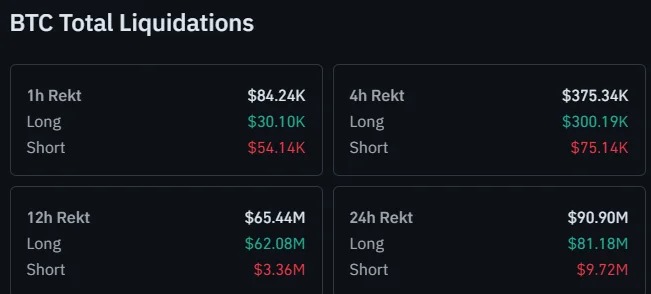
The Bitcoin derivatives market also showed significant pressure, with $90.88 million in BTC positions being liquidated over the past 24 hours. Among them, long positions accounted for $81.16 million, which is 89.3% of the total; short liquidations amounted to only $9.72 million, accounting for 10.7%.
When Bitcoin experiences a significant decline, long positions with leverage may be forced to close due to traders' inability to maintain the required margin. These closings add additional selling pressure, accelerating the downward trend and making it more difficult for buyers to stabilize the market.
A weaker stock market, ETF capital outflows, and long liquidations collectively constitute a reasonable explanation for the pressure on Bitcoin. However, these factors should be viewed as market conditions acting together, rather than proving that a single event caused this round of decline.
Until Bitcoin recovers the nearby resistance level and establishes a higher trading range, the short-term price trend remains fragile. Traders are watching to see whether buyers will hold this psychological support, or whether sellers will drive a deeper correction.
The next major trend of Bitcoin will depend on whether buyers can absorb selling pressure around $80,000, and whether institutional demand will rebound after ETF resumes trading.
Traders will also be watching the Federal Reserve's decision to be announced on October 28th for signals regarding interest rates and the broader financial situation. However, the impact of this decision on Bitcoin will depend on the extent to which the outcome deviates from market expectations.