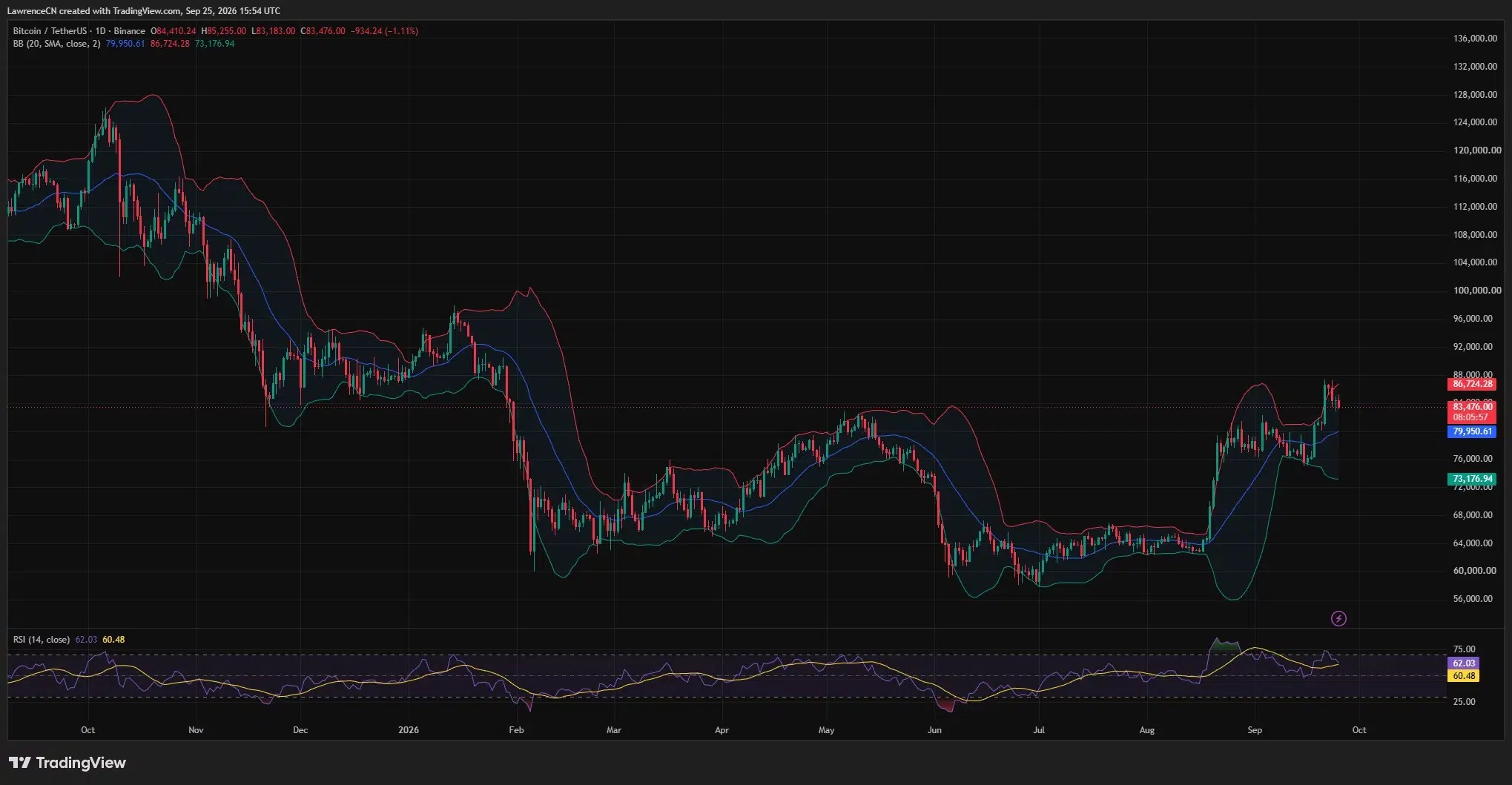
Glassnode: With selling pressure easing, is there hope for a recovery in Bitcoin prices?
According to Glassnode, short-term Bitcoin holders have emerged from a period with a strong willingness to sell in history, and the proportion of their holdings that are in a profitable state has dropped from nearly 100% in late September to about 70%.
- Glassnode indicates that among the Bitcoin held by short-term investors, the proportion of those in a profitable state has dropped from nearly 100% in late September to about 70%.
- Since September, the pace of profit-taking in Bitcoin has clearly slowed down. According to Glassnode, as of October 21st, the profits realized had dropped to approximately half of the previous level.
- On the trading days of October 22nd and 23rd, a total of $773.5 million in funds flowed out of US spot Bitcoin ETF.
- The most recent pullback in Bitcoin has also drawn the market's attention to the Federal Reserve's interest rate decision on October 28th, with investors focusing on signals that may affect the next price movement of cryptocurrencies.
In a market update on October 27th, blockchain analysis firm Glassnode stated that the recent decline in profitability has made Bitcoin a “significantly better entry point” for investors who expect the upward trend of Bitcoin to continue, compared to a month ago.
The company's latest charts show that the proportion of short-term holders in a profitable state has fallen below a certain threshold, which historically has been associated with more intense selling activity.
Short-term holders are generally defined as investors who hold Bitcoin for less than 155 days. The market pays close attention to the profitability of this group, as those who buy recently tend to react more quickly to price fluctuations and may sell when they have achieved considerable gains from their holdings.
In late September, almost all of the Bitcoin held by this group was in a profitable state, and as prices rebounded, investors had the opportunity to lock in their gains. However, subsequent pullbacks reduced the proportion of tokens traded at prices above their purchase cost.
According to the assessment by Glassnode, the unrealized profits that buyers can currently cash in on have decreased recently, however, the company has not indicated that Bitcoin is certain to rebound from its current level.
Bitcoin profit-taking has slowed down since September.
Before the release of the latest data, recent Bitcoin buyers experienced a period of increased selling activity, especially earlier this month when Bitcoin tried to regain the $85,000 level.
In the market report dated October 7th, Glassnode observed that short-term holders who sold on October 4th accounted for approximately 86% of all Bitcoins that flowed into the exchange on that day, representing the highest proportion in a year.
At that time, Bitcoin had just closed above $85,000 for the first time during that round of repairs, prompting some investors who bought Bitcoin in the previous months to choose to realize their profits.
However, since then, the selling activity has clearly cooled down.
On October 21st, the report titled "Week On - Chain" released by Glassnode stated that the scale of profit realization had dropped to approximately half of the level recorded during the high point of September for Bitcoin.
At the same time, the realized losses have been relatively stable; the largest loss of the previous week occurred on October 15th when Bitcoin approached $80,000.
The company also found that investors who bought Bitcoin one to two years ago have seen a slowdown in their selling activities; compared to the peak at the beginning of October, this group is currently transferring less than one-third of the number of tokens per day.
Bitcoin price faces resistance around $87,500
Despite the improvement in profit margins for short-term holders, Bitcoin continues to face selling pressure at higher prices.
Glassnode pointed out in the analysis on October 21st that the range between $85,000 and $87,500 is an important resistance area, with several key market indicators converging at this level.
Investors who bought Bitcoin 6 to 12 months ago had an average holding cost of about $86,700, while the selling orders from exchanges were concentrated between approximately $86,500 and $87,500.
Large-scale liquidation clusters are concentrated around $85,000 and $87,000. If Bitcoin attempts to rebound again, it could exacerbate volatility.
On the downside, this analysis firm pointed out that after Bitcoin briefly approached $80,000 on October 15th, there was interest from buyers in the market around that level.
This price range is particularly important because the estimated average purchase cost for spot Bitcoin ETF investors in the United States, as well as corporate financial coin holders, ranges between $80,000 and $81,500.
However, since then, Bitcoin has struggled to hold this support level.
As previously reported by crypto.news, on October 26th, Bitcoin fell below $80,000, reaching a low of around $79,332 during the session. The reason was leverage liquidations and the re-emergence of capital outflows from ETF, which put pressure on prices once again.
In the assessment on October 21st, Glassnode's “True Market Mean” (the real market average) – an indicator used to estimate the average purchase cost of the actively traded Bitcoin supply – was approximately $77,600.
Before the Fed's decision, Bitcoin's ETF capital flow remains unstable
As Bitcoin struggles to regain momentum, institutional demand has become another area of concern.
U.S. spot Bitcoin ETF saw considerable inflows in the first ten days of October, including a strong buying session on October 19th. However, this round of demand recovery was not evenly distributed.
According to the latest Bitcoin ETF capital flow data, these funds attracted $524.8 million in inflows on October 21st, but the following day they recorded $635.6 million in outflows.
On October 23, another $137.9 million flowed out, bringing the total outflow for these two trading days to $773.5 million.
Despite capital withdrawals, these ETF still recorded a net inflow of approximately $301.2 million over five consecutive trading days.
Meanwhile, Bitcoin fell below $80,000, which also shifted the market's attention to the interest rate decision that the Federal Reserve is set to announce on October 28th.
The Federal Reserve will announce its decision after a two-day policy meeting, and investors are paying close attention to any signals regarding interest rate trends.
The September personal consumption expenditure ( PCE ) inflation report will be released on October 29th, followed by a large-scale expiration of Bitcoin options on October 30th.