Binance claims that a months-long attack resulted in the theft of $6.3 billion in digital assets
Cointelegraph
1h ago
Ai Focus
Binance indicates that a coordinated attack that lasted for several months ultimately resulted in the theft of approximately $6.3 billion in digital assets. The company stated that the attackers obtained access by impersonating recruiters, tampering with software packages, and using internal AI tools, and then used wallet infrastructure and signing services to transfer funds; as of October 31st, Binance claimed to have frozen or intercepted $2.85 billion and recovered 98% of the affected token assets.
Helpful
No.Help

A programming assignment from a potential employer seems like an ordinary part of a job interview. In reality, it was part of a cyberattack that lasted for several months, ultimately resulting in the theft of $6.3 billion from Binance, raising questions about how exchanges protect their employees from such threats.

According to the post-event analysis released on Tuesday by Binance, this attack was part of a coordinated effort, with attackers taking advantage of both human vulnerabilities and internal security systems. The investigation results from the exchange detail how the hackers gradually gained access to its wallet infrastructure before the theft on October 29th.

According to the security report from Binance, this attack began in June. At that time, an engineer downloaded a tampered software package while setting up a AI programming tool. Although Binance detected the malware and replaced the affected devices, the attackers had already collected information about the wallet team of that exchange.

In September, attackers posing as recruiters targeted another software engineer, tricking them into downloading a malicious file disguised as a programming assignment. This malware infected the engineer's work computer and managed to bypass the security measures of the exchange.

On October 20th, the attackers utilized this compromised computer and an internal AI tool to further gain access into the systems of two other engineers, obtaining deployment credentials. On October 29th, they used these credentials to install malware within the wallet infrastructure of Binance.

Subsequently, the attackers obtained access to the exchange's internal wallet signing service. This service is responsible for authorizing cryptocurrency transactions, which allowed them to transfer funds bypassing the normal withdrawal process.

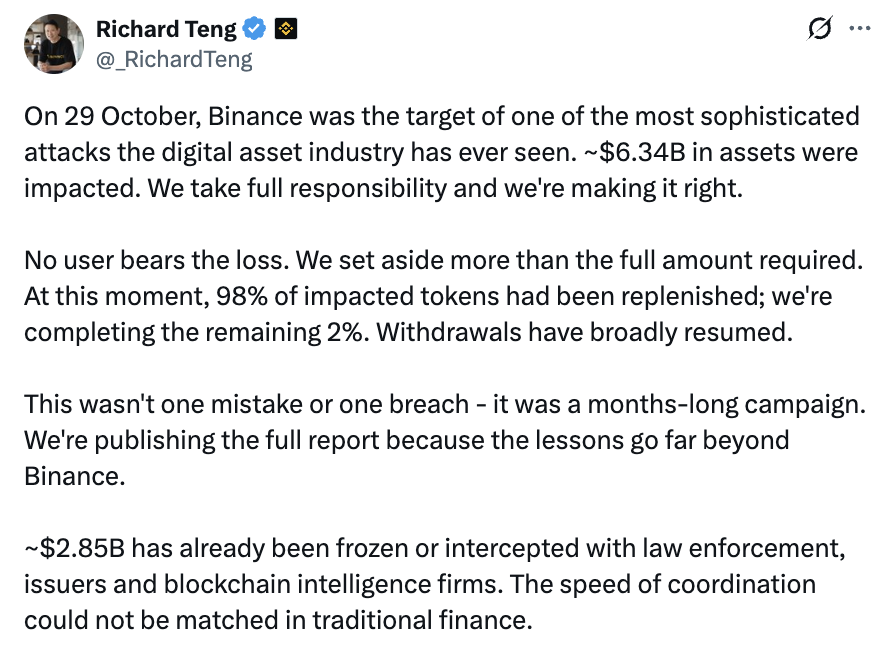
Co-CEO Binance stated on X on Tuesday: "This is not a mistake, nor is it a single intrusion – it is an operation that has been ongoing for several months." Richard Teng
Binance indicates that the attackers also took advantage of Ethereum's EIP-7702 mechanism. This mechanism allows wallets to delegate transaction permissions to smart contracts, enabling unauthorized transfers to continue even after exchanges suspend withdrawals. Its multi-party computation (MPC) decentralizes the control over transaction signatures, which also makes it more complicated to revoke these permissions.

According to the latest calculations by Binance, this intrusion affected approximately $6.3 billion in digital assets, of which $2.85 billion has been frozen or intercepted. The exchange stated that it will bear the losses itself and will not pass them on to customers. It also mentioned that as of October 31st, 98% of the affected token assets have been recovered.

The Federal Bureau of Investigation (FBI) attributed this attack, the largest cryptocurrency hacking incident in history, to North Korean hackers. On Tuesday, Kim Yo-jong, the sister of North Korean leader Kim Jong-un, denied her country's involvement and stated that such attributions are politically motivated, aimed at damaging North Korea's international reputation.

Magazine: Binance Hackers raced against time to transfer billions of dollars before their funds were frozen

Tip
$0
Like
0
Save
0
Views 27
HQYC reminds readers to view blockchain rationally, stay aware of risks, and beware of virtual token issuance and speculation. All content on this site represents market information or related viewpoints only and does not constitute any form of investment advice. If you find sensitive content, please click“Report”,and we will handle it promptly。
Submit
Comment 0
Hot
Latest
No comments yet. Be the first!
Related
Tesla, owned by Elon Musk, and SpaceX prevent their stocks from entering the OKX-ICE tokenization trading platform
According to the update notice from OKX to ICE TSV on November 2nd, Tesla and six other companies, including SpaceX, raised objections to the trading of their stocks on this tokenized stock trading platform, bringing the list of opponents to 56. Under the innovative exemption provisions of SEC, if a company raises written objections within 30 days, the platform will not be able to provide third-party tokenized versions of that company's stocks for trading.
Decrypt
·2026-11-04 02:25:16
0
NVIDIA Stock Price Today: NVDA Rebounds 3% from the $200 Support Level
NVIDIA's stock price rebounded by about 3% on Tuesday after approaching $200, but it is still below its previous record high of over $243. Reports indicate that Trump's statements regarding Israel and Iran boosted market sentiment, drove down oil prices, and led to an increase in tech stocks; at the same time, Anthropic expects its computing power to exceed 3.5 gigawatts by the end of 2026, and signals of market demand for chips also provided support.
Coinpedia
·2026-11-04 02:16:00
8
Cross River Bank chooses Arbitrum to advance loan tokenization; Wall Street accelerates its layout in blockchain finance
Cross River Bank announces cooperation with Offchain behind Arbitrum, planning to tokenize loans at the time of disbursement, and to build the related infrastructure using Arbitrum One and ZeroDev wallet technologies. All parties have completed the proof of concept, with the goal of going into production in early 2027, but the loan scale or commercial commitments have not yet been disclosed.
Coinpaper
·2026-11-04 02:15:58
8
NEAR Approves a 36% Reduction in Annual Issuance, Yet Coin Price Still Nearly Drops by 10%
The governance community of NEAR has approved a reduction of 36% in the annual token issuance volume, which may result in a decrease of several million tokens in future supply. However, against the backdrop of a broader sell-off in cryptocurrencies, the price of NEAR still fell by nearly 9%. This proposal will reduce the maximum annual issuance rate from 2.5% to 1.6% and will require review by the security committee, a 90-day preparation period, and the implementation of validator technology.
Coinpaper
·2026-11-04 02:15:54
9
CrowdStrike Spends Nearly $500 Million to Acquire Two AI Security Startups
CrowdStrike will acquire two AI security companies, Fiddler AI and Dreadnode, in order to expand its capabilities in monitoring, testing, and protecting AI models and agents. According to a report by The Wall Street Journal, the acquisition price for Fiddler AI is approximately $400 million, and for Dreadnode it is about $95 million.
TechCrunch
·2026-11-04 02:06:36
10
View More