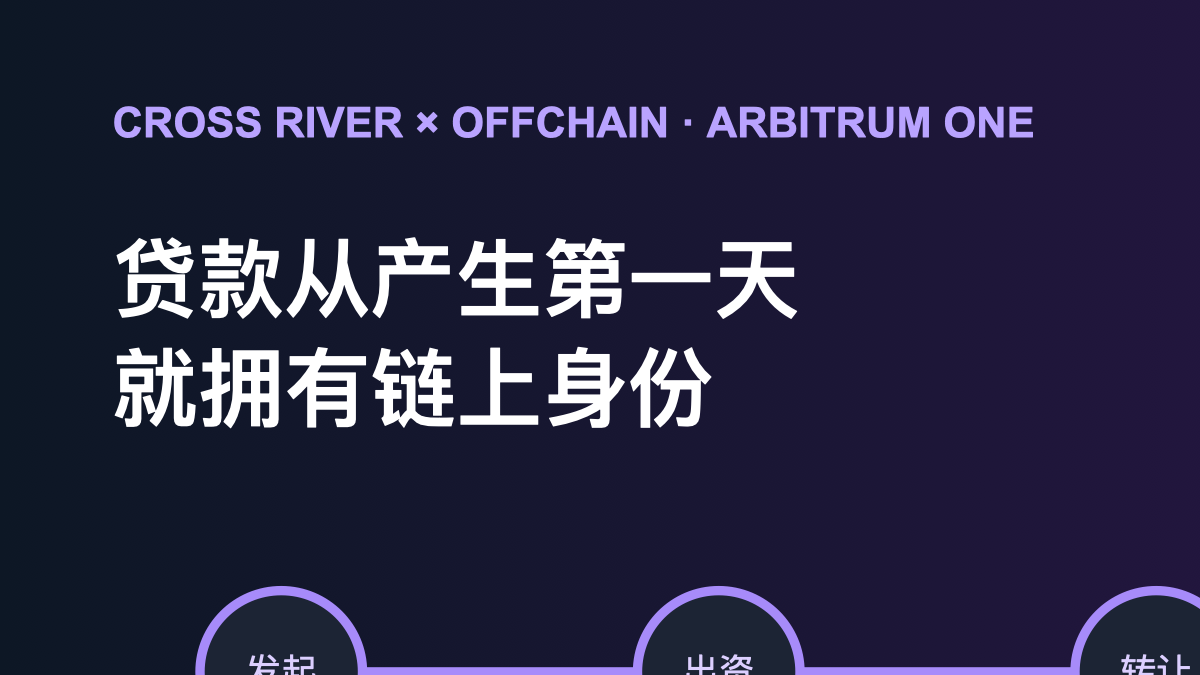


Most real-world asset tokenization projects start from the “last mile”: loans are first issued, recorded, and serviced within traditional systems. Only after the assets are established are certain rights mapped onto the blockchain. However, the developers of Cross River and Arbitrum, Offchain, announced on November 3rd that they would do the opposite – they would integrate tokenization directly into the loan initiation platform, allowing assets to be contributed to, held, transferred, and serviced on Arbitrum One from the very first day they are created.
For borrowers, the application, lending, and repayment processes still use the original customer interfaces; the changes are hidden behind the assets. The wallet infrastructure of ZeroDev under Offchain is integrated into the process, allowing the ownership of loans, funds, payments, and service activities to be recorded in a shared ledger, eliminating the need for re-verification across multiple systems with each transfer of assets.
This is not an announcement that a particular loan has been publicly traded, nor does it disclose the scale of the initial assets, the launch time, or the yield rate. It is first and foremost an infrastructure collaboration. What is truly noteworthy is that the process order has been changed: tokenization is no longer a post-loan packaging step, but has become part of the initiating system itself.
Generate unified records from the source; what is saved is not just one certificate.
When traditional loan assets enter the capital market, they often have to go through data migration among the initiating institutions, service providers, fund providers, and recipients. Each party maintains its own records, and changes in ownership, repayments, and fees require repeated verification. Theoretically, by establishing records on the blockchain from the initial stage, the asset lifecycle can be continuous around the same identity, reducing subsequent need for data consolidation.
According to Cross River, this structure can support continuous forward purchase arrangements, more flexible funding commitment scales, as well as new methods for packaging and distributing credit assets. For fintech companies, the appeal lies not only in faster settlement, but also in the ability to introduce on-chain funds and pools of capital from international investors without altering the borrower's front-end experience.
However, "the same chain" does not equate to "all facts being automatically consistent." Loans still involve the borrower's identity, contracts, service quality, overdue handling, and regulatory requirements. Records on the chain can prove that a transfer occurred, but they cannot alone verify the true income of the underlying borrower, nor can they replace debt collection, dispute resolution, or consumer protection. The tokenization of data at the source also shifts the risk of incorrect data being entered into the system earlier.
Bank-level trust relies on permissions and legal relationships, not just technology.
This solution chooses Arbitrum One and hides the wallet within a user-friendly process, indicating that blockchain products targeting institutions are moving away from the concept of "letting each user manage their own wallet." Borrowers may not need to understand blockchain addresses at all, while fund providers can use programmable records to manage holdings, transfers, and payments.
The key factor adopted by these institutions remains control. Who can create assets, who can transfer them, who can freeze or correct records in case of default, and how on-chain tokens correspond to legal claims—all of these must be clearly stipulated in the product rules and contracts. The announcement emphasizes that financial institutions can shape the infrastructure around their own business, which means they are closer to licensed capital market tools, rather than barrier-free tokens that anyone can trade freely.
This also explains why “native tokenization” is different from simply copying existing assets onto a blockchain. The latter mainly addresses issues related to display and transfer, while the former must be integrated into the core processes of credit granting, lending, services, and accounting. The transformation cost is higher, but if successful, the on-chain records can become an integral part of daily operations, rather than merely peripheral credentials.
RWA In the past, the market often used the scale of issuance to measure progress. Cross River and Offchain take the issue to a more challenging level: whether assets can have a sustainable digital identity from the very beginning. The answer still awaits verification through real loan volumes, default handling, secondary liquidity, and regulatory practices. However, the direction is clear. The next round of competition is not just about "who moves more assets onto the blockchain," but about who can ensure that the records on the blockchain encompass the entire life cycle of those assets from day one.
For investors, the next focus is not on the speed of the demonstration, but on whether the asset pool can consistently provide consistent principal, interest, overdue payments, and service data. For borrowers, it is important to ensure that technological improvements do not change the fees, privacy, or rights to appeal. Only when both parties are satisfied can native tokenization become a credible financing channel.