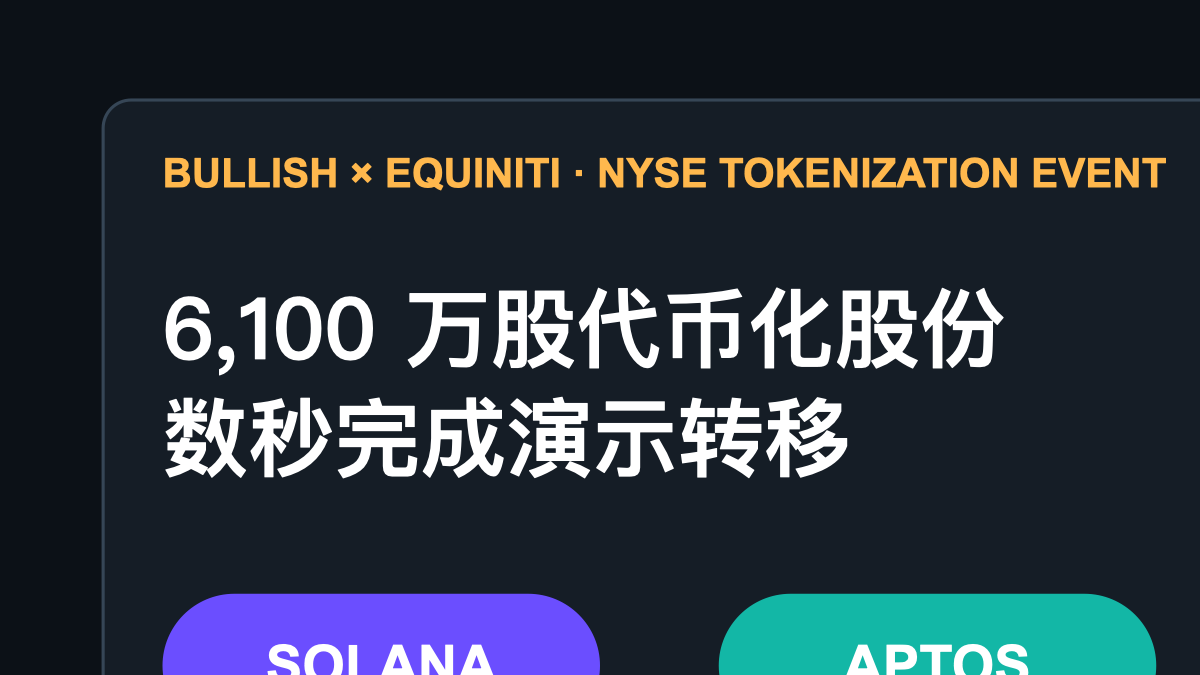


During a demonstration at the New York Stock Exchange, Bullish and the equity registration institution Equiniti completed the transfer of 61 million reserved Bullish tokenized shares on Solana. Officials stated that the process was completed in just a few seconds. On November 3rd, Bullish announced the addition of Aptos and Ethereum to the initial network partners, allowing issuers to choose which public chain their stock tokens would be listed on.
This batch of shares is not the additional 61 million shares issued to the market. Bullish indicates that they are reserved for completing the acquisition of Equiniti; the actual number of shares issued at the time of transaction settlement will still be determined according to the merger and acquisition agreement. What was demonstrated is the capability for registration and transfer, which cannot be directly equated with 61 million shares that have already entered 24/7 public trading.
More importantly, the official ownership records of tokenized shares are still maintained by the transfer agents. The blockchain provides the transfer and programmable interfaces, and the legal shareholder register has not been replaced by anonymous wallets. This structure aims to combine the speed of the public chain with the existing corporate operations, compliance, and investor relations of the securities market.
Multi-chain is not simply about copying three copies of a stock.
Bullish first tokenizes its own equity on Solana, and then chooses Aptos and Ethereum. The reason is that investors and liquidity are distributed across different networks. For issuers, multiple chains can reach more wallets and applications; however, this also immediately presents new challenges for infrastructure providers: how to prevent the same share from being represented repeatedly across multiple chains, how to maintain the total amount consistency during cross-chain transfers, and which system has the final authority in case of conflicts.
Official shareholder records are held by transfer agents, providing a central point of reference for these issues. No matter on which chain the tokens move, the ultimate legal ownership still needs to correspond with the registration system. This approach sacrifices a part of the "fully decentralized" narrative, but it is more in line with the reality that publicly traded stocks must deal with: voting, dividend distribution, lock-up periods, identity verification, loss recovery, and regulatory freezes all require clear responsible parties.
The demonstration also showed the direct distribution of digital event passes to tokenized shareholders' wallets. Compared to “faster transactions,” such actions by companies may be implemented even sooner. Issuers can distribute rights, event eligibility, or information based on holding conditions, transforming shareholder communication from quarterly emails into programmable interactions. However, any automatic distribution must handle holding snapshots, privacy, taxation, and issues with incorrect addresses; the ultimate beneficiary cannot be determined solely based on the balance on the blockchain.
A few seconds of transfer only addresses technical timing issues; it does not eliminate the risk of incomplete settlement.
A single on-chain transfer is completed within seconds, which demonstrates the speed of network processing; however, whether securities settlement is truly completed also depends on fund delivery, identity verification, transfer restrictions, and registration updates. If tokens can be traded 24 hours a day, issuers and service providers also have to deal with company announcement windows, market monitoring, customer service across time zones, and handling of abnormal transactions. "24/7" does not simply mean extending the trading hours of exchanges.
Bullish lists near-real-time settlement, real-time equity visibility, and programmable corporate actions as potential capabilities, all of which have practical appeal. However, the announcement did not disclose any interoperability plans between the three networks, the scope of investor access, the official launch date, or expectations for trading volume. As a result, the market is more inclined to view this move as an expansion of infrastructure rather than tokenized stocks having largely replaced the existing custody system.
The role of Equiniti is that traditional equity registration has not disappeared from the new system; instead, it has become a key link between legal rights and on-chain tokens. Public chains are responsible for making assets more accessible to programs, while transfer agents are responsible for determining "who legally owns these shares." The quality of synchronization between the two determines whether tokenized stocks represent a reliable new approach or just a faster but more complex interface.
Expanding from one chain to three chains, Bullish bets that issuers will not opt for a single network binding. However, the real test is not how long the list of supported networks is, but whether when stocks cross chains, dividends are distributed, votes are cast, or disputes arise, whether the three chains and the official registry can always point to the same answer.
Investors also need to distinguish between "token transferability" and "securities tradability." Account qualifications, jurisdiction, lock-up arrangements, and market rules can still limit liquidity. While the technology provides opportunities, it is the compliance system that determines who can take advantage of them. If these conditions are not clearly presented on the product interface, faster transfers may instead create more difficult-to-explain holding situations.