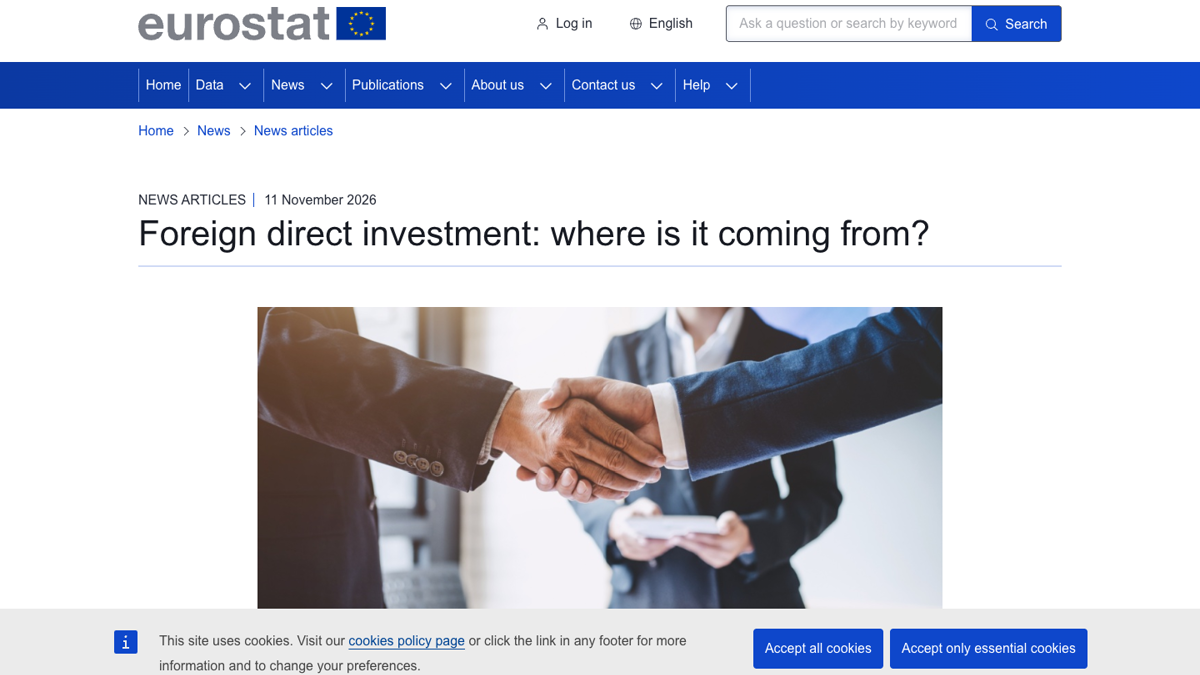


A sum of foreign capital may originate from the United States, pass through holding companies in the Netherlands or Luxembourg, and then enter another European enterprise. If we only consider the last leg of this transfer, the funds will be recorded under the name of the intermediate holding company, while the investors who actually bear the risks and make control decisions remain hidden behind the corporate chain. On November 11th, data for 2025 from 14 EU countries was released, which began to use the term "final investment economy" for tracking. According to these figures, the United States accounted for 15.4% of the total value of foreign investment in these countries, ranking first. Eurostat
Germany accounts for 11.5%, France for 9.4%, the UK for 9.3%, and Switzerland for 5.8%. This ranking does not represent the complete picture of foreign investment across the entire EU, as only 14 countries have reported their data, and data collection is still voluntary. What it provides is a clearer view of the underlying economic relationships: it reveals who ultimately controls investment decisions, bears risks, and reaps benefits, which is closer to the actual economic dynamics than simply identifying through which intermediary companies the funds flow.
The last link in the chain and the ultimate controller will tell two stories.
Traditional FDI statistics often allocate investments based on the location of the "direct investors." Multinational corporations set up multiple layers of companies for financing, tax, legal, or management purposes, and the direct investor may merely be a holding platform. However, when it comes to the ultimate investment economy, the investments are reclassified according to the location of the entity that holds control. Both approaches are legitimate, but they answer different questions: the former describes the legal path that the funds take, while the latter is more suitable for observing the source of control and risk.
Eurostat defines direct investment as one country's enterprise acquiring at least 10% of the equity in another country's enterprise, while FDI measures the total value of investments at a certain point in time. The final definition also allows the reporting country to be the ultimate investor itself, which can identify the situation where "funds circulate and then return to the home country" round-tripping. Such funds may appear to be foreign capital on the surface, but in reality, they do not bring any new external capital to the domestic economy. Recognizing them separately helps to avoid overestimating the actual cross-border investment.
However, the ultimate controller cannot replace all analysis. Enterprises may carry out financing, employment, and management in intermediate countries, and legal responsibilities are also distributed along the corporate chain. If regulators only look at the ultimate source, they will underestimate the role of intermediate jurisdictions in taxation, compliance, and risk isolation. The most useful approach is to present both the direct source and the ultimate source side by side, explaining how investments are made and who makes the final decisions.
In 14 countries, intra-EU investment still accounts for the majority.
Of the 14 reporting countries, in 9 countries, the majority of foreign investment ultimately came from other EU countries. In the Czech Republic, 75.1% of the investment originated from the EU, in Romania it was 73.3%, and in Estonia 64.8%. In another 5 countries, the majority of investment came from outside the EU: in Cyprus, non-EU sources accounted for 79.4%, while in Spain, Sweden, Greece, and Denmark, it ranged from 51.0% to 55.1%. Within the same common market, there are completely different capital networks connecting the various countries.
These ratios do not directly indicate which structure is better. Investment within the EU may benefit from common rules and lower transaction frictions, while non-EU investment may also bring new markets, technologies, and capital. What truly needs to be assessed are industry concentration, investment duration, control arrangements, and exit risks. If a country's foreign investment sources are highly concentrated, even if the total amount is large, it may be more susceptible to changes in the policies of a single economy.
The boundaries of data coverage are equally important. The results of 14 countries cannot be extrapolated to represent the precise shares of the 27 countries in the European Union; the 15.4% mentioned in the news is the proportion of the total value of these 14 reporting countries. Voluntary reporting means that rankings and proportions may change as countries join or as methods improve. When analyzing annual trends, it is necessary to confirm that the sample remains consistent, rather than mistaking changes in coverage for sudden migrations of capital.
Ownership transparency will change policy issues.
Knowing where the ultimate investors come from can affect investment reviews, industrial policies, and risk monitoring. Investments that seem to originate from diverse sources may actually be concentrated in a few economies upon closer examination; positions that appear to be foreign capital could also be a result of domestic capital flowing back. As a result, regulatory authorities can focus their attention on control rights, key industries, and the actual risk bearers, rather than just on the remittance routes.
For both enterprises and investors, transparency also increases the responsibility for explanation. Multi-layered structures may still have legitimate business reasons, but if statistics and regulation can penetrate through the intermediate entities, it will become increasingly difficult to rely solely on the registration location to disguise the source. This release by Eurostat does not claim to have completed a comprehensive picture of the entire EU; rather, it shows that the focus of statistics has shifted: the issue of foreign investment is no longer about "where the money comes from," but rather about "who ultimately decides whether it stays, expands, or withdraws."