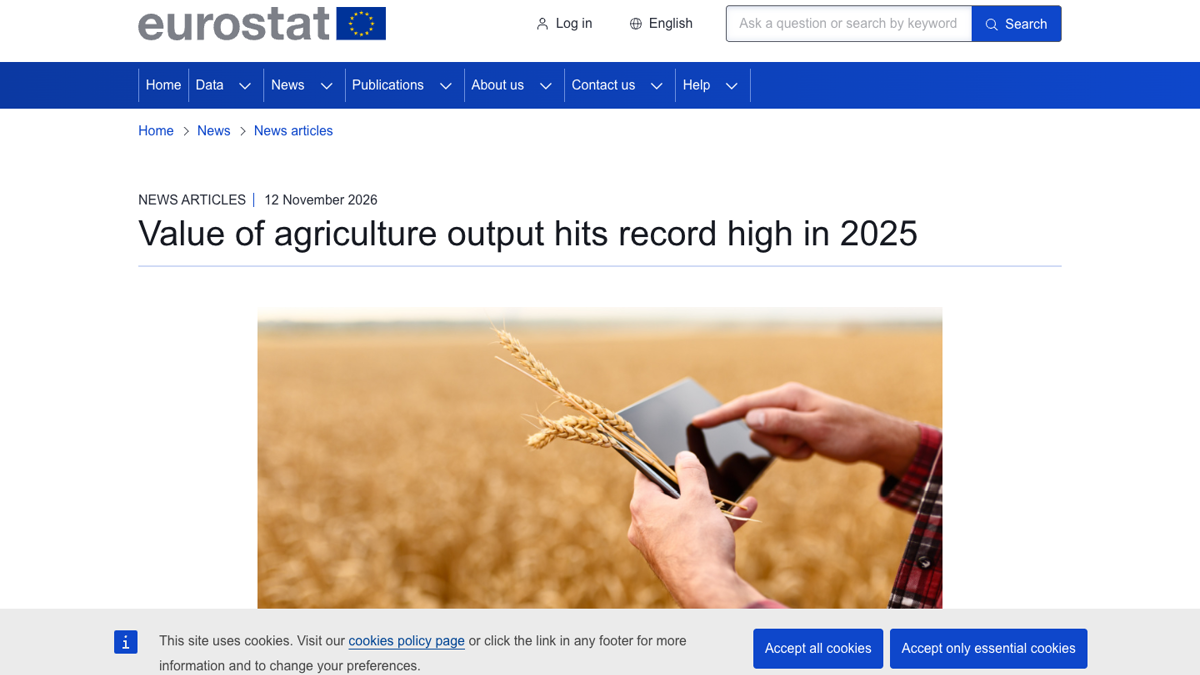


Announced on November 12th, Eurostat, the total agricultural output of the European Union in 2025 reached 558.7 billion euros at basic prices, a 4.8% increase from 532.9 billion euros in 2024, setting a new record. The intermediate input costs amounted to 309.1 billion euros, with a growth of 1.8%; the total added value of agriculture reached 249.5 billion euros, an increase of 8.8%. Output value, costs, and added value all increased, but at different rates.
Agricultural total output includes crops, animals, and agricultural services. The value of crop production was 273.2 billion euros, accounting for 48.9%, with a year-on-year increase of 1.6%; the value of animal and animal product production was 238.2 billion euros, accounting for 42.6%, with a growth of 9.2%. Therefore, the annual new high is not due to an average increase in all categories, but rather stronger price and production changes in livestock products that have pushed up the total amount.
A nominal increase in output value does not equate to a corresponding increase in production volume.
The basic price level is affected by both quantity and price. For certain products, even if there is no significant increase in production, as long as the selling price rises, the nominal output value will also increase; conversely, an increase in production may be offset by a decrease in price. Eurostat This news report focuses on changes in value and cannot be directly translated as meaning that the EU has produced 4.8% more agricultural products.
Intermediate inputs include feed, energy, fertilizers, seeds, and other production consumables. These inputs only increased by 1.8%, which is lower than the total output of 4.8%, yet the total added value increased by 8.8%. This difference indicates an expansion in the nominal value created by the agricultural sector, but it cannot be directly assumed that each farmer's profit also increased by 8.8%. Wages, depreciation, rent, interest, and taxes still affect the final income, and there are significant differences in cost structures across different regions and product categories.
The differentiation in the output value of crops and animals is worth noting. Crops still constitute the largest portion, but their growth was only 1.6%; however, the animal sector grew by 9.2%, becoming the main driving force behind the overall increase. When analyzing food prices, it is necessary to continue to break down the data into meat, dairy products, grains, and fruits and vegetables to avoid misinterpreting changes in total output value as an increase in prices for all foods in consumers' baskets at the same rate.
Growth in 22 member countries, but significant disparities still exist between nations
In 2025, the total agricultural output value increased in 22 out of the 27 EU countries. Romania saw the largest increase, at 13.6%. A few countries experienced declines, with Greece decreasing by 2.9% and Cyprus by 1.8%. The Common Agricultural Market did not produce a uniform outcome, as factors such as weather, crop composition, the proportion of livestock farming, input prices, and local purchase prices all influenced the performance of each country.
This also means that the overall situation in the EU cannot represent the circumstances of farmers in any single country. Regions with a higher proportion of livestock products may benefit from this round of value growth, while regions that rely on specific crops may face a different combination of prices and yields. If policies are based solely on the EU average, they are likely to overlook producers that are more affected by extreme weather, animal diseases, or energy costs.
An increase in output value will also be redistributed along the food chain. The final price paid by consumers is determined by factors such as farm prices, processing costs, logistics, retail markups, and taxes. A record-high total agricultural output value does not necessarily mean that supermarket prices will rise by 4.8% year-on-year, nor does it imply that farmers' incomes will necessarily decrease by the same proportion when prices fall. Contracts and bargaining power at different stages of the chain can delay or absorb these changes.
New highs are more suitable for observing trends in structure rather than celebrating a single numerical figure.
558.7 billion euros indicates that the nominal scale of the EU's agricultural economy continues to expand. A more explanatory combination is as follows: the growth in the animal sector is significantly faster than that in crops, the increase in input costs is lower than that in output, and therefore the total added value rises even more rapidly. At the same time, there are still variations in growth rates among member states. Only by taking all these factors into account can we avoid summarizing the entire agricultural sector with a single record figure.
Subsequent assessments will also require data on quantity indices, price indices, farmers' income, and actual inputs. If the nominal increase is mainly driven by prices, the improvement after inflation adjustment may be smaller; if both output and productivity also increase simultaneously, the foundation for growth will be more solid. Climate and energy factors will still cause rapid changes in annual results, and a single-year high cannot automatically extend into a long-term trend.
For consumers, businesses, and policymakers, the most important signal in this data is the structural change: livestock products will account for a larger increment by 2025, and different countries are not experiencing the same level of prosperity. The record-high total agricultural output value is a true statistical result, but it is neither the average increase in income for all farmers nor a substitute indicator for food inflation.