

Fed Vice Chairman Jefferson said on November 19th that AI construction is currently putting upward pressure on demand and inflation; only future improvements in productivity may be able to lower inflation. These two forces occur at different times, and interest rate decisions cannot offset them in advance.
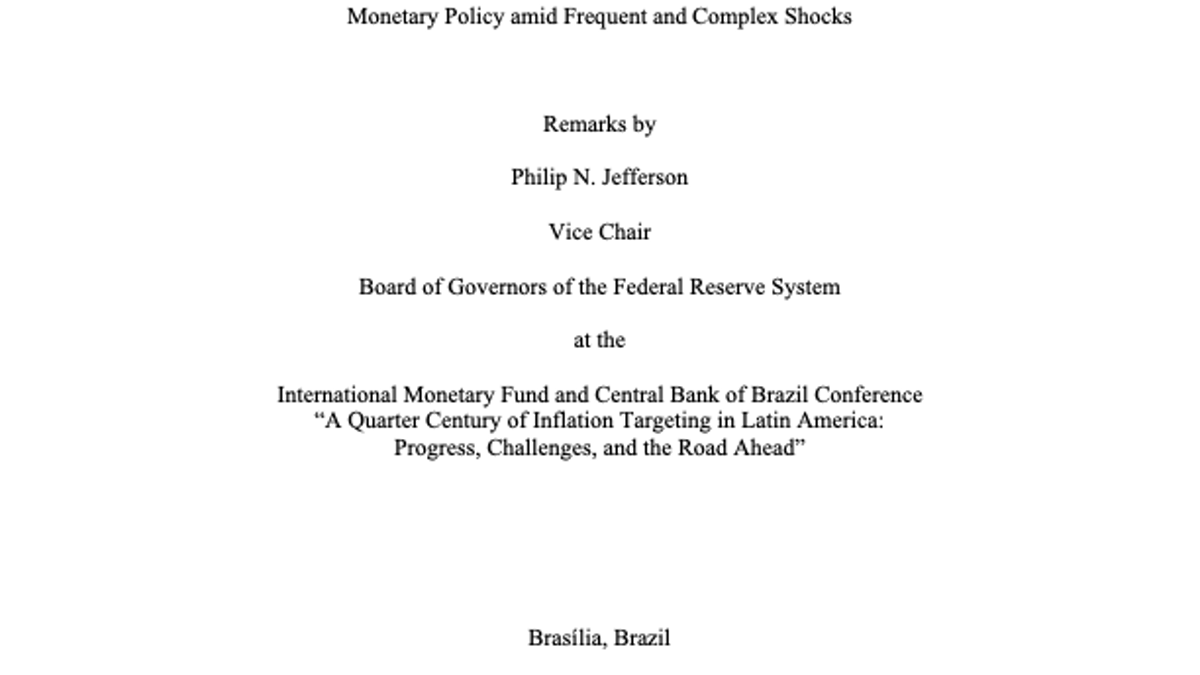
He discussed economic shocks at a meeting co-hosted by the Central Bank of Brazil and the International Monetary Fund in Brasília. His speech covered topics such as energy, trade, and AI; no new interest rate decisions were announced. A footnote also clarified that these were his personal views and did not necessarily represent those of the Federal Open Market Committee or other members of the council.
Oil prices are simultaneously affected by inflation and household income.
Jefferson initially classified shocks into two categories based on their effects: demand shocks and supply shocks. Demand shocks alter the spending of households, businesses, or governments, but they do not change production capacity; supply shocks, on the other hand, affect the productivity of labor, capital, or these inputs, thereby influencing how much the economy can produce sustainably.
The purpose of making this distinction is to determine whether policies can simultaneously take care of employment and prices. If the impact causes the output gap and inflation to move in the same direction, then these two objectives support each other; if they move in opposite directions, a trade-off becomes necessary. The output gap is the difference between actual output and the estimated potential output, and potential output itself also relies on estimates.
The footnotes in the speech further explain that a positive gap indicates excessive demand, with employment levels exceeding the sustainable maximum, putting upward pressure on inflation; a negative gap suggests relative oversupply, with the opposite effect. This refers to an analytical framework, and the speech did not announce the specific figures for the current gap in the United States based on this framework.
Energy is an example of such trade-offs. Jefferson said that the recent rise in oil prices related to conflicts in the Middle East could both drive up prices and reduce real incomes and demand. Focusing only on rising prices overlooks the pressure on household purchasing power; whereas focusing only on weakening demand ignores the price shocks that have already occurred.
He specifically noted that when the recent energy price shocks occurred, inflation in the United States was already above the target of 2%. Therefore, policy responses depend on the relative costs of missing each target and the distribution of risks, and it is not possible to preset actions based solely on the name of a single shock.
If inflation expectations face the risk of becoming unanchored, there is a stronger reason to address inflation more aggressively; if price pressures are under control, it may be appropriate to prioritize preventing a decline in employment. Both statements are conditional; one cannot take the first sentence as a decision to raise interest rates, nor can the second sentence be interpreted as a commitment to cut interest rates.
AI Investment must occur first; supply improvement may only follow thereafter.
AI makes the judgment more complex, as it can affect both total demand and total supply at the same time, but there is a sequence in timing. Jefferson said that in the past two years, the adoption of AI by enterprises has increased significantly, and an optimistic attitude towards technology is driving investment in data centers, advanced computing equipment, and related products.
These construction activities are first reflected in demand. The speech clearly states that the current AI construction puts upward pressure on demand and inflation. This is different from the understanding of AI as simply a tool for cost reduction: while a technology may ultimately improve efficiency, its implementation phase still involves purchasing equipment and generating expenditures.
Improvements on the supply side are described in terms of possibilities. AI may automate some tasks and enhance others, thereby increasing productivity and further boosting the potential growth rate of output. In the future, improvements in productivity may support growth while also putting downward pressure on inflation; however, he did not provide a timeline for when such changes will occur.
There are also two sides to the labor market. AI may replace some jobs, posing a real challenge to affected families; similar to many technological breakthroughs in the past, it could also give rise to new jobs and new businesses that have not yet been imagined. The speech did not provide net employment figures, nor did it state that the newly created jobs would necessarily offset those that are replaced in a timely manner.
From this, it can be seen that when judging US stocks related to AI, at least two things need to be distinguished: construction investment is increasing, and productivity gains have already been realized. The former is referred to in the present tense in this speech, while the latter is still qualified as future and possible. Including the supply dividends that have yet to be realized in the current inflation assessment would overlook the time lag he emphasized.
Interest rate clues are the conditions, but the speech did not provide an answer for the next time.
For readers who follow both U.S. stocks and crypto assets, this material provides a perspective on the boundaries of policy narratives: one cannot infer that current infrastructure spending will not put pressure on inflation merely based on the potential long-term productivity gains of AI. This interpretation is drawn from the logic of the speech; the original text does not provide any insights into asset price reactions or trading recommendations.
The verifiable criteria for judgment are as follows: first, distinguish whether a policy statement refers to current needs or potential future supply; then, check whether any conditional terms have been omitted. Jefferson placed AI at different times and also linked the two responses to energy policy to inflation expectations and employment risks, respectively.
In conclusion, he emphasized that these shocks do not come in isolation; issues related to energy, trade, and AI are all unfolding simultaneously. The Federal Reserve needs to weigh them all together to ensure that policies align with its responsibilities. His goal is to restore price stability while maintaining a robust labor market. This brief statement did not update inflation forecasts, interest rate targets, or voting intentions for the next meeting; rather, it left open the policy choices to be made in the face of multiple concurrent shocks.