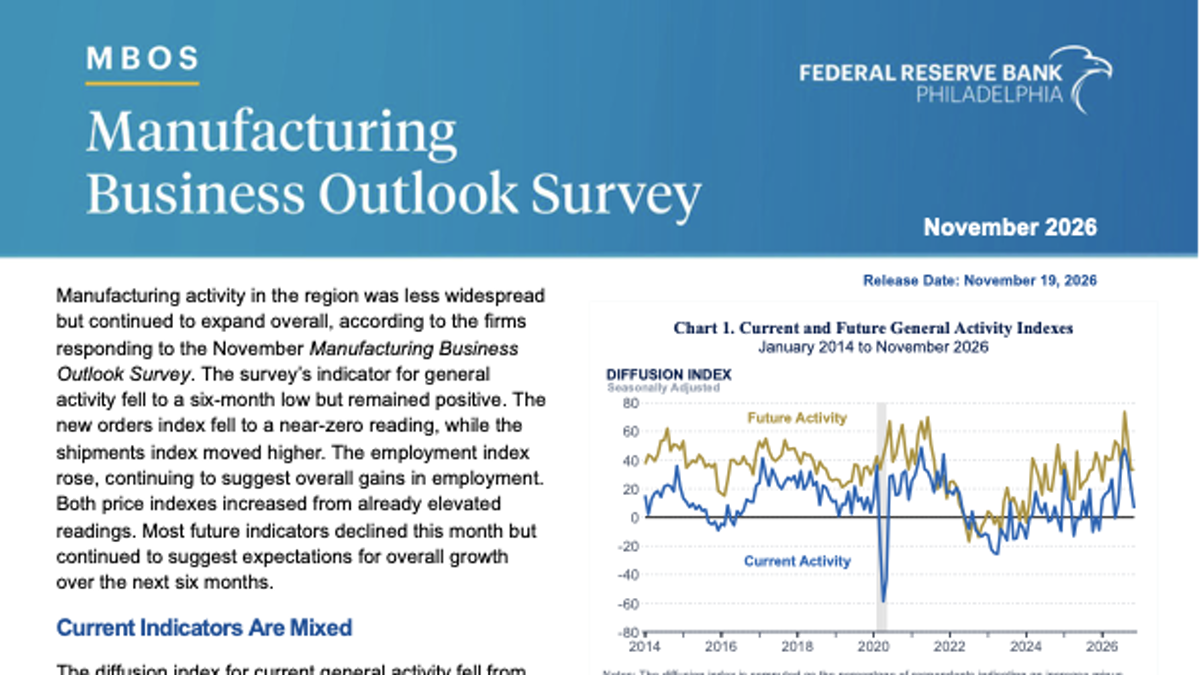


The Federal Reserve of Philadelphia released a survey on November 19th, showing that the new orders index fell to -0.4, while the ex-factory price index rose to 47.0, reaching its highest level since June 2022. Orders are nearly stagnant, and price increases continue to spread; both of these phenomena appear in this regional report.
The survey responses were collected from November 9th to 16th. The Overall Business Activity Index dropped from 20.9 to 6.3, the lowest level since May, but it remains positive. Based on this, the report concludes that the regional manufacturing sector continues to expand overall, although the scope of expansion has narrowed; however, it does not indicate that regional production has decreased by 14.6%.
New orders are weakening, yet shipments and recruitment continue to increase.
These indicators belong to the diffusion index, which is calculated by subtracting the proportion of companies that reported a decrease in responses from the proportion of companies that reported an increase. In overall activities, 36.1% of companies reported an increase, while 29.8% reported a decrease; subtracting these figures yields 6.3. This index measures the breadth of the direction of change, and the numerical value does not represent the growth rate of output.
The new order index has dropped from 4.3 to -0.4, showing a decline for four consecutive months. The table indicates that 31.7% of businesses have seen an increase in orders, 32.1% have seen a decrease, and 35.4% have remained unchanged. The negative value is very small, which actually means that there are slightly more businesses reporting a decrease in orders, and it should not be exaggerated as a complete collapse in orders.
However, the shipment index rose from 15.3 to 25.7, offsetting most of the decline from the previous month. The outstanding orders index shifted from 2.4 to -4.4, and the delivery time index dropped from 8.5 to 3.5. Several indicators showed different trends, and the survey did not delve into whether the increase in shipments for each company came from fulfilling old orders; therefore, it is not possible to attribute this reason to the companies.
Employment also did not turn negative along with new orders. The employee count index rose from 9.1 to 11.6, marking the first increase in three months; 21.1% of companies added employees, 9.5% reduced them, and 69.4% remained unchanged. The average workweek index increased from 7.5 to 11.2, indicating that there are still more companies with increased working hours.
The inventory index shifted from -12.8 to 5.3. This indicates a change in the distribution of companies according to the direction of inventory changes, and it cannot be directly converted into inventory amounts or the scale of backlogs. Orders, shipments, employment, and inventory each answer different questions. Summarizing a company's operations with a single number for overall activity will overlook these differences.
Price increases are more common, and customers are also more sensitive to them.
The input price index jumped from 43.2 to 58.2, the highest level since April. 58.2% of enterprises reported an increase in input prices, with zero reporting a decrease; the ex-factory price index rose from 40.1 to 47.0, with 48.1% reporting price increases and 1.1% reporting price decreases. The rise in both indices indicates that price increases are more common among the sampled enterprises, and it does not mean that the price of each product increased by 58.2% and 47% respectively.
This set of sub-items provides information for judging inflationary pressures in the United States, but the survey does not calculate national consumer prices nor does it provide corporate profit margins. The gap between input and selling price indices cannot represent gross profit margins; therefore, one cannot simply subtract 47.0 from 58.2 to conclude that profits have been depressed by 11.2 percentage points.
This month's special issue includes customer feedback: 42.3% of the surveyed companies stated that their core customers are more concerned about prices than last quarter; 53.8% believe the sensitivity remains similar, while 3.8% think it has decreased. This adds a constraint to price-increasing actions, but it does not mean that all companies have lost their ability to raise prices.
In addition, 56% of enterprises expect to be able to clearly foresee changes in industry costs over the next six months. Among those enterprises that can foresee these changes in their responses, 78.6% anticipate that competitors will raise prices, 14.3% expect prices to remain stable, and 7.1% expect prices to fall. The 78.6% figure refers to the aforementioned 56% group of enterprises; it should not be interpreted as meaning that nearly 80% of all manufacturing enterprises will raise prices.
For companies that are expected to adjust their prices due to competition, the median time for such price adjustments is three months, compared to four months in the previous quarter. This is a company's assessment of its competitors and does not represent an actual price list that has been implemented, nor does it constitute a forecast of future inflation by the Federal Reserve of Philadelphia.
Still optimistic about the future, but willingness to spend on capital is cooling down.
The overall activity forecast index six months from now is 33.6, which represents little change from last month's 33.0. 50.7% of businesses expect an increase in activities, while 17.1% anticipate a decrease; at the same time, the future orders index has dropped from 37.0 to 31.7, and the expected future shipments have also fallen from 35.2 to 25.4, both reaching their lowest levels in over a year.
The future employee count index has dropped from 30.1 to 24.9, still remaining positive; the capital expenditure expectations index has fallen from 34.9 to 18.9, marking the third consecutive month of decline and also the lowest level since February. A decrease in the capital expenditure index indicates that the net optimism has narrowed, but it cannot be interpreted as a 16% reduction in investment amounts.
The future input price and ex-factory price indices are 63.3 and 62.9 respectively, which are still significantly higher than the long-term average. From this, it can be seen that sample companies do not generally expect the pressure on prices to disappear rapidly just because orders have slowed down; this is an interpretation of the component combinations, not a new policy conclusion from the Federal Reserve.
For readers who hold US stocks and are concerned about interest rate environments, the available verification standard is to keep both the price and order details, and to first confirm the index denominator. The report indicates that all data has been seasonally adjusted, and the proportions may not add up to 100% due to rounding or missing responses. The changes indicated in this survey are quite specific: new orders show a slight negative trend, yet the range of price increases within the sample continues to expand.