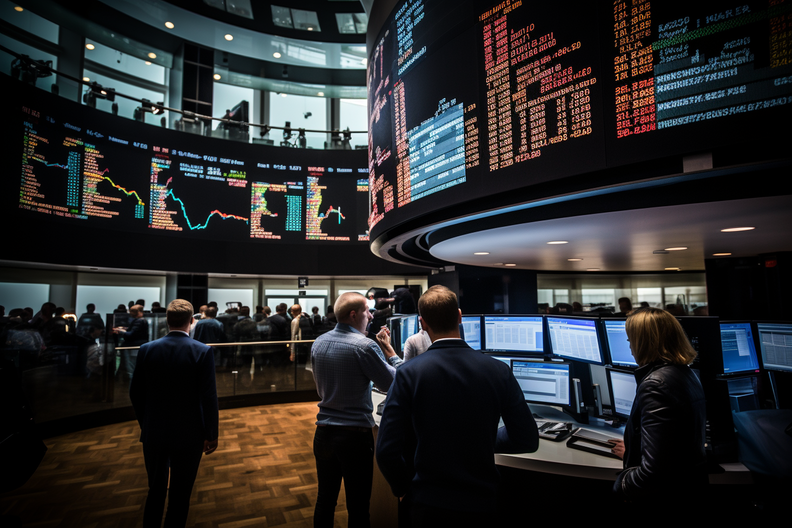














U.S. stocks continue to decline, financial conditions are tightening sharply, and the market is showing similar danger signals to those at the end of 2018: as market pressure continues to build, the Federal Reserve still faces expectations of further interest rate hikes. Investors are beginning to worry whether monetary policy will once again exacerbate market turmoil.
According to Goldman Sachs trading executive Rich Privorotsky, there are astonishing similarities between the current market and the end of 2018. He characterized the recent selling activity as a "comprehensive liquidation" rather than a normal rotation of sectors, and warned that the market may be shifting from a reduced risk appetite to a deeper contraction in liquidity.
At that time, the Federal Reserve raised interest rates continuously in 2018, and the S&P 500 index fell by 19.8% from its high in September to its low on December 24, approaching a technical bear market. As market pressure continued to intensify, the Federal Reserve finally signaled a pause in interest rate hikes in January 2019, marking a shift in policy stance.
These days, Privorotsky pays particular attention to the trend of gold. Stocks and gold have both been sold off simultaneously, and traditional safe-haven assets have failed to provide protection. In his view, gold may be the best indicator to assess the depth of the current liquidity crisis, and its trend could reveal whether market pressures are further deteriorating.
Lessons from the end of 2018: Continuous interest rate hikes ultimately forced the Federal Reserve to change its course
In 2018, the Federal Reserve raised interest rates four times throughout the year. On September 20th, the S&P 500 index reached a阶段性 high. Thereafter, as global economic growth slowed down, trade tensions intensified, and monetary policy continued to tighten, market pressures continued to accumulate.
In December, the Federal Reserve raised interest rates again, raising the target range for the federal funds rate to 2.25%–2.50%. However, concerns about the economic outlook and monetary policy continued to rise, and the S&P 500 index fell by nearly 20% from its September high to its low on December 24th.
The forced selling in the market ultimately prompted the Federal Reserve to adjust its policy stance. On January 30, 2019, the Federal Reserve stated that it would be patient when adjusting interest rates in the future, sending a clear signal to pause any further rate hikes, and subsequently the market saw a rebound.
Privorotsky believes that the current market is also facing dual pressures of tightening financial conditions and declining growth prospects, and the contradictions between policy and market are deepening.
Financial conditions suddenly tightened, and the market shifted from a rotational selling pattern to a widespread sell-off.
Privorotsky pointed out that the most obvious change in the current market is the spread of selling pressure from certain sectors to the entire market. On Thursday, the S&P 500 index rose by more than 1% at one point during trading, but ultimately closed down 2%, experiencing six consecutive days of decline and falling below the 200-day moving average once again. All 11 sectors on the index closed lower that day, with traditional defensive sectors such as utilities and consumer staples also not being spared.
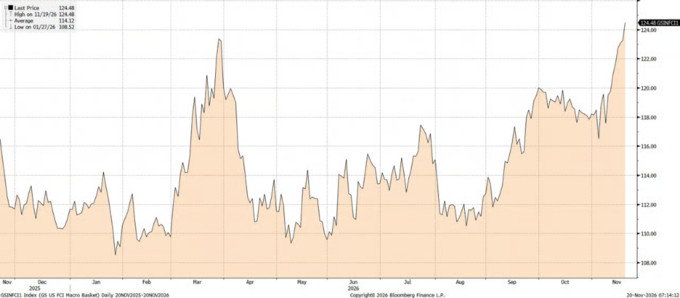
Meanwhile, Goldman Sachs' US Financial Conditions Index ( FCI ) macro basket rose to 124.48 on Thursday, reaching its highest level in over a year. Since early November, the index has increased by about 8 points in just over two weeks, indicating that financial conditions are tightening rapidly.
Current Federal Reserve officials have successively sent hawkish signals. The statement by Governor Waller regarding a 50-basis-point interest rate hike, as well as the officials' support for continued rate hikes mentioned in the meeting minutes, have further exacerbated market concerns. Rising capital costs have also put pressure on the expected returns on AI infrastructure investments.
Privorotsky believes that the technical aspect of the market has been severely damaged, and the negative Gamma effect in the options market is still exacerbating the downward trend. The previous sector rotation is evolving into a broader wave of stock liquidation.
Gold becomes the best indicator for observing liquidity crises
Among all assets, Privorotsky pays particular attention to gold. He believes that gold is the most valuable synchronizing indicator for observing the current market liquidity situation.
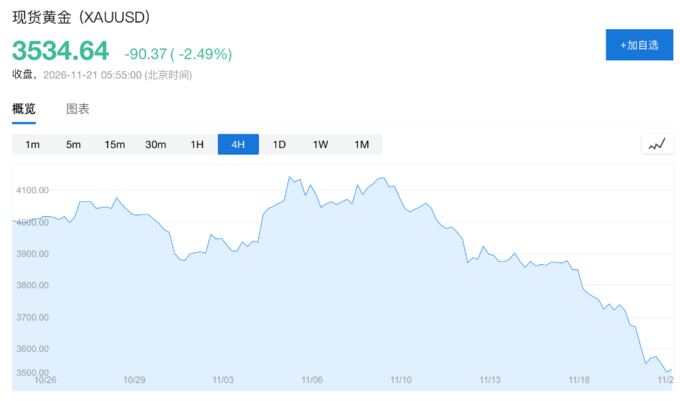
Normally, gold is considered a safe-haven asset, but this time it declined in tandem with stocks. The price of gold fell below $3,600, and the price of copper also saw a significant drop of about 5% in a single day.
This cross-asset synchronized decline signals something different from a regular market adjustment: investors are no longer just shifting from stocks to safe-haven assets such as gold; instead, they are selling various types of assets to obtain cash. What the market may be facing is a broader contraction in liquidity.
ANZ indicates that there is still approximately 200 tons of potential reduction space for speculative long positions in gold, meaning that the pressure to deleverage may not have been fully released yet.
At the same time, long-term government bond yields have declined, and the inflation break-even rate has narrowed, while stocks and gold have seen simultaneous selling pressure. Privorotsky believes that this combination indicates that market attention is shifting from inflation to issues of growth and liquidity, and that the bond market may have already begun to price in policy mistakes.
Therefore, whether gold can stop falling and stabilize will be an important indicator to determine whether the pressure on market liquidity has eased.
When will the market see a policy shift?
Privorotsky believes that the current pessimistic sentiment and the scale of unilateral deleveraging suggest that the market may be approaching a tactical low. Since fund positions are already significantly underweight, once a catalyst for a rebound appears, the market's rebound could be quite sharp.
But the real turning point still depends on whether policy expectations change. He continues to be optimistic about buying short-term government bonds, believing that there is a clear misalignment between this transaction and the risk signals reflected in the stock market.
In the near term, the market will be focusing on PCE data, the non-farm payroll report, and the FOMC meeting in December. Privorotsky believes that it is the CPI data from November that could truly force the Federal Reserve to re-evaluate its policy path, but there is still some time before that data becomes available.
It is worth noting that Goldman Sachs economists currently still expect the Federal Reserve to raise interest rates by 25 basis points in December and again in March 2027, while there is a clear discrepancy between bond market pricing and this forecast.