
Goldman Sachs says an abnormal pattern in the job market could impact workers' salaries
Businessinsider
2h ago
Ai Focus
Goldman Sachs stated that the pattern of "low hiring and low layoffs" in the U.S. job market has led to an abnormally low employee turnover rate, which may drag down wage growth. The firm estimates that the low turnover rate has reduced the annual wage growth rate by about 0.3 percentage points, and the expansion of AI applications may further suppress personnel turnover and salary levels in certain industries.
Helpful
No.Help

Goldman Sachs indicates that an abnormal trend in the job market may be affecting workers' salaries.

Goldman Sachs' analysis points out that the labor market pattern of 'low hiring and low layoffs' may lead to one consequence: employers are not conducting large-scale layoffs, but at the same time, they are also reducing new hires.

The economist Pierfrancesco Mei wrote in a report on Monday that this pattern has led to an "abnormally low" level of employee turnover, which is the rate at which workers change jobs in the market. Mei stated that in the end, this trend is not conducive to wage growth, as workers who switch jobs are more likely to accept lower salaries, while those who stay in their current positions are more likely to accept smaller salary increases due to a lack of security.

As an indication of turnover, the rate of job reconfiguration is currently hovering near its lowest level in 40 years. Recently, the average over 12 months for the proportion of new jobs created in the private sector compared to jobs that disappear from the employment market has dropped below 4%.
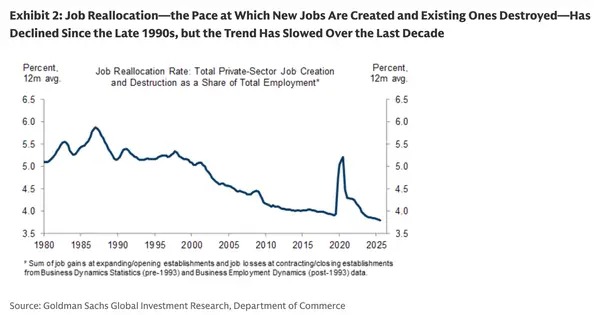
Goldman Sachs estimates that the low turnover rate has dragged down annual wage growth by about 0.3 percentage points. According to data from the U.S. Bureau of Labor Statistics, wage growth has been declining for most of the past five years, with the year-over-year growth rate dropping to 3.1% in October.

Mei indicates that, driven by the aging workforce and improvements in the matching of workers with employers, employee turnover has been declining for decades. This means that, compared to the past, there are fewer layoffs by employers and also fewer workers who resign voluntarily.

Goldman Sachs pointed out that there are two reasons for the recent acceleration in the decline in liquidity:

  • The wave of job-hopping during the pandemic has subsided.
  • The adoption of AI is also contributing to a reduction in turnover rates. Mei indicates that in industries with a higher adoption rate of AI and greater potential for automation, turnover rates have fallen below pre-pandemic levels.

It is generally believed by the outside world that AI may have a negative impact on workers, as theoretically companies can use this technology to reduce labor costs, thereby lowering the demand for workers in fields with a higher exposure to AI. An analysis by Apollo Global Management shows that the adoption of AI has eroded the salaries of the lowest-income groups: since 2023, the wages of workers in the lowest quartile of income have decreased by 10%.

Goldman Sachs also pointed out that if better labor-capital matching is hindered, productivity growth could also slow down. The bank stated that the ultimate impact could be a slowdown in "human capital accumulation," which means a decline in the long-term ability to create wealth.

In the current challenging job market, employees are now more inclined to keep their current jobs, a trend known as "holding on to jobs" ( job hugging ). According to data from the U.S. Bureau of Labor Statistics, the overall turnover rate has been around 2% in recent years, which is lower than the 3% in 2021.

Tip
$0
Like
0
Save
0
Views 43
HQYC reminds readers to view blockchain rationally, stay aware of risks, and beware of virtual token issuance and speculation. All content on this site represents market information or related viewpoints only and does not constitute any form of investment advice. If you find sensitive content, please click“Report”,and we will handle it promptly。
Submit
Comment 0
Hot
Latest
No comments yet. Be the first!
Related
Zcash fell back to around $700 after rising to $900
On November 24th, Zcash opened down 7.6% for the day, trading at around $718. This decline came after Bitcoin fell below $60,000, following a surge above $900 earlier in the week. The article also mentioned that technical indicators were weakening, and a heat map of liquidations indicated a potential closing area around $700. Additionally, Grayscale's US Zcash ETF recorded a capital inflow of $4.6 million on Monday.
crypto.news
·2026-11-25 02:14:59
4
Gold Price Outlook: Will U.S. Inflation Data Trigger a New Wave of Selling?
Gold prices fell by about 0.7% on Tuesday to $3,607, with the market focusing on the U.S. October PCE inflation report on Wednesday. If the data is stronger than expected, gold prices could test $3,500 again; if inflation slows down, they might rebound to around $3,700.
Coinpaper
·2026-11-25 02:06:10
10
Saylor Sees New Uses for Bitcoin
Strategy Executive Chairman Michael Saylor stated that Bitcoin can be used to meet some of the financial resource requirements of US derivatives exchanges and clearing institutions. CFTC Guidelines issued by staff state that Bitcoin, Ethereum, and payment stablecoins can be used to meet these requirements, but different discounts apply; at the same time, exchanges still need to maintain sufficient cash or highly liquid securities to cover at least six months of operating costs.
U.Today
·2026-11-25 01:54:14
10
Bitcoin mining power declines year-on-year for the first time since China banned mining
Glassnode reports that Bitcoin's computing power has decreased by 8% compared to a year ago, marking the first annual decline since China banned mining in 2021. Luxor states that miners' incomes have fallen in US dollars, while mining companies such as MARA and Riot are raising funds by selling coins to repay debts and building data centers.
crypto.news
·2026-11-25 01:34:12
10
Tech experts say NVIDIA's stock price is out of touch with reality, comparable to Dutch tulips and boring apes NFT
Eric Gordon, a professor of entrepreneurship at the Ross School of Business at the University of Michigan, stated that the correlation between NVIDIA's market value and economic reality is as weak as that between tulip bulbs in 17th-century Holland and the Bored Ape NFT craze during the pandemic. He also said that the significant fluctuations in NVIDIA's stock price after Jensen Huang's return indicate that the company's valuation "has little to do with its business" and is rather "related to its leaders."
Businessinsider
·2026-11-25 01:32:22
12
View More