












Key Points
- Gold prices fell back to around $3,600 before the release of U.S. inflation data.
- In September, PCE inflation rose year-on-year to 3.6%, higher than the Federal Reserve's target.
- Hotter inflation data could see gold prices test $3,500 again
On Tuesday (November 24th), as investors shifted their attention to the U.S. inflation report on Wednesday, gold prices fell by about 0.7% to $3,607. Prior to that, gold prices had rebounded on Monday, providing a brief respite from the nearly 9% weekly sell-off that occurred earlier.
U.S. inflation data may strengthen the Fed's expectations for interest rate hikes
The Bureau of Economic Analysis ( BEA ) will release the October Personal Consumption Expenditures ( PCE ) inflation report on November 25th at 8:30 a.m. Eastern Time in the United States.
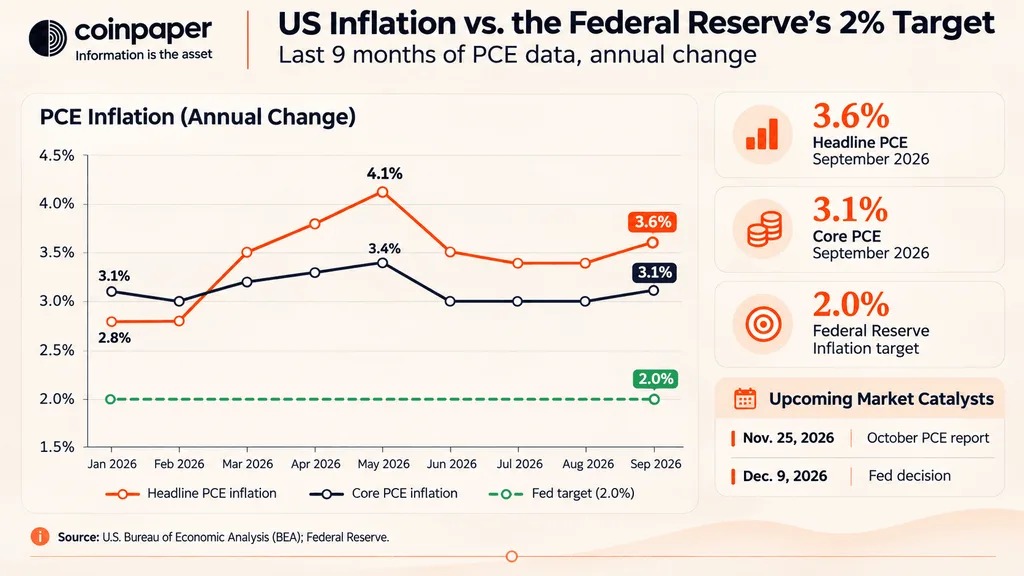
According to the data previously released by BEA, in September, the overall PCE inflation rose by 3.6% year-on-year, and the core PCE inflation (excluding food and energy) rose by 3.1% year-on-year. On a monthly basis, both the overall and core prices increased by 0.5% and 0.3% respectively.
Both of these annual indicators are significantly higher than the Federal Reserve's inflation target of 2%.
If the October readings are stronger than expected, it could reinforce market expectations for further monetary tightening, especially ahead of the Federal Reserve's policy meeting on December 8-9.
Higher interest rate expectations are already putting pressure on precious metals, as investors are re-evaluating the attractiveness of yield-free assets.
The strengthening of the US dollar and the rise in US Treasury yields continue to suppress gold prices.
Gold prices are also facing additional pressure from the strengthening US dollar, which makes gold bars denominated in dollars more expensive for international buyers.
Meanwhile, official data from the U.S. Treasury Department shows that the yield on benchmark 10-year U.S. Treasury bonds was 4.92% on November 23.
High actual yields will increase the opportunity cost of holding gold rather than interest-bearing securities. This can also explain why, during periods of accelerating inflation, gold prices sometimes fall, despite gold being traditionally viewed as an inflation hedge.
The World Gold Council pointed out in its market commentary on November 23 that ongoing monetary policy uncertainty, potential inflation surprises, and incomplete adjustments to speculative positions are significant risks in the near term.
However, the institution believes that the overall short-term risk for gold is roughly balanced, which means that another significant decline is not inevitable.
Gold Price Outlook: Will XAU / USD fall below $3,500?
The current psychological support level for gold is $3,600. If it continues to fall below this level, it could drop to the $3,550 range; this range was previously broken through during last week's sharp decline in gold prices.
If Wednesday's inflation report exceeds expectations and U.S. Treasury yields continue to rise, gold prices could test 3,500 dollars again. That would mean a further decline of about 3% from the current price.
On the contrary, if inflation data is weak, it could weaken the dollar and reduce market expectations for aggressive monetary tightening, thereby pushing gold prices back up to around $3,700.
To achieve a more sustained rebound, the gold price needs to return to the $3,800 range; this range was once an important level before it fell to a 14-month low.
Adrian Cole
Adrian Cole has been engaged in financial market reporting for over 6 years, with a focus on cryptocurrencies, stocks, and macroeconomic trends. He tracks Bitcoin, major altcoins, the U.S. stock market, interest rates, commodities, and various types of data that drive the market. Over the years, he has written hundreds of market updates and analysis articles, with an emphasis on price trends, investor sentiment, and the connections between traditional finance and digital assets.