Deutsche Bank stated in its latest global outlook for 2027 that the S&P 500 index is expected to rise to 9,000 points by the end of 2027. However, the bank predicts that the Federal Reserve will implement three more interest rate hikes, with the federal funds rate possibly rising to 4.625%.
These two seemingly different predictions point to the same core variable: AI capital expenditure. Deutsche Bank believes that AI investment will continue to drive U.S. growth, corporate profits, and stock market performance; however, at the same time, such investments may also exacerbate inflationary pressures, raise financing costs, and amplify the vulnerability of the credit market.
The equity strategy team of this bank is optimistic about tech stocks and the US and Asian markets; however, the credit strategy team recommends positioning in put options on the S&P 500 index to hedge against the market risks associated with the slowdown in AI capital expenditure.
AI Capital expenditure supports growth, but the productivity dividend may emerge later.
The chief economists David Folkerts - Landau and strategist Jim Reid stated in their 2027 outlook titled "High Expectations, but High Risks" that the recent decline in the stock market is more akin to a volatility event and does not indicate that the fundamentals have been undermined.
"Our stock strategists believe that the recent trend is a volatility event that may further develop before hitting bottom, but it will not undermine the fundamentals. They expect that driven by strong earnings, the S&P 500 index will reach 9,000 points by the end of 2027."
In terms of macro forecasting, strategists expect that the global economic growth rate will rise from 3.3% in 2026 to 3.5% in 2027, while the U.S. economic growth rate is expected to slow slightly from 2.4% to 2.3%.
Strategists estimate that AI-related capital expenditures have contributed about 0.9 percentage points to the annualized economic growth of the United States in recent times, but this contribution needs to be adjusted for the impact of import leakage, which is estimated to be between one-third and one-half. The bank predicts that the actual rate of equipment investment in the United States will slow from around 16% at the end of 2026 to around 10% in 2027, although it will still remain at a relatively high level.
In terms of capital expenditure, Deutsche Bank expects that the capital expenditure of hyperscale cloud service providers, including Oracle, new cloud computing companies, and Chinese-related enterprises, will increase from approximately $1 trillion in 2026 to about $1.35 trillion in 2027, and reach around $1.6 trillion in 2029, after which it will remain at this level.
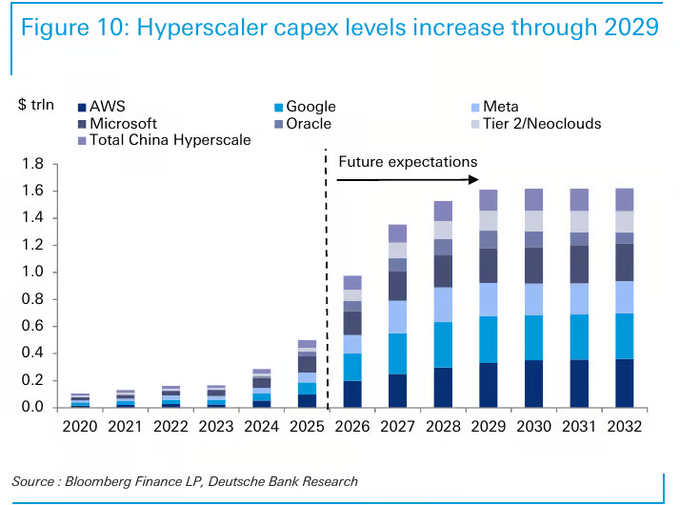
Strategists expect that AI could ultimately bring a productivity increase of 0.5 to 0.75 percentage points per year, but this effect will be “more pronounced in 2028 than in 2027.” The report also notes that the capital expenditure cycles driven by technological revolutions are often not smooth sailing.
The report states: "History still warns us that technological revolutions driven by capital expenditure rarely reach their anticipated endpoints smoothly. Overinvestment, recession, as well as unexpected winners and losers, are all part of this process."
Inflationary pressures remain, and the Federal Reserve may raise interest rates by another 75 basis points
Deutsche Bank expects that the overall CPI average growth rate in the United States will decline from 3.4% in 2026 to 2.7% in 2027. However, the reduction in core PCE inflation is expected to be slower: it is projected to remain above 3% at the end of 2026 and not fall to 2.5% until the fourth quarter of 2027.
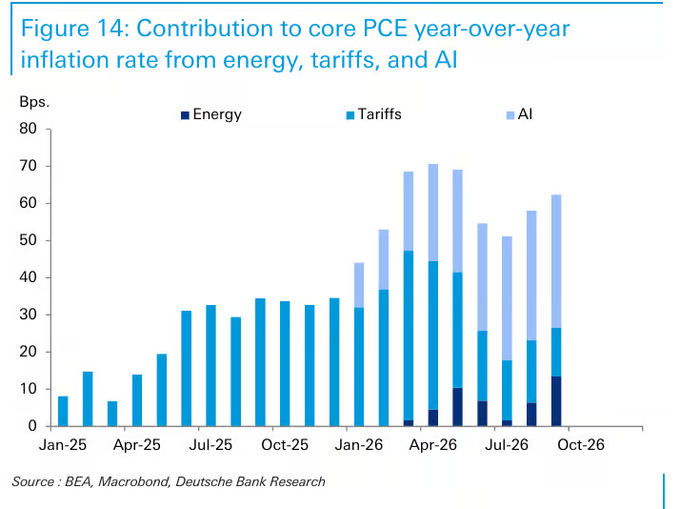
This line suggests that demand-driven inflation has begun to pick up, housing inflation remains sticky, and AI investments are also creating price pressures in certain sectors. The report mentions that energy, tariffs, and AI together contribute about 60 basis points to core PCE inflation, with AI accounting for more than half of that contribution, although these figures are estimates based on chart readings.
Based on judgments such as inflation exceeding targets, resilient economic growth, and a stabilizing labor market, Deutsche Bank expects the Federal Reserve to raise interest rates by 25 basis points in December 2026, January 2027, and March 2027, respectively.
Against the backdrop of inflation exceeding targets, resilient growth, and a stabilizing labor market, our economists expect the Federal Reserve to further tighten policy by 75 basis points, raising the federal funds rate from the current 3.875% to 4.625%.
Deutsche Bank estimates the nominally neutral interest rate to be in the range of 3.75% to 4%, which is more than 100 basis points higher than the level seen after the global financial crisis. The bank also predicts that by the end of 2027, the yield on 10-year U.S. Treasury bonds will reach 5.05%.
The stock team is targeting 9,000 points.
The optimistic judgment of this stock strategy team is mainly based on profit expectations. The team expects that the earnings per share of the S&P 500 index constituents will reach $430 in 2027, a year-on-year increase of 19%.
The report indicates that the earnings growth of the S&P 500 index was approximately 11%, 25%, 34%, and 34% in the first three quarters of 2026, respectively, with earnings levels already about 20% above the long-term trend channel. The equity strategy team believes that current market positions are still relatively low and have not fully reflected the strong earnings performance.
"At present, the stock positions in the overall market are at a moderately low level, which implies an expected profit growth of 1%. This is significantly lower than the current actual growth rate of over 30%, as well as the median company's growth rate of about 15%."
The stock strategy team believes that the stock price is still about 20% lower than the reasonable level corresponding to the year-end earnings. Following a lag of about 20 percentage points in the performance of tech stocks during recent industry rotations, the team has tactically over-weighted tech stocks, the U.S. market, and the Asian market.
However, the credit strategy team for that particular product adopted a different approach to risk management. The team stated, "It is necessary to use short-term hedging tools to guard against a slowdown in AI capital expenditures. Both the S&P 500 Index and the Euro Stoxx 600 Index are currently overvalued. Put options on stocks should serve as an effective hedging tool. In the credit market, we will underweight chip manufacturers, new cloud computing companies, and data centers."
The credit strategy team believes that high financing costs are putting pressure on non-cyclical companies with higher leverage ratios, and may also affect new cloud computing companies and data centers with lower ratings in the US AI industry chain. "In simple terms, the credit market needs interest rate relief."
AI brings upward potential, but also constitutes a source of risk.
This point is repeatedly emphasized in the report: the forces that drive the market upward can also become a source of risk.
The S&P 500 index has risen to 9,000 points, which is in perfect alignment with our strategists' profit and cash flow frameworks. However, this judgment is highly exposed to risks related to profits and AI. If our high expectations are met, 2027 could ultimately be a very good year. But in what might be another year of high volatility, don't expect this feeling every day.
From the configuration recommendations of different teams within Deutsche Bank, the sustainability of AI's capital expenditure will be a key variable in whether its 2027 forecast can be realized: if investments continue to support profitability and growth, the stock market may gain momentum; if financing costs and credit pressures curb capital expenditure, then the stock market, credit spreads, and the US dollar could all face repricing.
Dollar forecasts, bond market trends, and oil price predictions are all related to the AI cycle.
In the interest rate market, Deutsche Bank has shifted to a neutral duration stance and expects the yield curve to become even steeper. The bank believes that the yield curve for Japanese long-term government bonds is relatively low compared to that of the US dollar and euro, while French government bonds already incorporate a significant risk premium.
Deutsche Bank expects France's economic growth rate to be 0.5% in 2027, with the fiscal deficit accounting for 5.2% of GDP. The bank believes that France may become one of the important market issues in Europe in 2027, but its baseline assumption remains a decline in the risk premium after the elections, rather than a systemic crisis.
In terms of foreign exchange, the bank's foreign exchange team has revised its previous assessment of a weak dollar, now predicting that the dollar will remain relatively strong over a longer period. The bank expects the euro to fall to 1.08 against the dollar in the first half of 2027, before rebounding to 1.15; meanwhile, the dollar against the yen may enter the 140 range.
However, the same line indicates that the dependence of the dollar on the capital expenditure cycle of AI is increasing. The report states: "The most important risk is, firstly, the growing dependence of the dollar on the boom in capital expenditure of AI. If expectations for capital expenditure are to see a more significant decline, it will lower real interest rates in the United States and weaken inflows of funds into stocks, thereby weakening the two key pillars that support the dollar."
In terms of the energy market, the bank expects the price of Brent crude oil to average around $90 per barrel in the first quarter of 2027, to drop to $80 in the second quarter, and to fall to around $70 in the second half of the year. The bank also predicts that the price of WTI crude oil will be around $67 per barrel in 2027.
It also points out that oil price forecasts rely heavily on geopolitical developments, including the situation in the Strait of Hormuz, as well as whether Iran will shift the focus of conflict to energy infrastructure.