


Wall Street resumes trading on Black Friday, and NVIDIA's stock price rebounds.
NVIDIA's rebound is part of a broader recovery in U.S. tech stocks. As investors returned to the market after the Thanksgiving holiday, NASDAQ 100 index futures rose by more than 2%, and S&P 500 index futures and Dow Jones index futures also moved higher in tandem. Semiconductor companies such as AMD and Broadcom also joined the upward trend.
On Black Friday, the trading hours for U.S. stocks will be shortened, with exchanges planning to close at 1 p.m. Eastern Time instead of the usual 4 p.m. This holiday shopping season also brings consumer spending into the spotlight, but reports indicate that retail sales are not the direct catalyst behind NVIDIA's current upward movement in stock prices.
Jensen Huang's return and market concerns related to AI remain the focus
NVIDIA's recent fluctuations are closely related to co-founder Jensen Huang's reappointment as CEO on November 23. This news triggered a historic rise, with the stock price soaring by over 31% in a single trading day, but then some of that gain was lost in the following two trading days.
U.S. President Donald Trump stated that he had communicated with NVIDIA's board of directors and helped facilitate Jensen Huang's return. Trump also mentioned that he plans to have a conversation with Jensen Huang, while raising the possibility that the U.S. government holds shares in NVIDIA. However, no government investment agreement has been announced yet.
Investors will also be watching the upcoming congressional review, which involves Jensen Huang personally. Reports indicate that his return has alleviated a direct concern among the leadership, but it has not resolved the regulatory and governance issues surrounding the company.
NVIDIA Price Analysis: Can NVDA Continue Its Recovery?
The first resistance level is approximately between $155 and $157. If the stock price can remain above this range, the $160 to $165 range may become the next focus; this area appears particularly important after the previous sharp pullback.
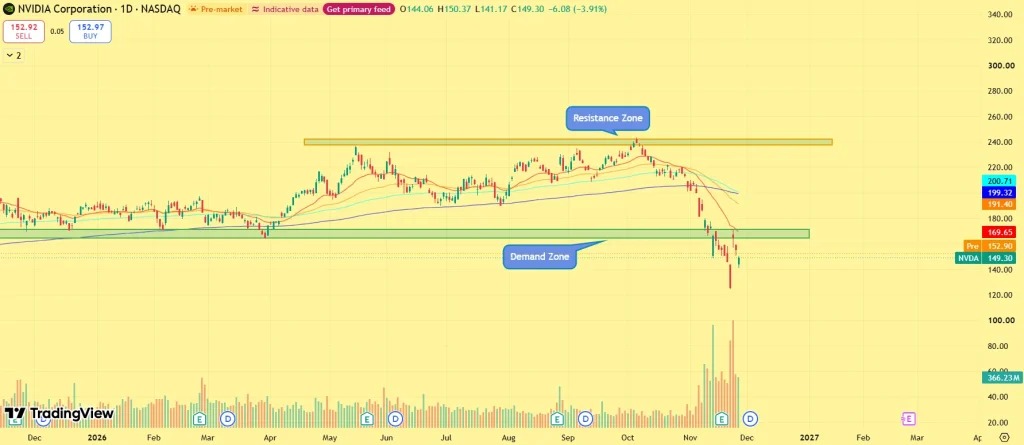
On the downside, $149 remains a direct reference point, while the $141 area represents the recent intraday low.
During the trading period of Black Friday, it may initially show whether investors are willing to re-establish their positions in NVIDIA. However, trading is usually lighter on holidays, which could also reduce the relevance of price fluctuations as a reference.
The report suggests that for sustained recovery, NVIDIA needs to gain stronger buying support beyond its initial pre-market response. For now, the nearly 4% increase in NVDA before trading indicates a renewed interest in AI transactions, but the company's export restrictions, leadership review, and broader investment concerns regarding AI remain unresolved.