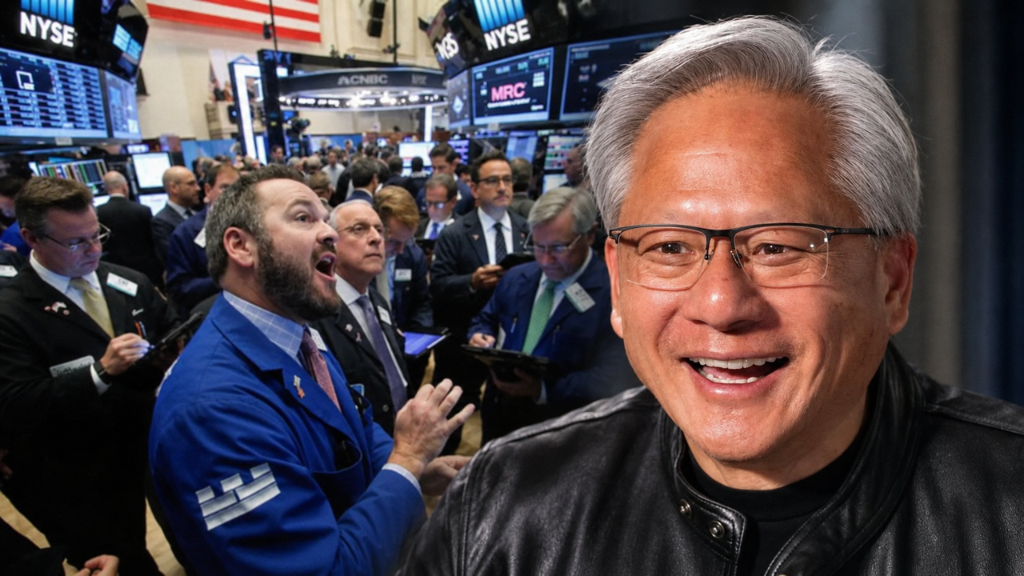
Jensen Huang took over NVIDIA again, sparking a rebound in U.S. stocks at the beginning of the week, but AI trading then encountered severe volatility once again. Anthropic fell below its issue price for the first time after listing, and NVIDIA lost nearly 10% in just two days. The Trump administration's bets on AI policies, doubts about the returns caused by tech giants' massive capital expenditures, as well as regulatory and macroeconomic policy risks, all contributed to a Thanksgiving trading week that still saw significant gains despite the turmoil.
Jensen Huang's return sparked a rebound on Monday; AI saw a warming trend on Friday after two days of selling.
On Monday, November 23rd, NVIDIA's board of directors announced that Jensen Huang would re-assume his position as the company's CEO, becoming a key catalyst in reversing the previous sell-off in U.S. tech stocks. Previously, Trump had publicly advocated for Jensen Huang's return, and the White House was also involved in related communications. Trump stated on Monday that Jensen Huang's reinstatement at NVIDIA is important for both the company and the U.S. economy.
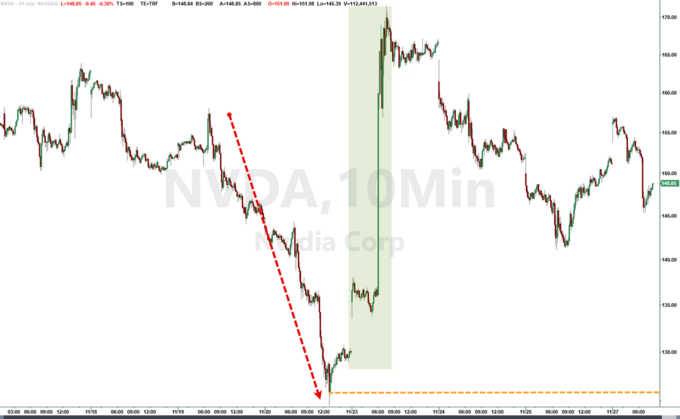
After the announcement, NVIDIA's stock price soared by 31.5% on Monday, with its market value increasing by nearly $1 trillion in a single day. The Nasdaq index closed up 6.51%, the S&P 500 index rose 4.73%, and the Dow Jones index increased by 3.01%. The entire industry chain saw a general rebound, with companies such as AMD, Micron, Sandisk, as well as CoreWeave, Nebius, IREN and other data center and computing power service companies all experiencing significant gains.
But this rebound quickly faced challenges. On Tuesday and Wednesday, NVIDIA fell for two consecutive trading days, with a cumulative decline of about 9.5%. Chip stocks such as AMD and Micron also came under pressure again. Anthropic fell below its issue price of $83 on November 24th, Tuesday, which was the fourth trading day after its listing, becoming another landmark event in this round of cooling in AI trading.
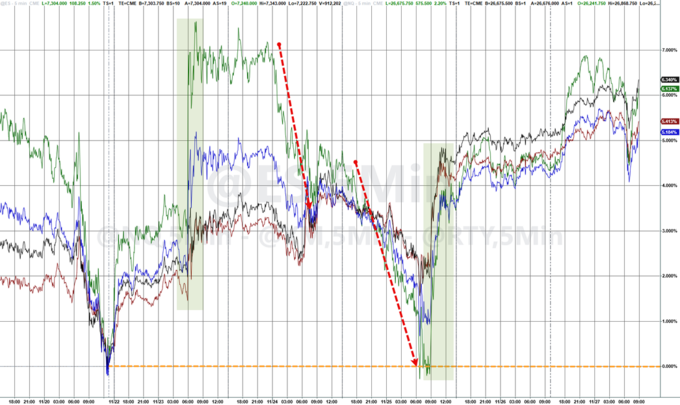
On Wednesday, there was a new wave of selling in U.S. stocks during trading, with the Nasdaq and the S&P 500 indices experiencing significant declines. However, buying at the end of the session helped the market recover most of its losses. After the Thanksgiving holiday on Thursday, the market turned upward again on Friday, with tech stocks, particularly those in the chip and AI infrastructure sectors, leading the gains.
All three major indices closed higher on Friday, setting new one-week highs. Among them, the Dow Jones Industrial Average recorded a four-day consecutive rise, marking the longest streak of gains since October 6th; the S&P 500 Index and the Nasdaq Composite Index, which had been declining for two consecutive days, both rebounded.
The S&P 500 index closed up 1.6% on Friday, with a weekly gain of 5.6%; the Dow Jones Industrial Average rose 1.18%, for a weekly increase of 5.46%; the Nasdaq Composite Index gained 2.31%, marking its largest weekly gain since April 2025, since October 2022, and since April 17 of this year, respectively.
The rebound in the AI industry chain has also spread again. Sandisk rose by about 16% on Friday, Micron rose by about 7%, and AMD as well as optical communication stocks such as Lumentum and Coherent performed strongly. Data center companies such as CoreWeave, Nebius, and IREN have once again attracted attention from investors.
NVIDIA only saw a slight increase of about 0.8% on Friday, but due to the large gain on Monday, the stock still rose by nearly 19.9% for the week as a whole. Anthropic saw a significant increase of about 11% on Friday, closing near $91.90, once again exceeding its initial public offering price of $83 IPO, ending the first week of trading without breaking below its issue price. The media believes that the rebound in Anthropic's stock price on Friday was not only due to the overall improvement in AI's stock performance but also reflects a recovery in the market's risk appetite towards this record-breaking IPO company.
It is worth noting that although the three major indices recorded significant gains this week, they have not yet fully recovered from last week's losses. Last week, the S&P 500 index fell by 8.61%, marking the largest single-week decline since April 4, 2025; the Dow Jones Industrial Average and the Nasdaq Composite Index fell by 8.02% and 10.02%, respectively, both recording their largest single-week declines since March 2020.
Therefore, a more accurate characterization for this week would be a recovery following a significant oversold condition, rather than the U.S. stock market having re-established a continuous upward trend.
Overfall rebound and position reversal drive a rally, but the AI industry chain is still in the adjustment phase.
Looking at the performance throughout the week, the breadth and magnitude of this rebound are quite prominent, but there are still significant differences in performance among different stocks.
The Philadelphia Semiconductor Index (SOX) rose by approximately 9.3% for the week, outperforming the three major stock indices significantly. Chip stocks, which had previously suffered heavy losses, once again became a focus for capital recovery. Companies that benefited from AI infrastructure construction, such as SanDisk, Micron, and AMD, performed particularly well. Optical communication companies Coherent and Lumentum, as well as CoreWeave, Nebius, and IREN and other AI computing infrastructure companies, also rebounded with the improvement in risk appetite.
However, the sharp fluctuations in NVIDIA and Anthropic indicate that investors have not completely dispelled their concerns about trading AI despite this week's rebound.
NVIDIA soared 31.5% on Monday, but then fell by about 9.5% over the following two trading days, with only a slight rebound on Friday; Anthropic fell below its issue price on its fourth trading day after listing and didn't regain that level until Friday. One of these two companies represents the core of the AI computing power industry chain, while the other serves as a high-valuation benchmark for the commercialization of AI models. The stock price trends of both reflect that the market is re-evaluating the investment returns and valuations in the AI industry.
In fact, an important driving force behind this week's rebound may not be a fundamental improvement in the fundamentals of the AI industry, but rather a reversal in investors' positions and market sentiment after extreme selling in the previous week.
Harris Financial Group Managing Partner Jamie Cox commented: 'The market is already severely oversold, a rebound is almost inevitable.'
Andrew Slimmon, a senior portfolio manager at Morgan Stanley Investment Management, explained from the perspective of capital positions why the rebound could continue: "A large amount of speculative capital had previously deleveraged out of tech stocks, so this rebound may extend into next week, as these funds will be forced to re-enter the market."
Slimmon also pointed out that the rebound in tech stocks began on Monday and continued until Friday after a reversal during midday trading on Wednesday. Funds that had quickly withdrawn from tech stocks may need to reinvest to restore their positions.
This also explains why the AI stock was able to rebound rapidly this week despite lingering concerns about its fundamentals: previous concentrated reductions in positions led to a low market position, and NVIDIA's unexpected reversal on Monday provided investors with a reason to re-enter the market. The oversold rebound, short covering, and passive restoration of positions all contributed to amplifying the rebound amplitude.
At the same time, U.S. economic data has shown resilience, providing some support for risk assets. The third-quarter economic growth data released this week exceeded expectations, indicating that U.S. economic activity still has some momentum. However, inflationary pressures have not eased accordingly; inflation accelerated in October, and the market has almost fully priced in the Federal Reserve's expected interest rate hike in December.
This means that, on one hand, economic resilience supports corporate profit expectations, while on the other hand, it may also keep interest rates high for a longer period, putting pressure on AI companies that have higher valuations and greater financing needs.
Governance disputes, trade frictions, and regulatory reviews: AI's prosperity faces multiple challenges
If Jensen Huang's return can be considered the most direct catalyst for the rebound in U.S. stocks this week, then the Trump administration's policy bets on the AI industry, along with the subsequent political and regulatory uncertainties, constitute the deeper underlying factors behind this round of market activity.
Previously, Trump pushed for Jensen Huang to take back control of NVIDIA, reflecting the importance the U.S. government places on maintaining its competitive advantage in the domestic AI industry. NVIDIA is not only a representative enterprise in the U.S. technology industry but also a key pillar for the construction of U.S. AI infrastructure and global computing power competition.
From this perspective, Jensen Huang's return is not only an adjustment to the corporate management team but also has significant policy and industrial implications. Initially, the market interpreted it as a restoration of the ecological stability of the AI ecosystem, which in turn led to a collective rebound for NVIDIA and its upstream and downstream companies.
However, the support of the Trump administration for the AI industry does not mean that the policy risks faced by the industry have disappeared.
On one hand, the Trump administration hopes to accelerate the construction of AI infrastructure to maintain the United States' leading position in global artificial intelligence competition; on the other hand, trade policies, restrictions on chip supply chains, and issues related to energy and land use in data center construction may all affect the expansion pace of the AI industry.
Bloomberg reviewed this week's market on November 27th, focusing on Trump's AI strategy, pointing out that Trump's policy bets were intertwined with Wall Street's re-evaluation of AI trades, making this Thanksgiving trading week one of the most volatile in recent years.
Of particular note is the change in the domestic political environment in the United States. After the Democratic Party made progress in the mid-term elections, markets began to worry that the AI industry may face stricter regulatory scrutiny. The power consumption of data centers, the impact of infrastructure construction on communities, and the market dominance of tech giants in the AI sector could all become focal points of future policy debates.
For AI infrastructure companies, these risks are not abstract political issues. Data center construction requires substantial capital investment and involves power supply, land approval, financing, and long-term customer contracts. Once regulations become stricter or project approval processes slow down, even if the demand for AI continues to grow, companies may face a prolonged investment recovery period.
There is another side to Jensen Huang's return as well. Although Trump's push for his reinstatement alleviated market concerns regarding changes in NVIDIA's leadership, corporate governance issues have not disappeared as a result.
In an interview released on Friday, Joachim Klement, the strategy director of Panmure Liberum, delivered rather sharp criticism of Jensen Huang's return, stating: "This is a nightmare of corporate governance."
Klement indicates that after communicating with several large ESG investors, he found that these investors are considering selling their NVIDIA stocks due to concerns regarding corporate governance. He believes that this could put additional selling pressure on NVIDIA's stock price in the coming weeks.
This indicates that although Trump's support was able to change the market's assessment of NVIDIA's short-term operational stability, it could not completely dispel investors' concerns regarding corporate governance, regulatory scrutiny, and political intervention.
In addition, the Trump administration's new tariff measures this week have also prompted the market to re-evaluate trade frictions and inflation risks. U.S. stock investors need to deal with the uncertainties of AI industrial policy, trade policy, and monetary policy at the same time, making high-valued tech stocks more prone to sharp fluctuations.
Global market risk appetite has warmed up, but the investment returns of AI remain the core focus.
This Friday, there were also positive signals worth noting in the global markets.
On the Chinese side, an executive meeting of the State Council held on Friday deployed further measures to stabilize the capital market, emphasizing the need to enhance the inherent stability of the capital market and improve mechanisms for market stabilization. It also proposed to leverage the role of institutions such as China Financial Investment Corporation. Following reports by Xinhua News Agency, the Chinese stock market saw a significant rise on Friday, with major indices in Shanghai and Shenzhen strengthening collectively, with sectors such as semiconductors, AI, and technology performing particularly well.
Mainstream media regard the signal sent by the Chinese government to stabilize the market as an important factor in driving a rebound in Asian markets, noting that the CSI 300 index recorded its largest one-day increase in two years on Friday. Technology stocks also saw a rebound in Asian markets such as South Korea.
Reports say that after South Korean regulators considered expanding the scale of the stock market stabilization fund, the South Korean stock index closed up more than 4% on Friday.
However, for this week's U.S. stock market, the improvement in global market sentiment is more of a supporting factor; what truly determines the market trend is still the issue of investment returns in the U.S. AI industry chain.
Reuters pointed out in its market review on Friday that investors have been wavering this week between buying on dips and concerns regarding the balance between AI spending, financing scale, and investment returns. Despite a rebound in tech stocks on Friday, the S&P 500 index and the Nasdaq are still likely to record their worst November performance since 2008.
For Wall Street, what needs to be observed next is not whether these AI companies will announce new capital expenditure plans, but whether these investments can be transformed into sustained revenue growth and cash flow.
NVIDIA's chip demand, the order growth from AMD, and the financing capabilities and profit prospects of storage chip companies, as well as computing power service providers such as CoreWeave, Nebius, and IREN, will all become important criteria for the market to assess the prosperity of the AI industry chain.
The performance of Anthropic in its first week of listing also provides another perspective: despite having a leading model, rapidly growing corporate clients, and a record-breaking IPO scale, AI still has to face high computing power costs, substantial infrastructure commitments, as well as the market's rigorous scrutiny of its valuation.
Therefore, the strong performance of U.S. stocks this week, which is the best in over a year, does not mean that the risks associated with trading AI have been eliminated. Jensen Huang's return has temporarily alleviated the uncertainty around NVIDIA's leadership, and the oversold rebound has driven funds back into tech stocks. Additionally, the Trump administration's policy bets on the AI industry have provided some policy support for the sector.
However, whether high capital expenditures can be converted into profits, whether financing costs will continue to rise, and whether the AI industry will face stricter regulation in the future, will still determine whether this rebound is the starting point of a new round of increases or just a temporary recovery during a period of severe adjustment.