


The S&P 500 index ( SPX ) fell into a technical adjustment zone on November 20th, which is the first time this has occurred since April 2025. As stock prices tumbled significantly from their historical highs set in October, markets began to worry about a slowdown in AI investment spending, overly high valuations of large tech stocks, and the direction of the Federal Reserve's interest rate policy.
On November 20th, the S&P 500 index fell by 3.7%, closing at 6,910.39 points, marking the seventh consecutive trading day of decline. Compared to the record high of 7,818.93 points set on October 6th, the index has seen a cumulative decline of 11.6%, officially meeting the technical adjustment criterion of a 10% pullback from recent highs.
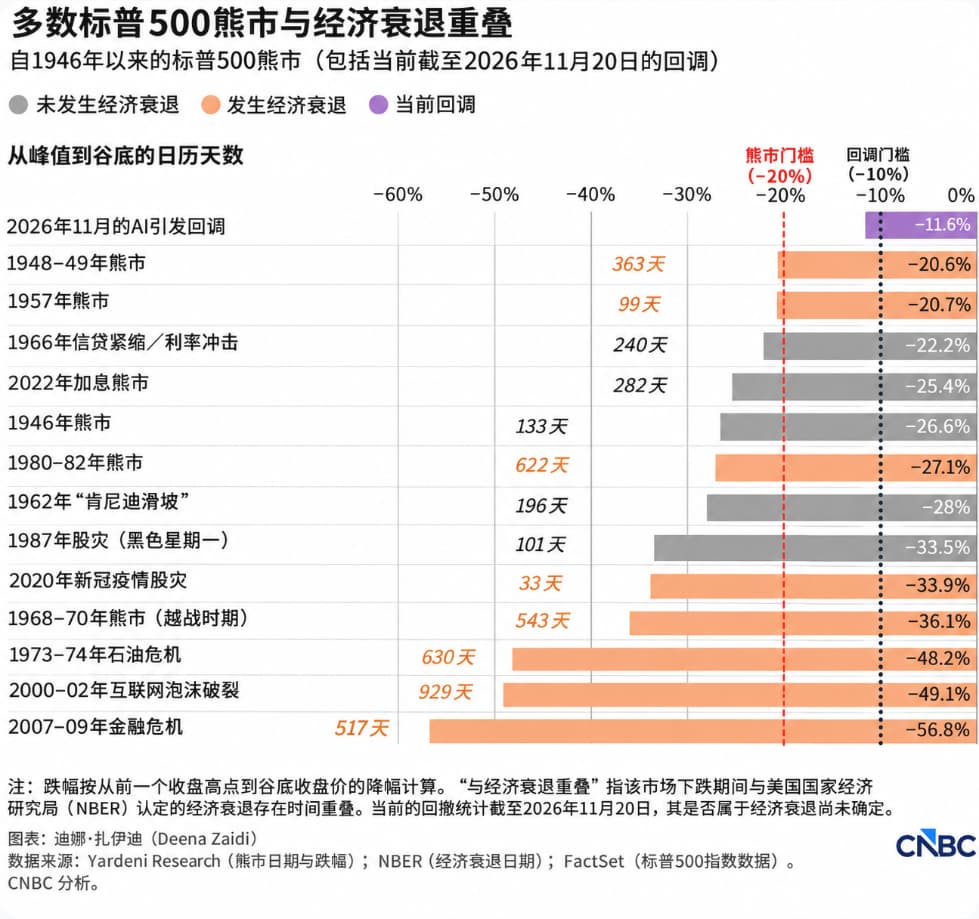
If technical adjustments continue to expand, they could evolve into a bear market, which means the index would fall by 20% or more from its recent highs. However, historical experience shows that neither technical adjustments nor bear markets necessarily imply that the economy will enter a recession.
Historical data shows that bear markets do not always accompany economic recessions.
According to the analysis of the historical performance of the S&P 500 index by CNBC, 8 out of 13 bear markets overlapped with periods of economic recession identified by the National Bureau of Economic Research ( NBER ) in the United States, while the remaining 5 bear markets did not coincide with any recessions.
NBER defines an economic recession as: a significant decline in economic activity that affects the entire economy and persists for several months or more.
The oil crisis from 1973 to 1974, the bursting of the internet bubble in 2000, the financial crisis from 2007 to 2009, and the economic downturn triggered by the pandemic in 2020 all occurred alongside economic recessions. However, severe bear markets also appeared in 1987 and 2022, yet the U.S. economy was not in a recession at that time.
Deutsche Bank: The current market adjustment lacks the typical triggers of historical bear markets
Henry Allen, a macro strategist at Deutsche Bank ( Henry Allen ), pointed out that since the "Kennedy Slump" in 1962, every bear market in the S&P 500 index has been accompanied by at least one of three scenarios: an economic recession, worsening economic data that sparked concerns about a recession, or aggressive interest rate hikes by the Federal Reserve. So far, none of these three factors have been clearly present in the current market adjustment.
Allen stated in his report on Tuesday that although the market sell-off last week was quite intense, there are clear differences between this adjustment and several recent major risk-aversion episodes. He believes that the prospects for economic growth have not suddenly been re-evaluated recently, which is different from during the impact of the COVID-19 pandemic. Back then, the pandemic pushed the global economy into recession, and the S&P 500 index plummeted by 33.9% in just 33 days. The current situation also differs from the impact of the tariffs implemented on "Liberation Day" in 2025, when the market similarly re-evaluated its outlook for economic growth.
Economic data has not shown any significant deterioration so far. The preliminary value of the US Composite Purchasing Managers Index ( PMI ) for November was 54.6, which is above the 50 threshold that indicates expansion in business activity.
Allen also pointed out that a clear shift towards a hawkish policy by central banks is another common factor in bear markets throughout history. For example, both the bear markets of 1966 and 2022 were accompanied by tightening monetary policies. However, the current decline in the stock market has not been accompanied by a re-pricing of monetary policy towards a hawkish stance by the market. Although there is a general expectation in the market that the Federal Reserve may raise interest rates again at its last meeting of the year on December 9th, since the start of the stock market decline, the interest rate market has instead shifted slightly towards a dovish stance.
Specifically, compared to October 6th when the S&P 500 index reached a record closing high, current market pricing reflects that there will be fewer interest rate hikes by the Federal Reserve by September 2027.
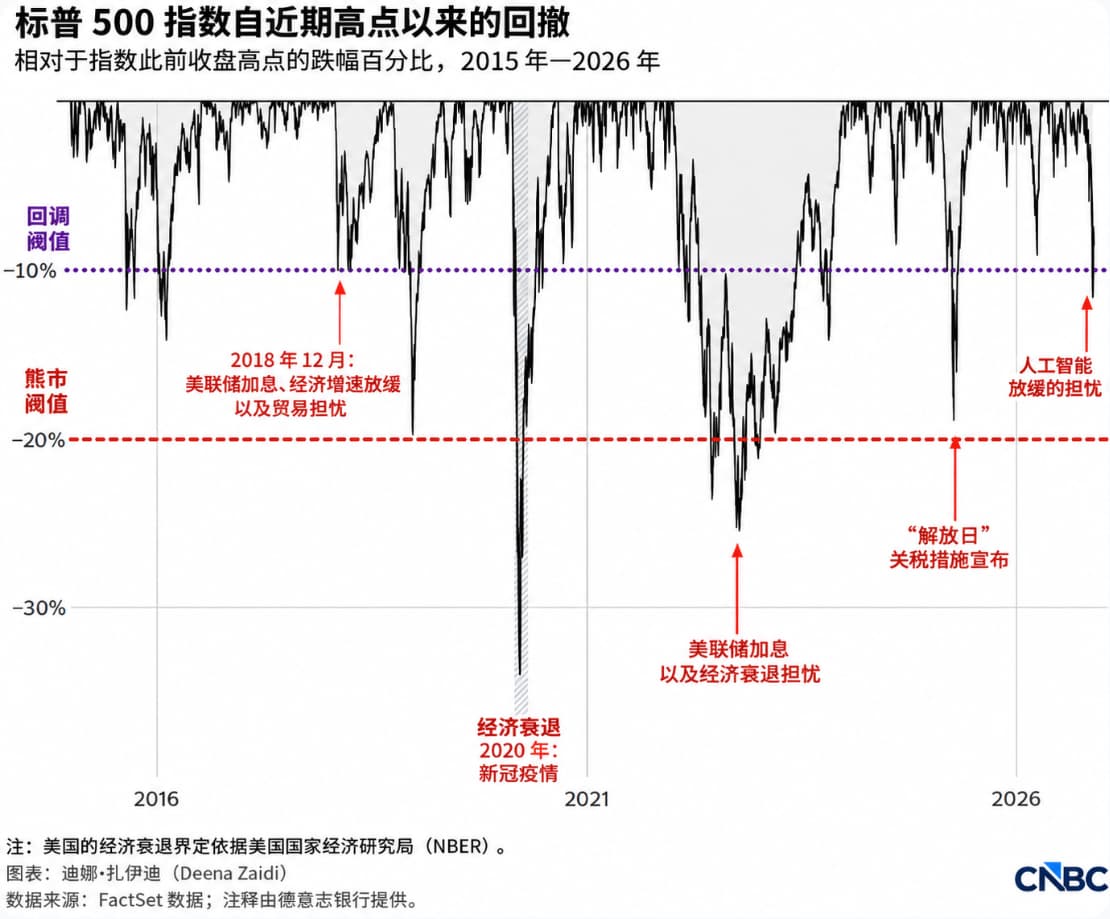
Allen stated that over the past 60-plus years, every bear market since 1962 has been accompanied by at least one of the aforementioned three factors. Therefore, if the current market enters a bear market without these conditions, it would be quite unusual.