

The reserve hedging strategy followed by Ethena regarding USDe is undergoing new adjustments. With the rapid expansion of the stock perpetual contract market this year, Ethena believes that the basis trading opportunities provided by this market may gradually surpass those of traditional crypto perpetual contracts, and this could influence the subsequent reserve allocation of USDe.
Stocks' sustainable positions are rapidly expanding.
The data cited by Ethena indicates that stock perpetual contracts were first launched on Hyperliquid in December 2025, with an open position size of approximately 90 million US dollars at that time. By January 2026, Binance also introduced Tesla-related contracts, with an initial position size of about 11 million US dollars.
This market then saw a rapid increase in volume. By August 11, the total open interest of stock perpetual contracts on multiple platforms had risen to $6.2 billion, an increase of about 10 times compared to March. Ethena also mentioned that contracts related to memory and AI hardware accounted for about half of the total positions on the two major platforms, indicating that funds were mainly concentrated in the technology sector.
Funding fees are higher than those of Bitcoin.
Ethena believes that the attractiveness of stock perpetual contracts mainly comes from higher funding rates. The basic approach is similar to crypto basis trading, which involves holding spot assets while shorting perpetual contracts to earn the funding fees paid by leveraged long positions.
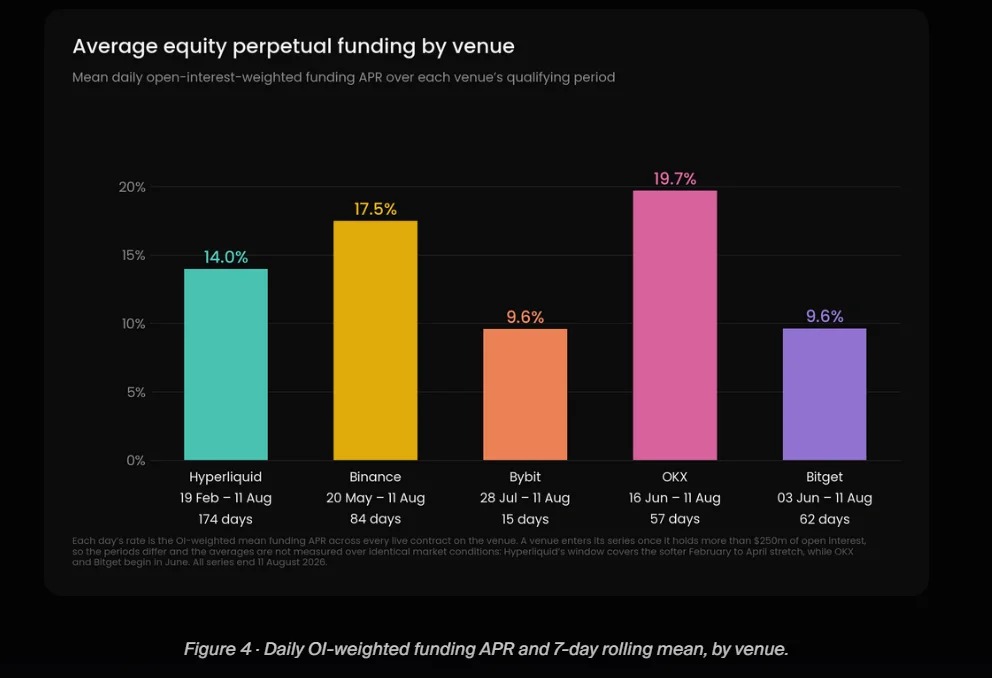
According to the data provided by Ethena, the annualized funding rate for Bitcoin in 2024 averaged 11%, which dropped to 4.9% in 2025, and as of August 11, 2026, the annualized funding rate for that year was only 2.2%. In contrast, during the period from May 20 to August 11, the annualized funding rate for Hyperliquid stock perpetual contracts, weighted by holding positions, averaged 14%, while for Binance it was 17.5%; during the same period, Bitcoin's annualized funding rate was 4.1%.
Ethena It is also noted that the correlation between the funding rates of stock sustainability and crypto sustainability is not strong. The daily correlation during the same period was 0.08 at Hyperliquid and 0.14 at Binance, indicating that these two sources of income are largely independent.
Ethena Looking forward to a larger market space
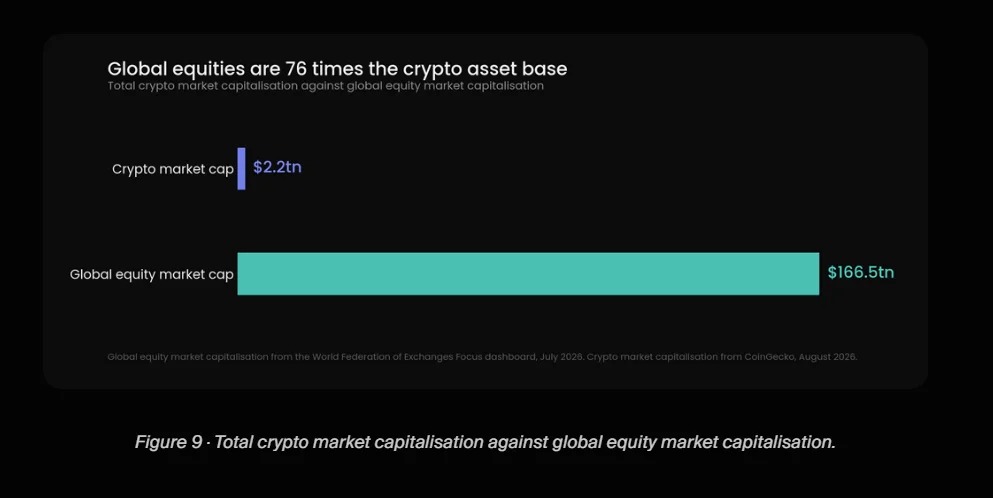
In terms of scale, the current stock sustainability market is still significantly smaller than the crypto sustainability market. The data in the article shows that the open interest of crypto sustainability contracts is approximately $94 billion, while that of stock sustainability is $6.2 billion. However, Ethena points out that in July 2026, the global stock market value was about $166.5 trillion, which is much higher than the crypto market's value of about $2.2 trillion.
Based on this gap, Ethena estimates that if the penetration rate of perpetual contracts in the stock market reaches 2.5%, the potential outstanding volume could reach approximately $4 trillion, which is nearly 40 times the historical peak of crypto perpetuals.
For USDe, this means that reserves will no longer primarily rely on crypto sustainability in the future. Ethena indicates that the company has processed over $30 billion in minting and redemption transactions without any losses that would affect the protocol, and has been operating hedging positions worth several billion dollars while adopting an off-exchange custody model.
It is anticipated that the perpetual configuration associated with Ethena may eventually surpass the crypto configuration. Deployment to the first partner exchanges is expected to begin in the coming weeks.