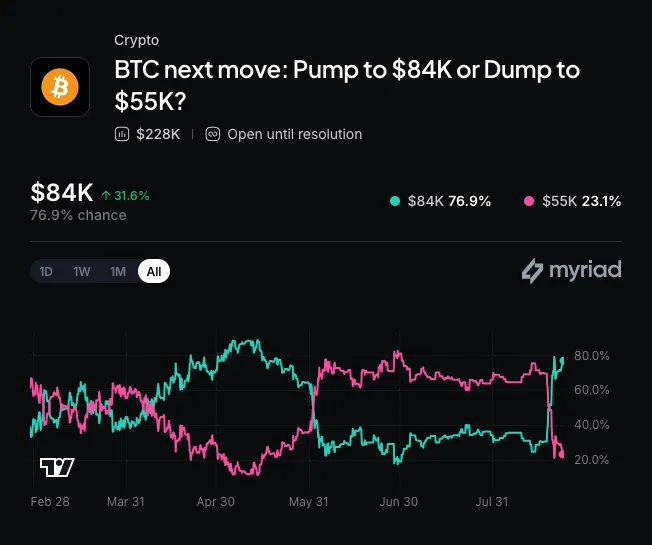


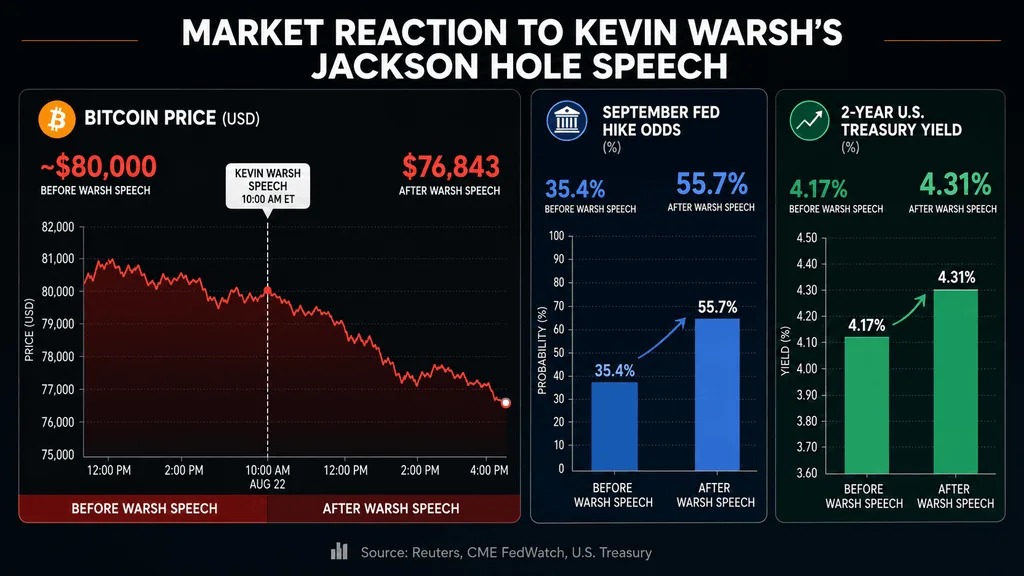
The speech by Federal Reserve Chairman Kevin Warsh at Jackson Hole reinforced market expectations for further interest rate hikes, causing the dollar and short-term U.S. Treasury yields to rise. In contrast, Bitcoin fell back below $77,000, giving up some of the gains it had made towards $80,000 earlier.
September interest rate hike expectations are heating up
Reuters data shows that after Warsh's speech, the odds of the Federal Reserve raising interest rates by 25 basis points in September rose to 55.7%, up from 35.4% before the speech. He did not explicitly commit to a rate hike, but stated that if inflation does not significantly return to the 2% target, the Federal Reserve still has 'work to do'.
In the United States, in July PCE, inflation was at 3.7%. This level indicates that policymakers still find it difficult to declare that inflationary pressures have been brought under control. As a result, markets have readjusted their assessments of subsequent policy paths, putting pressure on risk assets.
Short-term yield rates and the strengthening US dollar
After the speech, the yield on 2-year U.S. Treasury bonds rose to around 4.31%, and the dollar strengthened accordingly. For assets like Bitcoin that do not generate interest and have high volatility, higher risk-free yields typically diminish their attractiveness.
This contrasts with the situation earlier in August. At that time, U.S. Treasury bond repurchase measures alleviated long-term yield pressures, and coupled with increased institutional buying, Bitcoin once rose to around $79,500. As previously mentioned, during that rebound period, spot Bitcoin had a net inflow of about $1.9 billion in a single week. ETF
ETF is still flowing in.
Funds have not been completely withdrawn. Data shows that US spot Bitcoin ETF saw a daily net inflow of $242.3 million on August 27, marking the ninth consecutive trading day with a net inflow, with a total inflow of approximately $3.04 billion.
However, the buying side of ETF is currently facing a more challenging macroeconomic environment. The market has previously regarded $77,000 as a key level for short-term trading. If this price level cannot be regained for a long time, the recent upward trend may further weaken; if it can once again exceed this level, it would indicate that the demand for ETF still has the capacity to offset the pressure brought about by the more hawkish policy expectations.