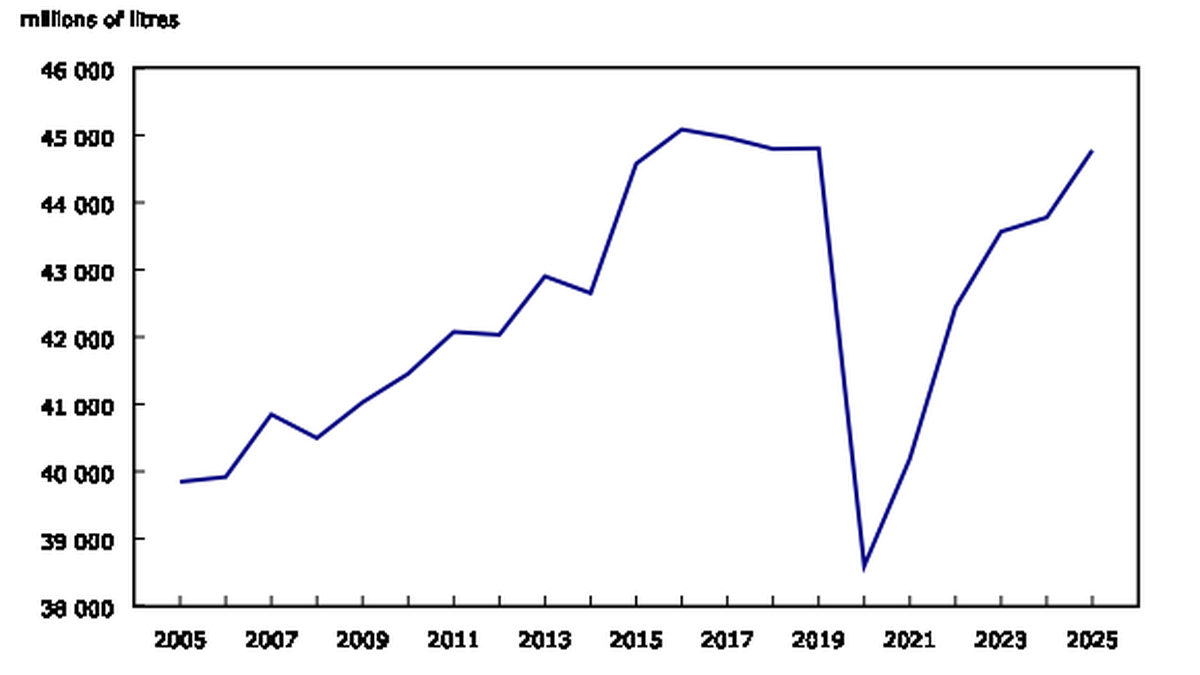


The annual fuel sales data released by Statistics Canada on October 2nd does not align with the intuition that "gasoline demand will inevitably decline immediately after the widespread adoption of electric vehicles." In 2025, Canada's total gasoline sales reached 44.8 billion liters, a year-on-year increase of 2.3%, the highest since 2019; net gasoline sales for road use amounted to 42.7 billion liters, an increase of 1.9%, but were still 1.5% lower than in 2019. One indicator has reached a new high, while another has not yet fully returned to pre-pandemic levels. The difference is not due to statistical errors, but rather to different methodologies of measurement. To accurately assess transportation energy demand, it is first necessary to clarify which types of fuel consumption are included in the calculations.
The "total sales volume" reported by the statistical bureau includes gasoline for various road grades, as well as fuel used for non-road purposes such as agriculture, forestry, construction, and mining. "Net sales volume," on the other hand, is closer to the actual sales of road fuel after taxes have been paid according to the road usage tax rates, with corresponding tax refunds deducted. Treating 44.8 billion liters as the total fuel consumption of all private cars would overestimate the fuel needs of households for driving. While the overall volume does indicate that the fuel market is still large, it cannot alone answer whether cars are now able to travel longer distances or not, nor can it determine the success or failure of electric vehicle policies.
With more cars and cheaper fuel, why is the demand still on the rise?
The Statistics Bureau indicates that by 2025, the number of gasoline-powered road motor vehicles registered in Canada will reach 24.2 million, an increase of 1.8% year-on-year, which is about 419,600 more than the previous year. The expansion of the fleet means that even if the average fuel consumption per vehicle remains unchanged, the overall fuel usage may still increase. At the same time, gasoline prices are 8.6% lower than in 2024, and the decrease in prices may encourage residents and businesses to drive more, transport more, or refuel more frequently. However, the Statistics Bureau only notes that these two factors occur simultaneously, and it cannot be asserted that the price drop "caused" the entire increase in sales based on annual comparative data alone.
Provincial changes are also worth noting. The total gasoline sales in Ontario increased by about 363.8 million liters, a growth of 2.2%; in Alberta, it increased by about 212.4 million liters, a growth of 3.3%. British Columbia and Quebec saw increases of 2.7% and 1.3%, respectively. The upward trends in all regions do not necessarily indicate the same reasons: factors such as population, vehicle composition, industrial fuel usage, travel distances, and prices may vary from place to place. The Statistics Canada also mentioned that Canadian residents will make 342 million domestic trips in 2025, which is 1.5% more than in 2024 and 2.5% more than in 2019. This provides context for transportation activities, but not all trips can be directly converted into gasoline consumption.
At the time this set of data was released, zero-emission vehicle promotion policies were also being adjusted in most regions of Canada. British Columbia suspended subsidies for passenger vehicles in May 2025, while Quebec planned to end its program by the end of 2026. Although a significant proportion of newly registered vehicles in both provinces are zero-emission, the total sales volume of gasoline continued to grow. A reasonable explanation is that it takes several years for the proportion of electric vehicles among newly added vehicles to significantly change the fuel demand of all vehicles in use; however, the current data does not directly calculate this rate of substitution, and therefore it cannot be considered an officially confirmed causal conclusion.
When looking at energy transition, we cannot focus solely on gasoline as the sole option.
Diesel net sales increased by 4.2% to 17.9 billion liters in 2025, while liquefied petroleum gas (LPG) net sales grew by 1.5% to 524.9 million liters. Diesel is often associated with freight transportation, construction, and agricultural activities; therefore, its growth indicates that the reliance on fuel for these activities remains. However, without a more detailed breakdown by industry, it is not appropriate to attribute the entire increase to the recovery of a single sector. Oil product sales are measured in liters, not in terms of expenditure; when prices fall, an increase in sales may be accompanied by different trends in fuel bills. By separating volume from price, we can better understand the actual pressures faced by consumers and businesses.
The Bureau of Statistics also explained that the data from this survey is used for calculations such as inter-provincial fiscal balance payments, with historical series dating back to 1987. Its advantages lie in its continuous measurement scope and wide coverage, but the downside is that the data is released on an annual basis, which is relatively slow. Therefore, the data for 2025 that we see today cannot directly reflect the current weekly fuel consumption behavior as of October 2026. To determine whether demand will turn around this year, it is necessary to consider monthly prices, vehicle registrations, traffic volumes, and sales figures for subsequent years, rather than treating six years of high levels as a real-time trend.
The changes in the fuel market cannot be simply described as a "counterattack by traditional energy sources." An increase in the number of vehicles on the road, declining prices, and structural changes in economic activities are sufficient to support overall fuel consumption even as electric vehicles grow. On the other hand, the net road gasoline consumption is still slightly lower than in 2019, which reminds us that we cannot assume that every household's dependence on fuel has increased since before the pandemic just because total sales have reached new highs. What these data truly reveal is a time lag in transformation: the new vehicle market can change first, but the fleet of vehicles in use and energy demand are moving at a slower pace. To assess the effectiveness of emission reductions, we need to take into account vehicle mileage, fuel efficiency, power generation structure, and emission statistics in the same analysis.
There is another often overlooked factor: both the population and the number of vehicles in Canada are changing. Even if the total gasoline sales return to higher levels, the fuel consumption per person or per vehicle may not increase accordingly; similarly, a decrease in fuel consumption per vehicle could be offset by increased driving mileage. This time, the statistics bureau did not provide a direct breakdown of per capita and per vehicle figures. Therefore, the most cautious approach to reporting is to focus on the verified figures for sales volume and registered vehicles, leaving the question of "why there is an increase" for further analysis. This is more in line with the data itself than drawing conclusions about energy transition based on a total amount.
Source: Statistics Canada, "Motor Vehicle Fuel Sales for 2025," October 2, 2026. https :// www150.statcan.gc.ca / n1 / daily-quotidien /261002/ dq261002a-eng.htm