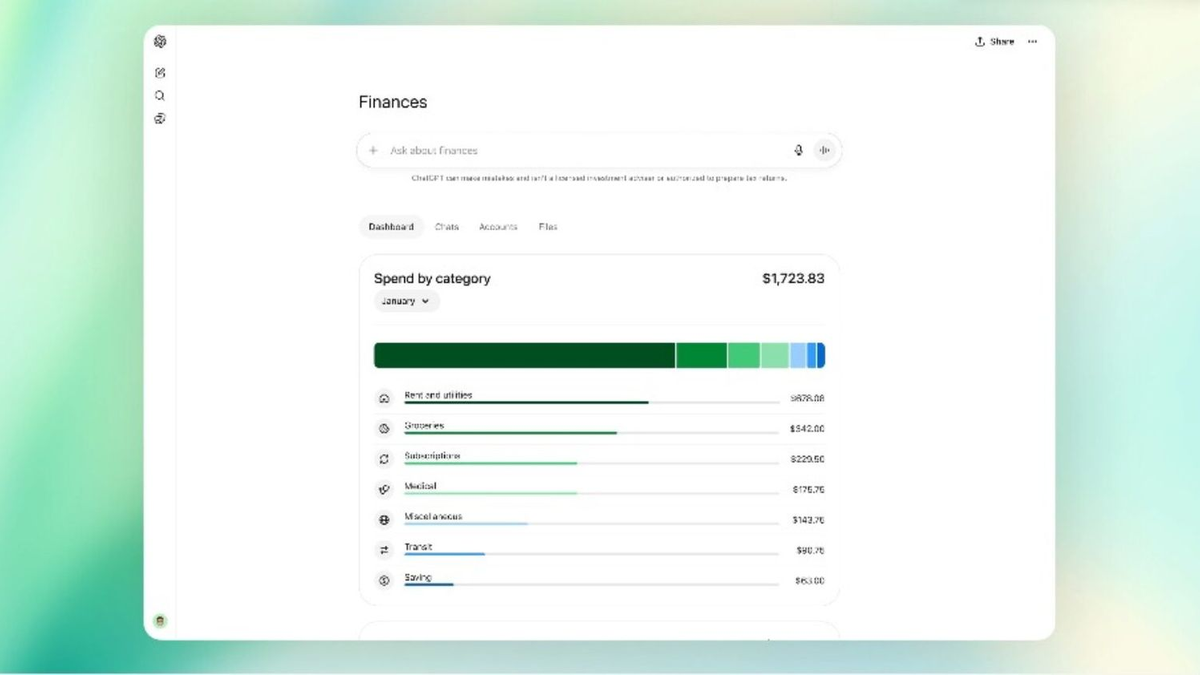


On October 2nd, OpenAI updated its product description: The Finances feature from ChatGPT has begun to be gradually rolled out to users in the United States of Free and Go, covering web pages, iOS and Android. Users can link their financial accounts, allowing answers to refer to real spending, savings, and investment information. This is not a simultaneous launch for everyone around the world, nor does it mean that ChatGPT has become a trusted financial advisor. What has changed is the access point: the personal financial Q&A service, which previously required payment to try out, is now becoming available to a wider range of everyday users.
At first glance, personal finance seems to be nothing more than additional data collected by chat products. However, unlike regular web searches, account integration puts bank transactions, credit card purchases, and investment holdings all within the same conversational context. When users ask questions like “where did my money go?” or “can I save more?”, the answers must be meaningful if they are to be helpful. Failing to specify the time period, the range of accounts involved, or the method of categorization can lead to misleading summaries. For example, treating a single travel expense as a fixed monthly fee, or overlooking a single credit card transaction, can distort what appears to be an accurate overview. This new approach deserves attention, but the key is not how similar the responses are to those given by financial advisors, but whether it enables ordinary people to identify, correct, and avoid these mistakes.
It has expanded the scope to solve the entry problem, but it hasn't addressed the boundaries of data for users.
The wording used for the release of OpenAI is “rolling out”, which indicates a gradual rollout. The region is clearly limited to the United States, and the channels are specifically web pages and two major mobile operating systems. The target audience consists of Free and Go users. It is not true that anyone can now access this feature in any region, nor that all free users have already seen the same interface, as stated in the announcement. The financial experience of those with existing paid plans is in the same product direction as this expansion, but the new news on October 2nd involves changes to the entry requirements and coverage, rather than the announcement of a completely new banking infrastructure.
After connecting an account, the system may be able to see salary deposits, bills, transfers, and investment assets, but it may not necessarily know the purpose behind each transaction. Restaurant expenses could be for business reimbursement, rent may be shared by two people, and the cash balance in a securities account cannot be equated with money that can be spent at any time. A convincing product should not present inferences as facts; instead, it should clearly explain the source of the data, the timing of updates, and the scope of any omissions. For example, when answering a question about an increase in transportation expenses last month, users should be allowed to ask which specific transactions are included; if the account is not connected to all banks, the conclusion can only apply to the accounts that are actually connected.
There is another easily confused line of demarcation in personal financial products: explaining facts and presenting options is not the same as making decisions to buy or sell on behalf of others. Expense analysis can help users identify duplicate subscriptions, budget overruns, or services that are not used frequently; investment advice, however, involves risk tolerance, taxation, account restrictions, and market changes. The smoother the chat interface, the more likely users are to mistake a brief summary for a complete piece of advice. For platforms, perhaps the most important product consideration is to keep uncertainties, limitations of application, and areas that require independent verification in prominent positions, rather than having models provide definitive answers to every question.
Privacy issues cannot be simply glossed over with the phrase “secure connection.” The sensitivity of bank data is higher than that of general shopping preferences. Users need to know who is handling the connection, what information will be used to generate responses, whether the connection can be revoked, and how the analysis that has already been conducted after the connection is severed will be retained or deleted. Product descriptions provide some guidance on secure connections, but different institutions, account types, and user settings may affect the actual fields that can be accessed. News reports cannot infer from a single demonstration that all connections are secure, nor can they declare on behalf of officials that there are no data risks at all.
For financial assistants to prove their value, they must first learn to say "I don't know."
From the user's perspective, the greatest potential of this expansion is to lower the barrier to organizing bills. Most people don't lack a complex financial dashboard; rather, they need tools that can promptly answer questions like "why is there less money left this month?" A user-friendly interface can transform scattered transaction records into questions that can be further explored: which subscriptions are still deducting funds, whether food expenses have increased in price or just the frequency of purchases has gone up, and how much the savings goal differs from the current cash flow. Such convenience must be based on the ability to review the original records; otherwise, the smoother the answers, the more concealed the potential for misguidance.
For the industry, a more relevant metric to compare is not how many suggestions the model provides, but whether users miss out on any transactions as a result, whether errors can be quickly corrected, and whether they have a clearer understanding of their cash flow. Connection failures, incorrect merchant classification, and double-counting can all affect the results. The scale of free users may make these issues more common than during paid, limited-scale trials: novices may not be familiar with the authorization pages, and transfers between multiple accounts are more likely to be misidentified as income or expenses. Platforms need to make the process of "verifying a transaction" as easy as "asking a question."
This is also why expanding the scope cannot be directly equated with commercial success. OpenAI has not yet announced in this update the new user connection rate, retention rates, financial improvement effects, or error rates. People may try a one-time bill analysis, or they may be reluctant to link their main accounts due to privacy concerns; all of these will need to be answered by subsequent verifiable data. The launch time outside of the United States has also not been determined in this announcement, so it cannot be stated that regional restrictions will be lifted soon.
The integration of financial data into general chat products has once again brought to light an old issue: when assistants gain access to more personal information, do they help users see the reality more clearly, or do they create an illusion that they know everything? The changes on October 2nd only confirmed the gradual access for users with IDs Free and Go. Whether these tools can become reliable depends on their ability to present evidence and clear boundaries to users even when accounts are incomplete, classifications are controversial, and investment issues exceed their understanding.
Source: OpenAI " ChatGPT Release Notes " Updated on October 2, 2026, https :// help.openai.com / en / articles /6825453- chatgpt-release-notes