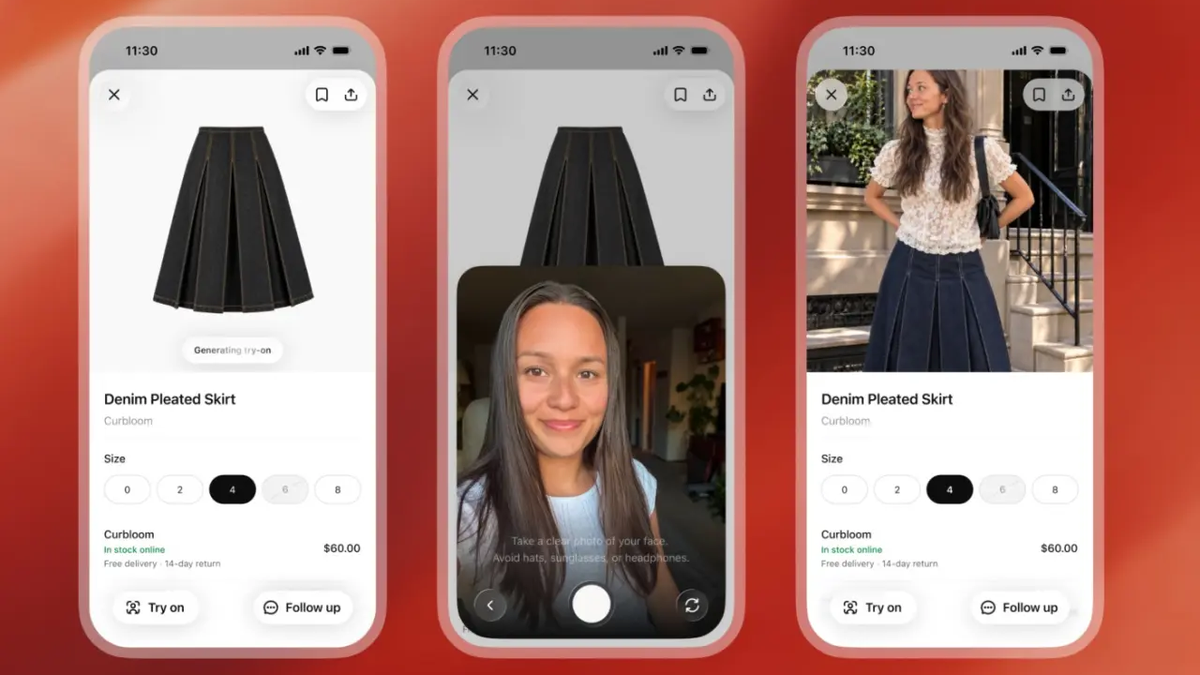


In the product update on October 1st, OpenAI added virtual try-on and product favorites features to the shopping experience for ChatGPT. Users can select " Try on " on the clothing or accessory product cards, take or upload a selfie, and the system will use ChatGPT Images to generate a preview of how the item would look worn. The reference photos can be saved for later use and can also be replaced or deleted in the personalized settings. Products can also be added to favorites or organized into folders. This feature is available on both mobile and web versions, but the announcement does not state that every merchant or every product supports it, nor does it claim that the generated preview can replace the need to check sizes or the actual product.
This change addresses a very specific hesitation in online shopping: after seeing a piece of clothing, consumers need to imagine whether it suits them. Product pages with images and descriptions are good at showcasing models, but they struggle to provide an idea of how the clothing will look on the consumer; search results allow for price comparisons, but they cannot guarantee the final appearance when worn. Generative imaging combines product photos with selfies, lowering the barrier to imagination, but it also introduces new uncertainties before making a purchase. The pictures may look great, but factors such as fabric drape and fit cannot be accurately assessed based on a single photo alone.
From "finding products" to "seeing oneself", the shopping entry point has moved forward one step.
The "Try On" button appears in the clothing and accessories product list. Users can click on it from the list or upload a photo of a garment in the chat to ask how it might look on them. This process differs from the previous method of first searching for a product, jumping to the merchant's page, and then imagining the effect: "BJW_KEEP_00002" integrates discovery, discussion, and visual preview into a continuous conversation. The "Favorites" function prevents multiple searches from being scattered throughout the chat history, allowing users to save potential products for later comparison.
A typical use case is when choosing a coat before traveling. Consumers may first define their budget, color, and occasion, and then hesitate between several options; virtual try-on provides visual references, while the favorites list allows them to save their choices. However, this does not mean that the platform has accurately obtained information such as the user's shoulder width, sleeve length, or shoe size. The angle, lighting, and obstructions in a selfie can affect the resulting composite image, and the product images provided by merchants may also have been edited with lighting and retouching. The help documentation for OpenAI clearly reminds users that try-on images do not guarantee an accurate representation of the product or the person's appearance, nor do they ensure a perfect fit; therefore, it is still advisable to check the merchant's size chart, product details, and return policy before making a purchase.
This reminder is not a small print clause, but rather a critical boundary of the functionality. Consumers may regard the generated images as evidence, assuming that the colors, patterns, and fabric textures are close to those of the actual products. In reality, while models can make clothes “look like they would fit well,” they cannot accurately reflect the true elasticity of the fabrics, shrinkage after washing, or size discrepancies. Some garments rely particularly on precise measurements such as waist circumference, shoulder lines, and sleeve lengths; if the seller does not provide complete specifications, the more realistic the preview, the more necessary it is to clearly indicate on the interface that it is merely a simulation.
The saving of reference photos also changes the balance of privacy considerations. Uploading them once and retaining them for a long time are not the same thing. OpenAI states that users can replace or delete these photos in "Settings → Personalization → Reference Photos." For consumers, it is best to know in advance where the images will be stored, whether they will be automatically used as references in the future, and how to remove them. Photos that involve facial and body features are identifiable, and the convenience offered by the product cannot be traded off by hiding authorization steps behind attractive try-on images.
The more realistic the image, the less likely the merchant information will be able to fade into the background.
From the retail perspective, virtual try-on does not necessarily immediately increase the conversion rate. It may help consumers eliminate styles they clearly dislike, but it could also lead to higher expectations for returns due to the overly idealized images. What truly needs to be observed are the changes in purchases, returns, and satisfaction after try-on, rather than simply counting how many images are generated. OpenAI did not release these operational metrics in this update, so the outside world should not label a new feature as a verified e-commerce revolution.
Merchants also face issues with display accuracy. Different brands have inconsistent sizing systems and methods of photographing products, resulting in significant differences in the information provided by flat photographs of clothing, photos of the garment on the body, and detailed images of accessories. If the generation system lacks high-quality product data, it may misrepresent details such as pockets, patterns, or materials. Trial-fit images can serve as a helpful reference, but if they become a crucial basis for placing orders, it is necessary to make it easy for users to return to the original product images, specifications, and the seller's page, to prevent the "synthetic appearance" from overshadowing the actual product information.
The bookmark function may seem ordinary, but it makes ChatGPT more like a continuously used shopping workstation. Users can search for products across multiple sessions, save their favorites, and compare them by category, without having to search from scratch each time. However, bookmarks do not lock in prices or guarantee inventory availability. Product prices, shipping fees, available sizes, and merchant policies can change, so users still need to check the latest pages before making a payment. Keeping products in one's own “library” solves the problem of organization, not the timeliness of transaction conditions.
The focus of competition in this update may not lie in whether “AI” can actually draw clothes onto people, but rather in whether it is possible to maintain both the attractiveness of visual previews and the verifiability of product information. Shopping is a process that progresses from interest to payment, and the closer one gets to the point of payment, the more users need accurate measurements, prices, and return policies. Images provide inspiration, while structured product information is responsible for making decisions concrete; if these two are disconnected, try-on sessions will merely become another form of elaborate advertisement.
As of October 1st, it is confirmed that OpenAI has announced the addition of virtual try-on and favorites features on both the ChatGPT mobile app and web version. The scope of application, the quality of generated content for different products, and the commercial effectiveness still need to be verified through subsequent data analysis. The most practical approach for consumers is to treat it as a sketch of a dressing mirror, rather than relying solely on size charts or physical product promises: first, view the preview; then, check the original image against the product details; and only after that make a decision to place an order.
Source: OpenAI " ChatGPT Release Notes " Updated on October 1, 2026, https :// help.openai.com / en / articles /6825453- chatgpt-release-notes ; OpenAI " Shopping with ChatGPT Search ", https :// help.openai.com / en / articles /11128490- shopping-with-chatgpt-search