


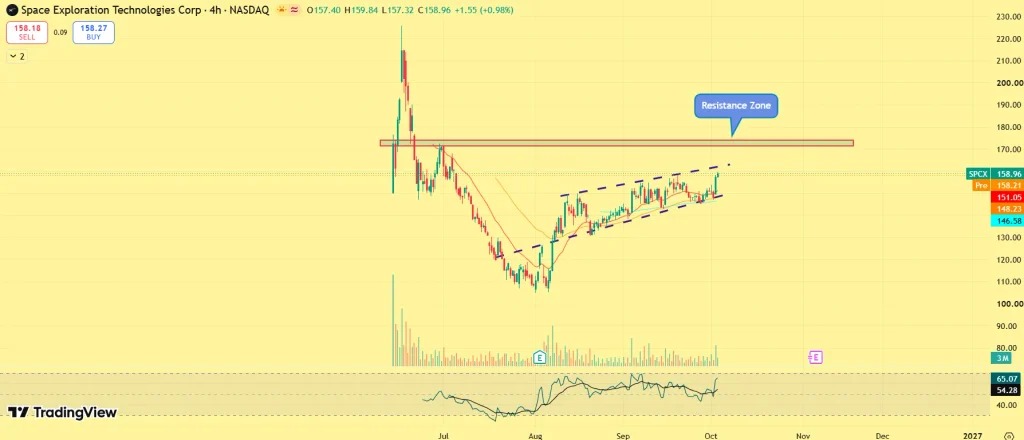
SPCX The stock price rose by 7.35% to $158.96, bringing the stock close to the breakout level of $170.
Morgan Stanley maintains a 'overweight' rating and a target price of $300, with its valuation logic mainly centered around the growth of SpaceX in AI, Starlink, as well as in infrastructure deployment.
If the stock price continues to break through $165, $175, and $190 will come into focus; if it encounters resistance at those levels, $150 will still be a key downward level.
SpaceX Stocks are heating up again in the eyes of investors. A previous rise of about 7% has pushed SPCX towards the $160 range, bringing a key breakout level within reach. On this occasion of growth, Morgan Stanley maintains a target price of $300, and the milestone progress of Starship as well as the continuously expanding AI computing business also strengthen its long-term growth narrative. However, the stock is currently facing a critical technical test around $165. If it can break through clearly, it may signify a broader revaluation and point towards $190; if it encounters resistance again, then SPCX will likely remain trapped within the recent range.
Why does Morgan Stanley believe that SPCX could reach $300?
Morgan Stanley has set a target price of $300, which is the core reason for their bullish outlook on SpaceX's stock. However, this judgment is not based solely on its rocket-like business performance. Analyst Adam Jonas maintains a "overweight" rating and believes that after adjusting for expected growth, SpaceX's valuation becomes even more attractive. The firm estimates that SpaceX's projected EV / EBIT in 2028 is around 30 times, whereas other large-cap AI companies have a valuation of about 16 times.
However, if measured by the adjusted EV / EBIT /G valuation ratio, the valuation of SpaceX is approximately 0.3 times, which is lower than the median of about 0.5 times for comparable large market capitalization companies. This is precisely the core of Morgan Stanley's argument: SpaceX may seem expensive according to traditional valuation indicators, but its growth trajectory could be sufficient to support a higher multiple.
Therefore, the $300 target price depends on whether SpaceX can expand multiple businesses simultaneously – AI computing, Starlink and launch infrastructure – rather than just increasing the number of rocket launches.
SpaceX Stock price rebound makes $170 the focus
If it can firmly reach $165, SPCX will break through the current resistance zone; if it can continue to break through $170, it will more strongly confirm that this rebound has evolved into a broader breakout. After reaching $170, the next upward range is around $175 to $190. On the downside, if the rebound cannot be maintained, the stock price may fall back to $150; if that support level is lost, the $140 range will also become important.
The progress of Starship brings another layer of catalysis.
Starship has also gradually shifted from a research and development focus to more commercially meaningful operations. The 14th Starship mission was a success, entering orbit and deploying 26 Starlink Version satellites, marking the first time this spacecraft has completed both an orbital mission and a revenue-generating task. However, an engine issue shortened the duration of this flight, indicating that there is still work to be done in terms of reliability and reusability.
The next major test is the 15th flight. Morgan Stanley has listed the development of Starship as one of the key catalysts for SPCX, especially the planned aircraft recovery attempt. If the recovery is successfully completed, it will more strongly demonstrate that SpaceX is making progress towards the rapid reusability required for achieving a higher launch frequency.
What is needed for SPCX to break through $170?
In the next phase of this upward trend, both price movement and business execution need to be confirmed simultaneously. From a technical perspective, the stock SpaceX needs to first exceed $165 and then achieve a sustained breakthrough above $170. This will move the stock out of its recent rebound range and bring the price range of $175 to $190 into consideration.
Fundamentally speaking, investors will be paying attention to:
- Starship The 15th flight and advancements towards the reusability of aircraft
- AI Calculate production capacity and new customer contracts
- Starlink Growth
- Emission frequency and its economic efficiency
- Income growth brought by a broader ecosystem SpaceX
The stronger these catalytic factors are, the more easily investors will be able to provide justification for a higher valuation premium, thereby supporting the stock price to move towards $300 and beyond.