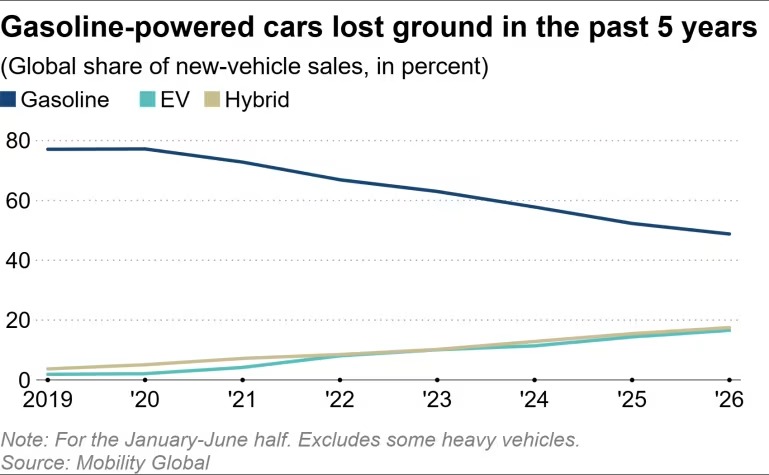
IT News on October 6th: According to Nikkei Asia, affected by the conflicts in the Middle East that have driven up international oil prices, the proportion of fuel-powered vehicles in global new car sales from January to June this year has dropped below 50%.
Sales of fuel-powered vehicles, excluding hybrid and other electrified models, decreased by 10% year-on-year to 20.25 million units. The share of these models in global new vehicle sales fell by 3 percentage points to 49%.
In just five years, this proportion has significantly dropped from 73% in 2021. It is reported that this is the first time since the 1920s when cars began to become popular that the market share of fuel-powered vehicles has fallen below 50%. This data comes from Mobility Global (formerly known as S&P Global Automotive Mobility), and the statistical scope does not include some heavy-duty vehicles.
IT has noted that following the attacks by the United States and Israel on Iran, oil prices have soared sharply. The accompanying increase in gasoline prices, coupled with concerns about fuel supply, has significantly dampened the global demand for gasoline-powered vehicles. In the Chinese market, sales declined by 26%, while in the European market, they fell by 13%.
Lower operating costs are a major advantage of electric vehicles, and the main beneficiaries of the shrinking demand for fuel-powered cars are electric vehicles; in the first half of the year, sales of electric vehicles increased by 12%, reaching 6.87 million units. Electric vehicles accounted for 17% of all new car sales, which is several percentage points higher than before, and has already surpassed the 16% threshold that is generally considered to be the turning point for widespread adoption.
Electric vehicle sales in the Chinese market account for half of the global total. However, since the reduction of relevant tax incentives in January, local electric vehicle sales in China have declined by 3%, to 3.44 million units. With the Donald Trump (Donald Trump) administration canceling the related incentive policies, electric vehicle sales in North America have also dropped by 15%.
The growth momentum of electric vehicles has shifted to other markets. Electric vehicle sales in Europe increased by 32%, reaching 1.81 million units. Data from the Association of European Automobile Manufacturers shows that in the first half of the year, for the first time ever, total electric vehicle sales in 31 major European countries surpassed those of gasoline-powered vehicles.
Electric vehicle sales in Southeast Asia surged by 81%, reaching 350,000 units; in Oceania, sales more than doubled to 110,000 units.
Data from the International Energy Agency shows that Chinese automakers such as Geely and BYD have seen rapid expansion in their export business, with Chinese brands accounting for 60% of the total global sales of electric vehicles and plug-in hybrid vehicles. In markets outside the United States, Europe, and China, 55% of the electric and plug-in hybrid vehicles sold are imported from China.
Mobility Global predicts that by 2030, the production of electric vehicles will account for more than 30% of the total automobile production. By then, electric vehicles will dominate, surpassing hybrid models as well as traditional internal combustion engine vehicles, including diesel cars.
Since July, the market share of electric vehicles globally has continued to rise. Mobility Global Deputy Director Kawano Yoshimichi (Yoshiaki Kawano) stated: "Around 2024, due to factors such as reduced subsidies, the pace of electric vehicle adoption slowed down, and sales of hybrid models increased. However, with rising oil prices, consumers have once again realized the lower operating costs of electric vehicles, and now sales of electric vehicles have resumed growth."
Government policies still greatly influence the pace of the adoption of electric vehicles. Since last autumn, when the United States cut subsidies and relaxed fuel economy regulations, local demand for electric vehicles has plummeted. Automakers such as Honda and General Motors have subsequently adjusted their electric vehicle development strategies and incurred substantial losses.
Even so, Kamei Kawano ( Yoshiaki Kawano ) believes: "Among consumers who have already purchased electric vehicles, very few are switching back to gasoline or hybrid cars. As vehicle prices continue to decline, the market scale, which is driven by real consumer demand and no longer relies on subsidies, is likely to continue to expand."
For Japanese automakers that bet on hybrid vehicle models, the proportion of electric vehicles in their product sales is still relatively limited. Hybrid vehicles have better fuel efficiency than conventional gasoline cars, and even as oil prices rise, hybrid models continue to be popular in the market. In the first half of this year, global hybrid car sales increased by 10%, reaching 7.27 million units, accounting for 18% of global new car sales.