On Monday (October 5th) local time, the three major U.S. stock indices all closed higher. International oil prices fell, while most technology stocks rose, pushing the Nasdaq to set a new closing record. News of corporate mergers and acquisitions also boosted market sentiment, with industrial software company PTC and logistics firm RXO both experiencing gains of over 33% and 22%, respectively.
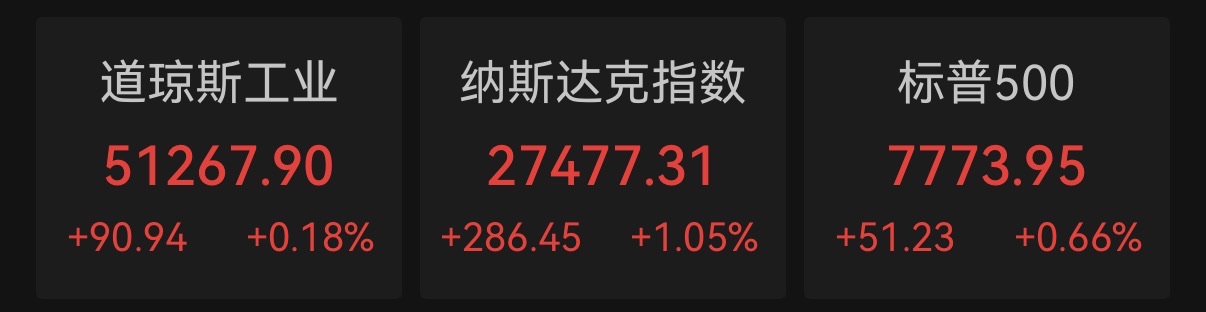
As of the close, the Dow Jones Industrial Average rose by 90.94 points, or 0.18%, to 51,267.90; the Nasdaq Composite Index rose by 286.45 points, or 1.05%, to 27,477.31; and the S&P 500 Index rose by 51.23 points, or 0.66%, to 7,773.95.
The decline in oil prices and corporate mergers and acquisitions became the focus of market attention on that day. At the same time, the U.S. service sector continued to expand, but input costs rose further, and yields on U.S. Treasury bonds continued to rise. Investors continued to assess economic resilience and inflationary pressures.
B. Riley Wealth Chief Market Strategist Art Hogan stated that as economic data remains relatively weak and the earnings season approaches, the decline in energy prices has become a positive development that attracts investors' attention.
The third-quarter financial reporting season is about to begin, with large banks set to release their results first next week. Data from the London Stock Exchange Group ( LSEG ) shows that analysts expect earnings of companies in the S&P 500 index to grow by more than 30% year-on-year during this quarter, with artificial intelligence-related enterprises being a significant contributor to this growth.
In terms of economic data, the Institute for Supply Management (ISM) of the United States announced that the Purchasing Managers Index for the service sector in September was 54.9, lower than 55.4 in August, and remained in the expansionary range for the 27th consecutive month. The Business Activity Index fell from 61.7 to 56.5, and the New Orders Index dropped from 60.9 to 59.8; the Employment Index rebounded from 47.8 to 50.1, returning to the expansionary range for the first time in three months.
Price pressures remain prominent. The input price index rose from 72.6 to 74.0, reaching a new high since July 2022; the backlog order index also climbed to 56.6, the highest level since July 2022. The supplier delivery index increased to 53.2, indicating that delivery speeds have further slowed down.
Steve Miller, chairman of the Services Industry Survey Committee, stated that tariffs and fuel costs are the most frequently mentioned supply chain issues by the surveyed companies, with fuel costs being mentioned about twice as often as any other single issue. Supply chain constraints continue to affect delivery times and costs, while an increase in backlogged orders and maintaining a high level of business activity and new orders have driven employment sub-items back into expansion.
The market's expectations for further interest rate hikes this month are still significantly lower than they were a week ago. Data from CME's Fed Watch tool indicates that as of Monday, the market expects a 24% probability of a Fed interest rate hike at its October meeting, compared to about 70% a week prior.
This Wednesday, the Federal Reserve will release the minutes of its September interest rate meeting, providing more clues for the market to assess the subsequent policy path. The next interest rate meeting is scheduled to take place from October 27th to 28th.
In the bond market, the yield on 2-year U.S. Treasury bonds was reported at 4.84%, up 1 basis point from the previous trading day; the yield on 10-year bonds was 5.31%, up 3 basis points; and the yield on 30-year bonds was 5.66%, also up 3 basis points. The yield spread between 10-year and 2-year bonds widened to 47 basis points, and the yield curve became slightly steeper compared to the previous trading day.
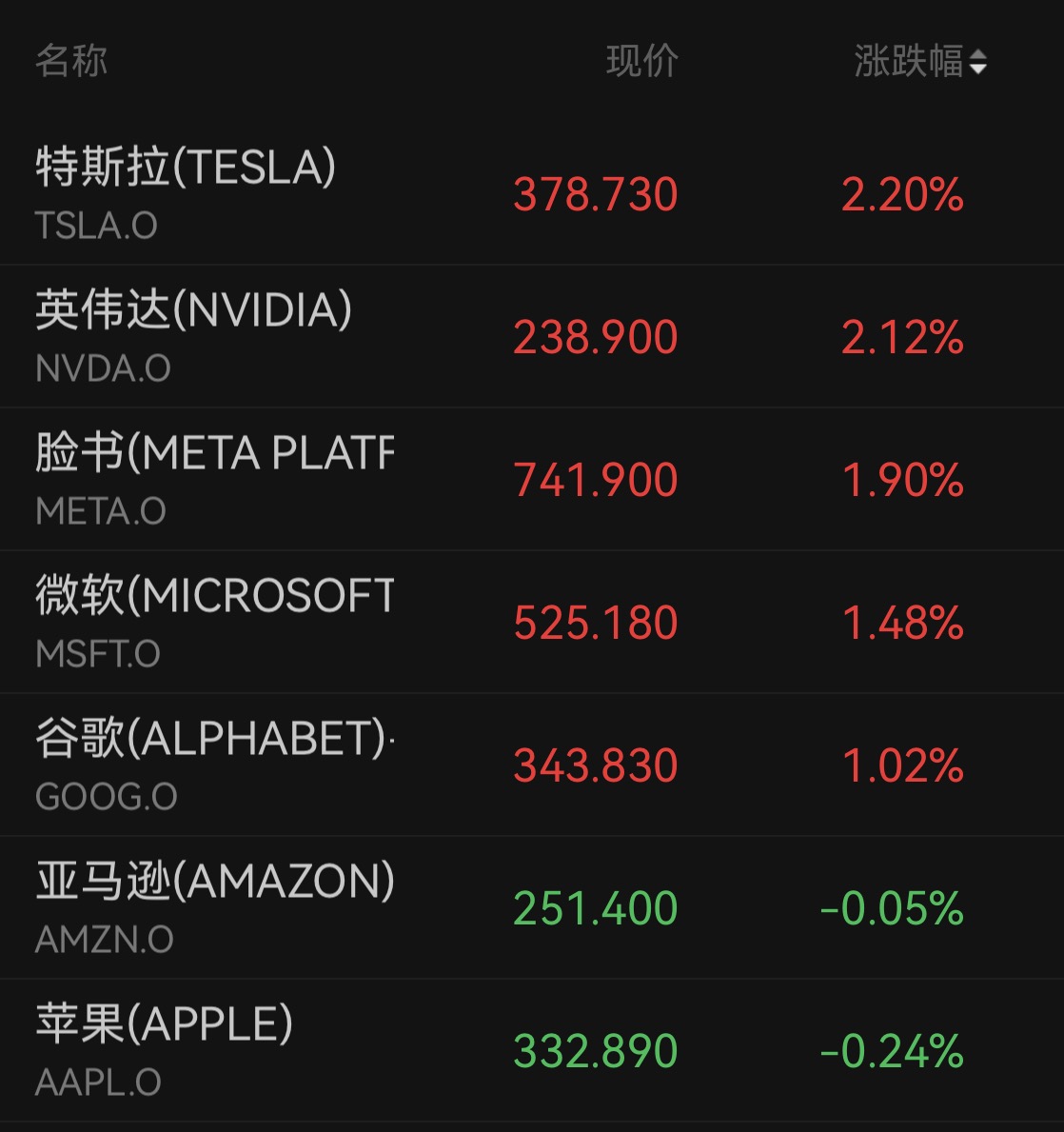
In terms of popular stocks, most large technology companies saw increases. Tesla rose by 2.20%, NVIDIA by 2.12%, Meta by 1.90%, Microsoft by 1.48%, and Google by 1.02%; Amazon fell by 0.05%, and Apple by 0.24%.
Within the semiconductor sector, there was a divergence in trends: the Philadelphia Semiconductor Index rose by 0.28%. TSMC ADR increased by 2.75%, Broadcom rose by 2.08%; AMD fell by 0.34%, Micron Technology fell by 0.38%, and Intel fell by 2.63%.
Hard disk stocks rebounded after a sharp decline on the previous trading day, with Western Digital rising 6.34% and Seagate Technology rising 4.49%;
Storage chip stocks continued to decline, with Micron Technology falling 1.02% and SanDisk falling 0.92%.
Optical communication stocks showed mixed performances, with Lumentum rising by 0.58% and Coherent falling by 1.01%.
M&A news triggers significant fluctuations in individual stocks. Schneider Electric announced its intention to acquire industrial software company PTC for $205 in cash per share, with a equity consideration of approximately $22.6 billion, which represents a 42.3% premium over the closing price of PTC on the previous trading day. PTC rose by 33.49% to $192.26, but still remains below the acquisition bid.
Software stocks showed mixed performance: Autodesk rose by 4.51%, Salesforce fell by 2.09%, and Accenture fell by 1.94%.
Large-scale integration transactions have also occurred in the logistics industry. Robinson Global Logistics announced the acquisition of RXO in the form of cash and stock, with a transaction value of approximately $5.8 billion. According to the agreement, shareholders of RXO will receive $17.25 in cash and 0.0856 shares of Robinson Global Logistics per share, which corresponds to a price of about $30.25 per share at the time of the announcement, representing a 29% premium over the closing price of the previous trading day.
The two companies expect to achieve annual net cost synergies of approximately $300 million within two years after the completion of the transaction. The stock prices of both parties have shown significant differences: RXO has risen by 22.54%, while Robinson Global Logistics has fallen by 10.85%.
Energy stocks showed mixed performance: ConocoPhillips rose by 1.30%, ExxonMobil fell slightly by 0.01%, and Chevron declined by 0.11%.
Hot Chinese concept stocks generally rose, with the NASDAQ China Golden Dragon Index increasing by 1.71% to 5613.68 points. Alibaba rose by 4.68%, Pinduoduo by 3.34%, Baidu by 3.17%, JD.com by 2.25%, and Bilibili by 2.15%. NetEase rose by 1.85%, Ctrip by 1.84%; Xpeng Motors rose by 1.62%, Li Auto by 1.50%, and NIO by 1.48%.
In addition, international oil prices have fallen in both cases. WTI The settlement price of November crude oil futures fell by $1.68, a decrease of 1.84%, to $89.43 per barrel; the settlement price of December Brent crude oil futures fell by $1.93, a decrease of 1.89%, to $100.32 per barrel. WTI Prices have dropped below $90, while Brent remains above $100.
Gold futures closed slightly lower. The settlement price of December gold futures fell by $5.50, or 0.13%, to $4,156.80 per ounce. Analyst Fawad Razzakzada stated that high U.S. Treasury yields and a stronger dollar continue to put pressure on gold prices.
Article Author
Non-farm payroll falls short of expectations! Prospects for interest rate hikes cool down again, U.S. stocks close higher, Tesla gains nearly 5%, storage sector weakens, gold and silver decline.
On a weekly basis, the Dow Jones Industrial Average fell by 1.26%, the S&P 500 Index declined by 0.27%, while the Nasdaq Composite Index rose by 0.45%.
Gold falls below $4,200 to a seven-week low, while the A-share gold sector bottoms out and recovers
Under the dual pressure of inflation concerns triggered by high oil prices and high yields on U.S. Treasury bonds, international gold prices have recently experienced a sharp decline before rebounding.
Tao Dong: Expectations for 'higher and longer' interest rate hikes are rising, and the bond market is in turmoil
The US Treasury market, with a market value of $32 trillion, is like a gas station filled with oil and gas; a single spark could trigger a series of explosions.
The "Super Data Week" long holiday is approaching, and major global assets are awaiting revaluation.
The U.S. core PCE in August and non-farm employment data in September will directly affect market expectations for Federal Reserve interest rate hikes, becoming key variables in the pricing of major global assets.
Tao Dong: Walsh climbs out of one pit only to fall into another.
The assessment of future interest rate hike risks in the market lacks a clear benchmark; it's wise to move funds elsewhere for now.