

Viewpoint | Andrew M. Cuomo, former Governor of New York State
The revolution of digital assets has arrived, and it is already changing our financial system.
We no longer need to discuss whether it will continue to develop. It will. The question is whether the United States will establish clear and sustainable rules for its development within its own territory.
For now, the answer is no.
The CLARITY Act was originally intended to address this issue. This act could have provided a national framework for digital assets, clarified the responsibilities of federal agencies including the U.S. Securities and Exchange Commission (SEC) and the U.S. Commodity Futures Trading Commission (CFTC), and ensured that businesses, investors, and consumers had a clear understanding of the rules.
The House of Representatives passed the CLARITY Act in 2025, but Congress has yet to send the act to the President. The Senate was unable to advance the act in September, which has led most people to wonder: what will happen next?
At the same time, these federal agencies have hastily introduced new regulatory provisions that have significantly reshaped the market. Both SEC and CFTC have enacted these new regulations in a very aggressive manner to fill the gaps left by Congress, proposing a new federal framework for crypto trading platforms, as well as customized regulatory systems for certain crypto assets.
In the short term, this is good, and we will also see many new market opportunities as a result. However, the reality is that these rules were adopted without the Market Structure Act being passed by Congress, relying on the existing statutory powers of regulatory agencies, and thus lack the permanence that new laws would provide.
Especially from the perspective of the Democratic Party, what is more crucial is that these rules were adopted despite opposition from Congress. This means that these rules have been politically fragile from the very beginning.
And the Congress, which is often underestimated, can fight back with great ferocity.
The next election could overturn these rules.
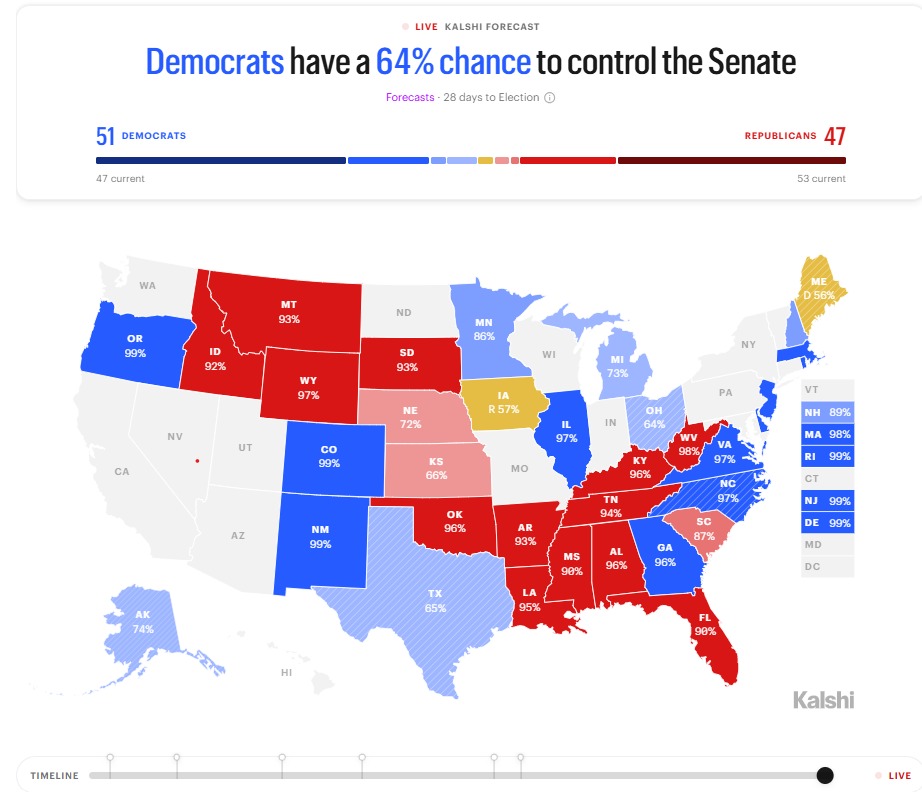
If the predictions about the market and current electoral trends are credible, then after the mid-term elections, the Democratic Party will control one or even both chambers of Congress. And the ability of Congress to obstruct and disrupt the actions of regulatory agencies should never be underestimated.
The Democrats have a 64% chance of controlling the Senate. Source: Kalshi
When I was working at the Department of Housing and Urban Development under the Clinton administration ( HUD ), I personally experienced such a situation. The mid-term elections of 1994 allowed the Republican Party to take control of both the House of Representatives and the Senate. As a result, the power of that department was greatly restricted. Supervision was strengthened, and funding allocations became a tool for pressure; Congress used every means at its disposal to challenge and limit government agencies. This is exactly what Congress does when it believes the executive branch has overstepped its bounds.
The Democratic Party will seek to prove their claims that there is corruption in the Trump administration, and that the actions of regulatory agencies are intended to benefit individuals and collectively benefit political donors. Whether these claims are fair or not, they will drive politics. And politics, in turn, will promote oversight.
Legislative bodies have a lot of tools at their disposal. Regulatory agencies are required to submit rules and regulations before new laws take effect, giving members of Congress the opportunity to get involved. Congress can limit the funding for agency programs, push for legislation to overturn agency actions, or use the Congressional Review Act to repeal certain regulatory provisions. Congress also has the power to investigate and issue subpoenas, which, when combined with public hearings, can have a significant impact. Just ask Anthony Fauci and Jack Smith to confirm that.
Congress must put politics aside
The overall challenge lies in the need for technological innovation in the private sector to be coordinated and consistent with wise government regulation. After the failure of the CLARITY Act, ambiguity prevailed. This is detrimental to businesses, investors, consumers, and the United States as well.
Companies should not have to guess whether the rules implemented today will continue to exist after the next election. They should not decide whether to build and invest in the United States based on which party is in power in Washington. They should be clear about what is legal, what is prohibited, who oversees what, and how the rules will be enforced.
The United States should have a system that encourages innovation while also protecting consumers and investors. The United States should have rules that prevent illegal activities and maintain market integrity. The United States should have a framework that businesses can rely on when deciding where to hire, invest, and build.
Other countries understand this. They are establishing their own frameworks, such as Europe's 'Regulations on the Supervision of Crypto Asset Markets' ( MiCA ) or Singapore's 'Payment Services Act', in order to provide regulatory certainty and set standards. The United States cannot allow political deadlock to determine the future of financial innovation.
It is of paramount importance that the next Congress set a top priority: to put politics aside, even if only temporarily, and pass bipartisan legislation that authorizes digital asset business activities, allowing companies to invest in the United States safely and rationally.
About the AuthorAndrew M. Cuomo served as the Governor of New York from 2011 to 2021, and prior to that, he held positions as the Attorney General of New York State and the U.S. Secretary for Housing and Urban Development. He currently serves as a member of the board of OKX, and also co-chairs OKXICE, a joint venture between OKX and Intercontinental Exchange. This joint venture focuses on tokenization and native digital financial products.