

For foreign employees of some of the largest employers in the tech industry, there is an additional layer of uncertainty added to an already unpredictable system.
The Trump administration's decision to suspend Microsoft, Adobe, and other named technology companies from participating in the Permanent Labor Certification (Permanent Labor Certification, abbreviated as PERM) program has sparked new debates: whether stricter technology immigration policies are actually protecting American workers or harming American businesses.
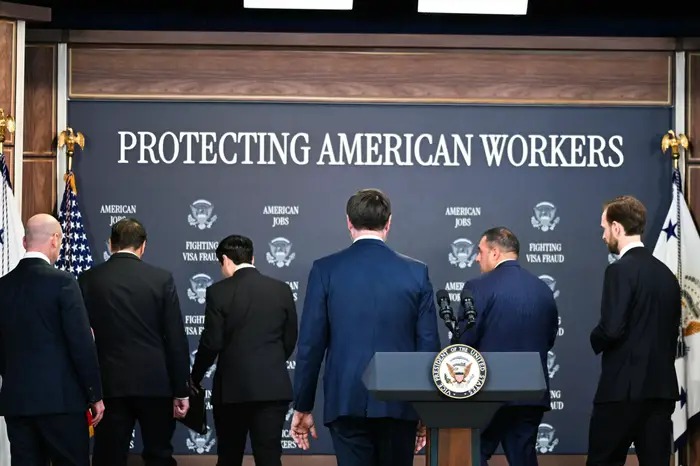
On Thursday morning, Vice President JD Vance announced this suspension decision at a press conference. He specifically mentioned Microsoft and stated, "If you do the math, for every employee that Microsoft laid off, one semi-foreign contract worker took their place."
Microsoft issued a statement on Thursday, denying the accusations of Vance, stating that most of its H-1B applications were for existing employees, not for hiring new staff.
The company stated, "Among the approximately 6,000 H-1B visa applications submitted in our last fiscal year, 80% were for extending or changing the status of existing Microsoft employees. These were not for hiring new staff."
In addition to Microsoft and Adobe, this action also affected six large IT services companies that are closely linked to India's tech industry: Tata Consultancy Services (TCS), Infosys, Wipro, HCLTech, Cognizant, and Capgemini.
The following are the views of immigration policy experts and individuals from India's tech community:
Ron Hira, Professor of Political Science at Howard University
A political science professor at Howard University, who has long criticized the H-1B project, stated that this move by Microsoft is "very important."
Hira has long believed that employers may use this program to suppress wages and put American workers at a disadvantage. He told The Associated Press on Thursday that the regulations should require employers to prove that hiring H-1B workers will not harm Americans doing similar work.
"This was never carried out," said Hira.
Doug Rand, former senior advisor to the U.S. Citizenship and Immigration Services
Rand, who once served as a senior advisor to the U.S. Citizenship and Immigration Services during the Biden administration, holds a contrary view. In a statement to The Associated Press, he stated that the announcement by Vance is "self-contradictory."
Rand believes that this policy may exacerbate the problems that Vance claims to want to solve. The immigration status of H-1B workers is usually tied to their employers, whereas a green card allows workers to switch jobs more freely and to have more leverage in salary negotiations.
Rand told The Associated Press: "If the Trump administration is really concerned that H-1B workers are 'contract laborers', then they will never stop companies from helping their own H-1B employees apply for green cards."
Dinesh Pai, founder of Indian technology
Pai is the Investment Vice President of Zerodha, India's largest brokerage firm, and he responded to what a stricter path to permanent residency in the United States might mean for India.
He stated on X that the negative impacts could include a decrease in high-income Indians remaining in the United States, which in turn would lead to reduced remittances, a decline in soft power, and less angel investment flowing to Indian startups. He also pointed out that India receives about $125 billion in remittances each year, of which the United States accounts for roughly a quarter.
But he also saw potential benefits. If American companies are unable to bring talent to the United States, he wrote, “they are likely to bring jobs to India.”
He added that the uncertainty surrounding US visas may also encourage more top engineers to stay in India and to establish local companies as well as AI startups.
Nasscom, Indian IT Industry Trade Organization
The main technology industry organization in India, Nasscom, stated that immigration policies and the movement of high-skilled talent should be considered as two separate issues.
In a statement to local media, the organization stated: "Although this decision affects a specific immigration route, Nasscom has always believed that immigration and the movement of high-skilled talent are two different issues that should not be viewed from the same perspective."
The organization also stated that the number of employees who have transitioned from H-1B to permanent residency through PERM is “relatively limited.”
Microsoft
Immigration