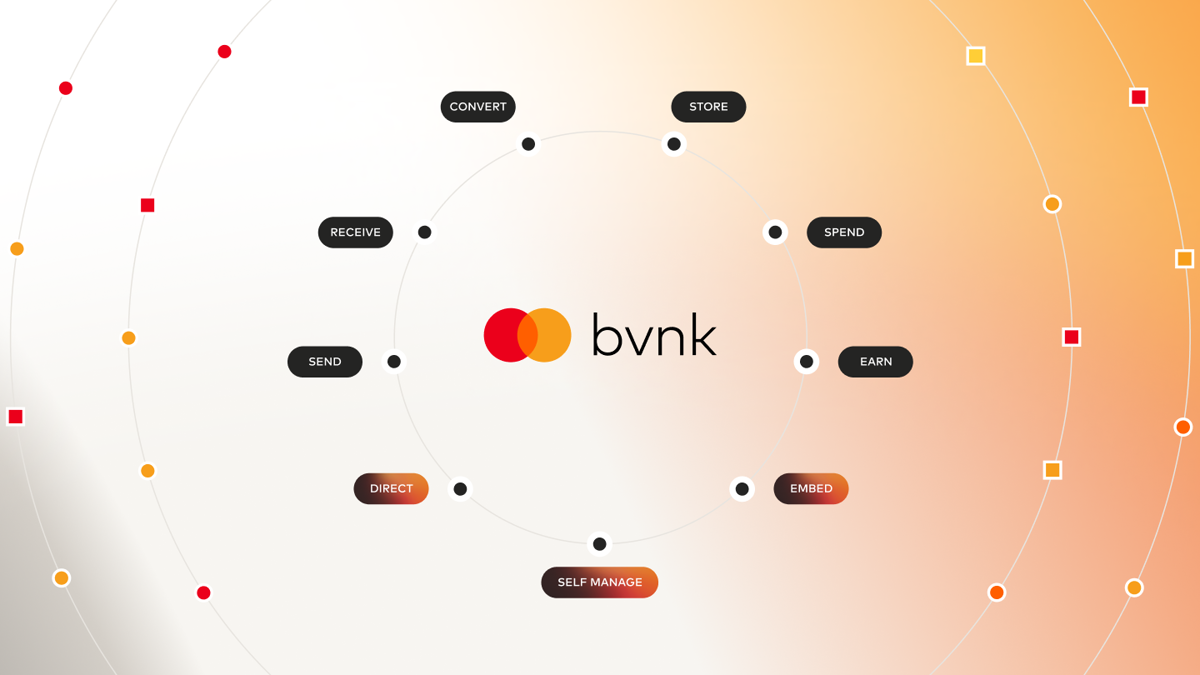


Mastercard and BVNK announced on October 15 the launch of Global Money Platform, bringing together capabilities such as fiat currency accounts, stablecoin balances, exchanges, card purchases, and local bank payments under one API. According to the press release, the platform is already able to provide services through BVNK; companies like Nuvei and Marqeta will be among the first integrators. When reading this news, it's important to distinguish between "the platform is now live" and "all the listed features are available in every country, for every currency, and for every customer." For example, Mastercard mentioned that its goal of covering over 40 currencies in more than 200 countries and regions is expected to be achieved by 2027, and it should not be misconstrued as something that has been fully completed today.
This release is not an isolated stablecoin product. MasterCard completed the acquisition of BVNK in August this year, and the platform launched in October is one of the first major implementations following the integration of both parties' capabilities. BVNK provides the infrastructure for stablecoins, while MasterCard has a traditional payment network and cross-border transfer system. In the past, companies often had to connect to separate services such as bank accounts, foreign exchange dealers, stablecoin custody and redemption services, card-issuing institutions, and local withdrawal channels. The platform aims to encapsulate these components into a modular interface that customers can enable gradually according to their needs, without having to rebuild the entire financial system all at once.
From on-chain transfers to corporate financial processes
The speed of on-chain transfers for stablecoins only addresses a small portion of the capital movement process. After manufacturers receive payments from overseas, they may need to maintain liquidity in various currencies before making payments to suppliers in multiple countries; payment institutions have to consider customer identities, sources of funds, exchange costs, weekend settlements, and local bank connectivity. The ability for money to move across one blockchain does not mean that the recipients can immediately obtain usable fiat currency in their local bank accounts. MasterCard’s emphasis on multi-currency accounts and local payments this time is precisely to integrate the transferability of blockchain with enterprises’ daily accounts receivable, payable, and financial management processes.
The "global fund account" described in the press release allows for the management of fiat and stablecoin balances within the same product, with conversions possible through a single API. For fintech companies, it can serve as an embedded financial infrastructure component; for large enterprises, it may be used to manage cross-regional liquidity. However, these benefits are contingent on clear compliance requirements in different markets, bank cooperation, asset backing, redemption arrangements, and technical service levels. The platform introduction does not perform a risk assessment for each enterprise. Customers should still verify the specific assets supported, chains, countries, deposit and withdrawal times, fees, and rules for handling failures.
MasterCard stated that the platform integrates its Mastercard Move fund transfer capabilities and plans to allow stablecoin balances to be paid into the recipient's bank account in local currency. It also mentioned that stablecoin balances can be used for consumption in merchant scenarios through the card network, and card issuance is supported in over 130 countries. Here, it should not be mistakenly written as "merchants directly receiving on-chain stablecoins" instead of "card network availability." In most scenarios, it involves internal platform exchanges, card network authorization, and settlement; however, receiving merchants may still receive local fiat currency. Technically speaking, this represents a connection between on-chain assets and existing payment systems, rather than a simple substitution of stablecoins for bank cards.
The real competition lies in conversion costs and risk control.
The market commonly measures the application of stablecoins by trading volume, yet it overlooks the cost structure that enterprises are most concerned about: A cross-border payment involves several exchanges from the time it is recorded until it becomes finally available. There are questions regarding how much capital needs to be reserved, which operations must be manually reviewed, and who bears the risks of exchange rates and compliance issues. If a single interface can reduce system integrations and the amount of idle funds, platforms may gain adoption by enterprises; however, if liquidity is weak, fees are opaque, or dispute resolution is difficult, even fast on-chain processing cannot guarantee overall efficiency. The target customers mentioned in the press releases include payment companies as well as card-issuing platforms, indicating that the focus of competition is shifting from "which coin to support" to "whether a platform can reliably handle the entire financial flow."
This link also involves responsibility allocation. Stablecoin issuers are responsible for maintaining the value of the coins and implementing redemption mechanisms, infrastructure providers are responsible for integrating assets and payment capabilities, card organizations and their partners handle network rules and merchant reach, while corporate clients are responsible for ensuring compliance with their own business regulations. Any issue at any level can disrupt the user experience. Especially when a platform combines multiple assets, jurisdictions, and payment channels, audit logs, transaction screening, risk limits, and exception rollback become more important than marketing slogans. Corporate buyers should require service commitments for each step of the process, rather than just relying on a comprehensive overview.
MasterCard has also listed agent commerce and tokenized deposits as areas of support for the future. This is a roadmap, not a mature feature that has already been implemented on the platform at this time. The capital market may see the new platform as a step towards traditional payment networks recognizing the value of stablecoins, but its commercial success will need to be tested by the activity, retention rates, and unit economics after the first batch of customers are actually engaged. What can be confirmed today is that the product platform has announced its launch, and the partners and scope of functions have been officially described; what cannot be confirmed is the final timeline for rollout in all regions, nor can we predict from the press release that stablecoins will replace bank deposits.
Users should also note that there are multiple levels of "availability": just because a platform is open to partner companies, it does not mean that all end-consumers have already access to the same services; being on the initial list of participants does not mean that the service has been launched and a large number of actual transactions have been processed. Only when the supported assets, coverage areas, fee structures, and payment processes become increasingly transparent can the market determine whether this multi-currency platform is truly superior to decentralized solutions.
Source: Mastercard, October 15, 2026, " Mastercard and BVNK launch Global Money Platform to power a multi-money world": https :// www.mastercard.com / global / en / news-and-trends / press /2026/ october / mastercard-and-bvnk-launch-global-money-platform-to-power-a-mult.html