Key Points
- Former Ripple advisor questions whether the adoption by institutions will drive demand for XRP
- Banks can transfer stablecoins without using XRP as collateral.
- Liquidity, compliance, and custody remain the main obstacles for institutions to adopt.
Former Ripple CBDC advisor Anthony Welfare indicated that banks may increasingly adopt XRP Ledger, but this may not necessarily lead to a proportional demand for XRP. He believes that merely having the technical capability does not guarantee large-scale adoption by institutions.
Welfare indicates on AllinCrypto Podcast that XRPL has the capabilities in terms of payment and tokenization, but banks must still meet a series of requirements before deploying blockchain infrastructure on a large scale.
A former Ripple advisor questioned the connection between XRPL's approach and the requirements of XRP.
Welfare acknowledges that XRPL possesses a number of features that are attractive to financial institutions, including fast settlement, low transaction costs, and a built-in decentralized exchange.
However, he emphasized that liquidity, custody arrangements, regulatory compliance, and interoperability remain key conditions for transforming these capabilities into commercial applications.
The difference between XRP and XRPL is particularly important. XRP is the native digital asset of that network, while XRP Ledger can also support the issuance of currency, stablecoins, and tokenized financial instruments.
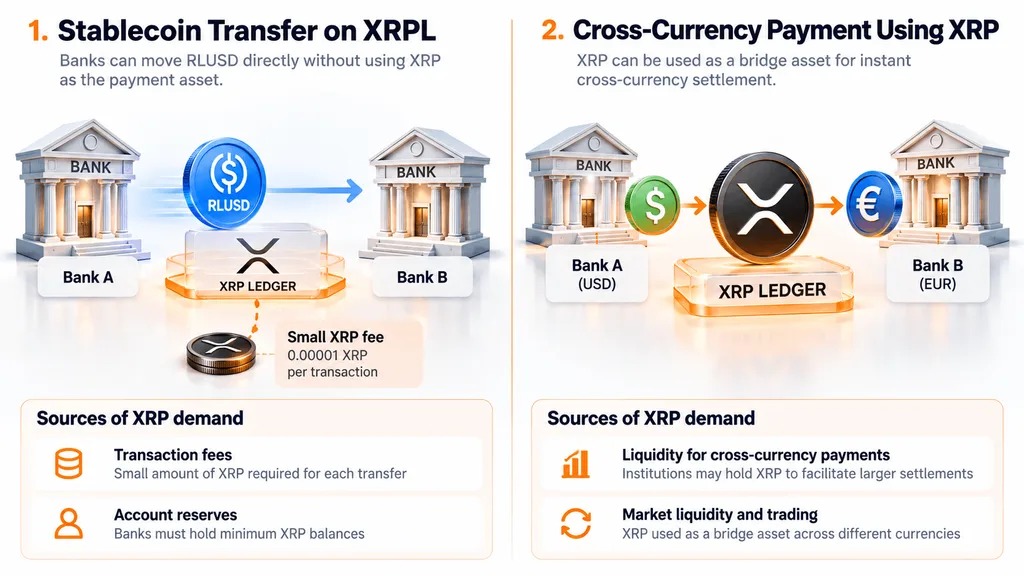
According to the official documentation of XRPL, each standard transaction requires the payment of a very small network fee based on the XRP currency, which is usually 10 drops, that is, 0.00001 XRP.
The network also requires account holders to maintain a reserve of XRP. Currently, each account starts with 1 XRP.
However, these requirements do not mean that banks must use XRP as the main asset in every payment.
For example, two institutions can transfer a type of issued US dollar-stabilized coin through XRPL, without having to convert the entire payment amount into XRP.
As Ripple expands its institutional payment infrastructure, this distinction becomes increasingly important.
The bank collaboration of Ripple brings stablecoins into the spotlight
Ripple has recently reached a cooperation with DriveWealth to integrate the financial infrastructure based on RLUSD into a brokerage network that serves over 100 financial partners.
This DriveWealth integration will begin with the European business, and the plan to expand to the United States is still in progress.
This arrangement indicates that financial institutions can benefit from the XRPL infrastructure when using RLUSD rather than XRP as the primary settlement asset.
However, this does not mean that the function of XRP disappears.
This token is still necessary for transaction fees and account reserves, while certain cross-currency payments and liquidity strategies can also directly use XRP.
Therefore, the key variable is not just how many institutions announce integrations, but whether these applications will create a sustained demand for liquidity priced in XRP.
Other institutional projects bring about more direct exposures.
Nasdaq-listed company Evernorth holds approximately 473 million XRP, and plans to deploy its fund pool through institutional trading and income strategies.
Unlike integration with stablecoin payments, the business model of Evernorth directly involves holding a large amount of native tokens.
At the same time, the XRP supportive DeFi protection on Flare also provides another example of deploying capital through XRP related infrastructure.
What drives the demand for meaningful XRP?
Welfare also indicates that private blockchain networks may initially attract more institutional activity, while certain transactions or records will eventually be connected to public infrastructure.
This will make interoperability particularly important, rather than ensuring that a single public chain can dominate the entire market.
His view is not that XRP has no institutional use, but rather to separate the potential adoption of the ledger from the investment in scenic areas before the issuance of tokens.
An increase in the number of transactions may lead to a higher consumption of XRP for fees, but due to the low fees, a high volume of transactions alone is not sufficient to create significant buying pressure.
Marcus Hale
Marcus Hale is a cryptocurrency and financial markets contributor who reports on Bitcoin, Ethereum, digital assets, regulation, ETF, and institutional adoption. His work focuses on developments that may impact the market, investor trends, as well as the broader forces that shape the crypto economy.