Ripple's David Schwartz warns of SecuX wallet phishing notifications; emergency maintenance raises doubts
Coinpaper
1h ago
Ai Focus
Ripple Before CTO David Schwartz, we remind cryptocurrency holders to be cautious of a suspicious notification related to the SecuX wallet application. This notification directs users to a phishing website that requires them to enter a 12- or 24-digit recovery phrase. Meanwhile, SecuX underwent emergency system maintenance, and although it was claimed that services had been restored, users continued to report access issues on October 17th. Public information has not confirmed that the SecuX servers, wallet software, or notification system were compromised, nor is there any verified evidence indicating that this incident led to the theft of cryptocurrencies.
Helpful
No.Help

Key Points

  • David Schwartz has identified a phishing link leading to a wallet recovery phrase.
  • The maintenance of SecuX coincides with a continuous stream of complaints regarding application access issues.
  • There is currently no confirmed evidence indicating that the infrastructure of SecuX has been compromised.

Former Chief Technology Officer Ripple warns cryptocurrency holders about a suspicious notification related to the SecuX wallet app. This notification directs users to a phishing website, where they are asked to enter a 12-digit or 24-digit recovery phrase.

At the time this warning appeared, hardware wallet providers were undergoing emergency maintenance, which also raised questions from the outside world about the security of their applications.

In a post on October 16th, Schwartz explained that clicking on the notification would cause the wallet app to start normally. However, when he checked the notification history of Android, he found that the relevant link pointed to a forged page that requested users to provide wallet recovery information.

The timing is particularly concerning, as SecuX announced an emergency system upgrade on the same day. Although the company later stated that services had been restored, users continued to report issues accessing their wallets on October 17th.

SecuX Maintenance Raises Questions About Wallet Security

SecuX announced a large-scale system maintenance on October 16, stating that the move was aimed at enhancing the security and stability of the application. The company subsequently stated that normal operations had been restored, but ongoing reports of access difficulties indicate that not all users' issues have been resolved.

A phishing notice coincided with a technical disruption, raising an important yet unanswered question: are there any connections between these two incidents, or did they simply occur at the same time?
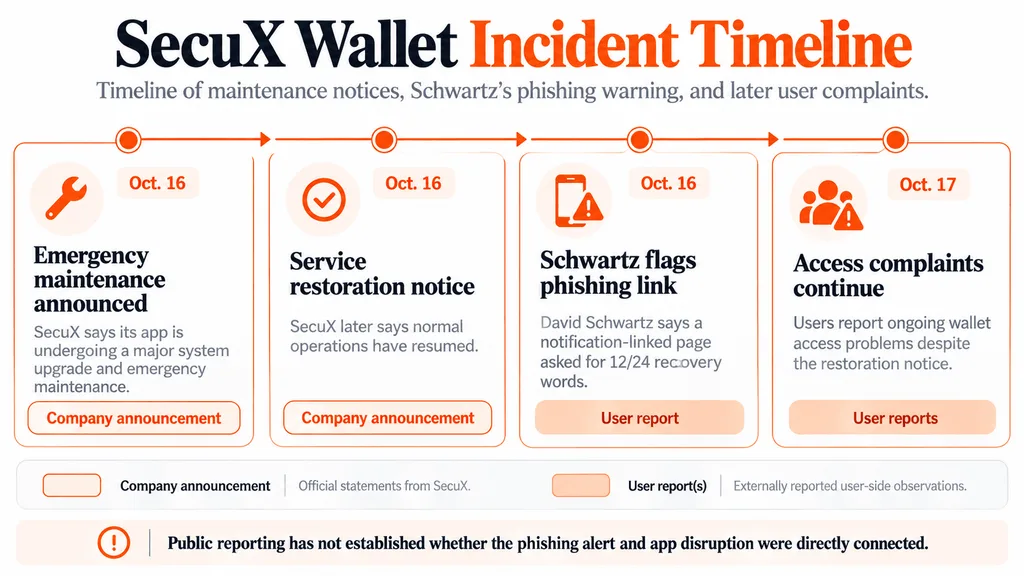
Neither the claims from Schwartz nor publicly available information have proven that the servers, wallet software, or notification infrastructure of SecuX have been compromised. The source of this notification has not yet been confirmed, and there is no verified evidence to suggest that this incident led to the theft of cryptocurrencies.

SecuX also reminds users separately that legitimate representatives will never ask for a recovery phrase; a recovery phrase is used to access information related to cryptocurrencies in a wallet.

Why can't hardware wallets prevent every type of phishing attack?

Hardware wallets are designed to protect private keys by isolating sensitive signing operations from connected devices. However, this protection does not prevent users from voluntarily disclosing their recovery phrases to fraudulent websites.

Recovery phrases can be used to restore wallets on compatible devices or applications. Therefore, anyone who obtains these phrases may be able to control the relevant cryptocurrencies without having the original hardware wallet.

This distinction is particularly important, as attackers are increasingly impersonating well-known wallet providers. Previously, scams targeting Ledger and Trezor used physical letters with false verification instructions to trick recipients into disclosing recovery information.

Other attacks make use of personal information obtained from leaks in customer databases. Such information leaks can make hardware wallet phishing more deceptive, without the need to crack the underlying devices.

SecuX supports a variety of cryptocurrencies, including XRP, Bitcoin, and Ethereum. However, the warnings regarding Schwartz do not imply that XRP Ledger has vulnerabilities, nor do they indicate that holders of XRP are the specific targets of this incident.

Tip
$0
Like
0
Save
0
Views 26
HQYC reminds readers to view blockchain rationally, stay aware of risks, and beware of virtual token issuance and speculation. All content on this site represents market information or related viewpoints only and does not constitute any form of investment advice. If you find sensitive content, please click“Report”,and we will handle it promptly。
Submit
Comment 0
Hot
Latest
No comments yet. Be the first!
Related
Bessent warns Zelensky that the United States should be "very cautious" about claiming to restrict Starlink
U.S. Treasury Secretary Scott Bennett warned Ukrainian President Zelenskyy to be "cautious" when publicly discussing U.S. support for Ukraine. Previously, Zelenskyy stated in a NBC program that he believed the U.S. government was responsible for the slowdown in Ukraine's Starlink internet speed, and claimed that Ukraine had been cut off from U.S. intelligence for a time. Bennett responded that both Trump and Rubio have clearly denied that anyone in the Trump administration would do such a thing, calling Zelenskyy's accusations "very reckless."
CNBC
·2026-10-18 23:28:12
1
Ripple News: David Schwartz states that XRP Ledger is not intended to become Ethereum, and reveals plans for 2027
The chief architect of XRP Ledger and honorary Ripple CTO David Schwartz stated that XRP Ledger is not intended to become Ethereum, but rather focuses on financial tasks such as the tokenization of real-world assets, payments and liquidity, lending, and stablecoins. He also discussed RLUSD's multi-chain layout, AI proxy payment settlement, as well as the priorities for 2027 centered around GTreasury and Hidden Road.
Coinpedia
·2026-10-18 23:07:55
11
Meta Faces $145 Billion in AI Expenditure Challenges; Wall Street Bets on 6% Stock Price Volatility Following Financial Reports
Meta Platforms will release its third-quarter financial report on October 21st, with the market focusing on whether its substantial AI capital expenditures can be translated into stronger profits. The company expects capital expenditures to range from $130 billion to $145 billion in 2026, analysts predict revenue of around $63.3 billion for the third quarter, and the options market anticipates a stock price fluctuation of about 6% after the financial report is released.
Coinpaper
·2026-10-18 22:59:02
13
From a natural gas trader to creating a CoreWeave with a contract worth $104 billion AI Michael Intrator
Before founding CoreWeave, Michael Intrator was engaged in natural gas trading and energy investment management. Today, the company he helped to establish has accumulated approximately $104 billion in contracted revenues, but it also carries billions of dollars in debt, leading to increasing financing pressures.
Coinpaper
·2026-10-18 22:59:00
16
Babylon proposes to integrate native Bitcoin into Aave V4; there is no need to encapsulate BTC to borrow stablecoins.
Babylon Labs has proposed a governance initiative that suggests users lock their native Bitcoin in a special Taproot vault and borrow stablecoins through Aave V4, without the need to transfer BTC off the Bitcoin blockchain. This scheme has passed preliminary community testing but still requires further risk assessment and governance approval.
Coinpaper
·2026-10-18 22:58:59
13
View More