

American voters will participate in mid-term elections on Tuesday, which could change control of Congress and shape the future of cryptocurrency regulation.
According to a report by Reuters on October 27, during this electoral cycle, crypto industry groups have invested approximately $176 million in over 100 elections.
Coinbase, Ripple and Andreessen Horowitz are among the main funders of the political network Fairshake.
The election results may reshape the prospects of the stalled CLARITY legislation and determine which members of parliament will lead the committees responsible for regulating the industry.
Democrats seek to take control of Congress
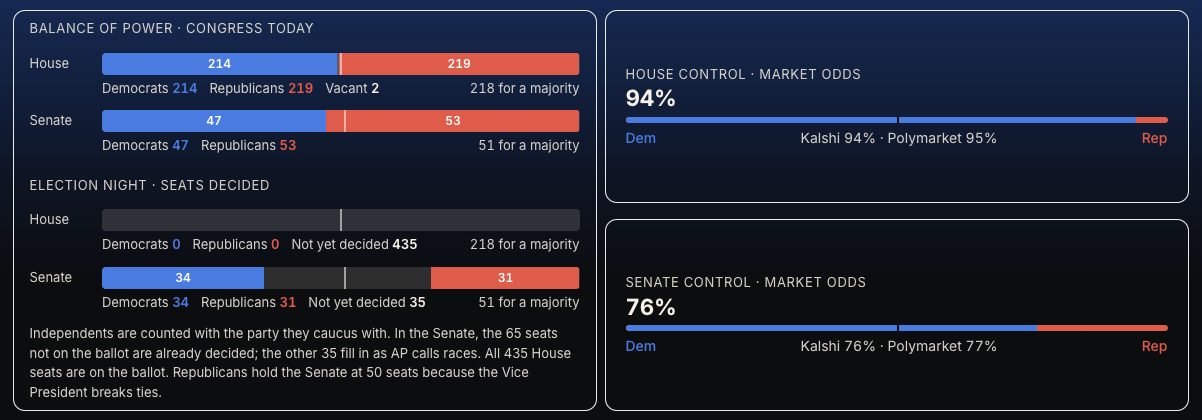
According to the election dashboard of the Blockchain Association, before the mid-term elections on Tuesday, the Republican Party controlled both chambers of Congress, holding 219 seats in the House of Representatives and 53 seats in the Senate.
The Democratic Party is seeking to reverse this majority position. According to data from Kalshi at the time of publication, the market tends to predict that the Democratic Party will win both the House of Representatives and the Senate.
Voters will decide on all 435 House of Representatives seats and 35 Senate elections, thereby determining which party will control Congress during the final two years of President Donald Trump's second term.
If the Democratic Party controls Congress, there may be more congressional scrutiny of crypto businesses associated with Trump, as well as of the decisions made by regulatory agencies. Control of the Senate will also affect the confirmation of future presidential nominees for regulatory positions.
Ohio, Nebraska, and Texas attract attention from the crypto industry
The Senate race between Ohio Republican Jon Husted and Democrat Sherrod Brown is regarded as an important case to test the political influence of the crypto industry. It is reported that industry groups have invested over 50 million dollars to oppose Brown. Brown has long criticized the crypto industry and may once again assume a senior committee position in the Senate.
In Nebraska, Republican Senator Pete Ricketts is facing off against independent candidate Dan Osborn. According to the Washington Observer, Ricketts, who is a member of the Senate Banking Committee and supports crypto-friendly legislation, has benefited from nearly $11 million in expenditures by Fairshake.
Texas is also a race worth watching, with Republican Ken Paxton and Democrat James Talar competing in a fiercely contested Senate election. Cointelegraph previously reported that Digital Freedom Fund, who has the support of Winklevoss, has already invested funds to support Paxton.
Regardless of who wins, the CLARITY legislation faces challenges.
Changes in congressional control may delay the passage of the CLARITY Act, but even under Republican leadership, this bill to reform the crypto market structure has been facing difficulties.
The bill will divide the regulatory responsibilities for the crypto market between the U.S. Securities and Exchange Commission (SEC) and the Commodity Futures Trading Commission (CFTC), and will establish rules for intermediary institutions. On September 15th, the Senate failed to advance the bill with a procedural vote of 49 to 50 votes, falling short of the required 60 votes.
Relm Insurance, the head of the Innovation and Digital Capital Platform, said to Cointelegraph: "The change in congressional control is likely to reset the timeline for the CLARITY legislation."
Global Settlement Network CEO Ryan Kirkley also believes that the problem is not merely about which party is in power.
Kirkley indicates that 'under the control of the Republican Party, it is already very difficult to advance the CLARITY bill in the Senate; therefore, the issue is clearly not just about which party holds the majority of seats.'
The industry has already obtained a federal-level stablecoin framework through the GENIUS Act, which came into law in July 2025.
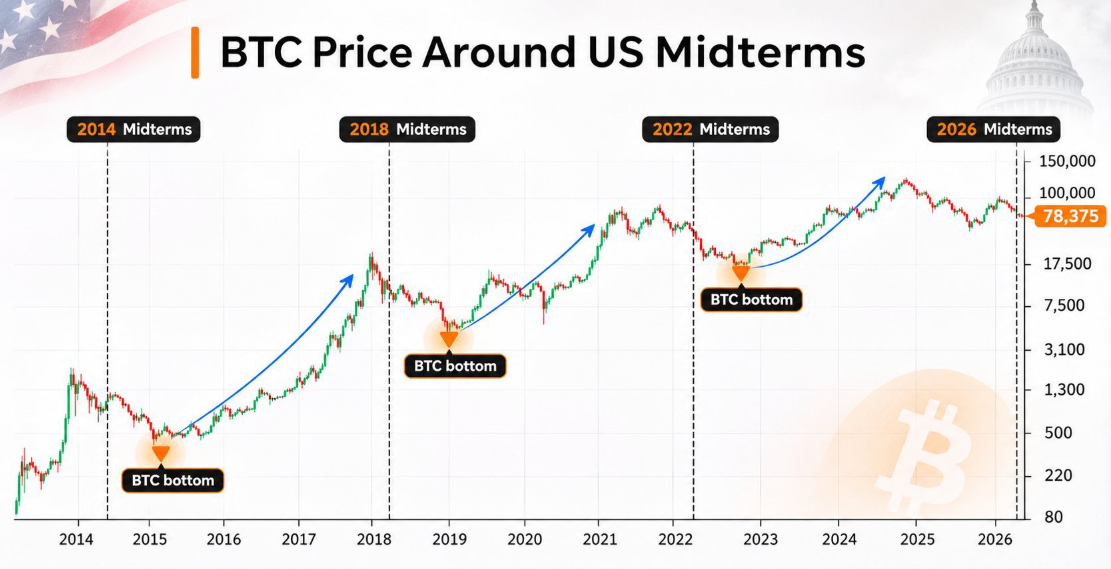
The past performance of Bitcoin in mid-term elections provides limited insights for traders.
Data shows that after the mid-term elections in 2014, 2018, and 2022, Bitcoin fell below its earlier lows of that year.
0G CEO and Co-founder Michael Heinrich said about Cointelegraph: "I will be cautious about Bitcoin's performance after the past few mid-term elections. There aren't enough sample periods to consider it a pattern, and the current market structure is also different: The impact of ETF capital flows, institutional portfolios, and global liquidity on prices is much greater than in the past."
The Kirkley of GSN indicates that institutional capital flows, interest rate expectations, and market liquidity are the more direct factors affecting Bitcoin.
He said, "Bitcoin doesn't need a particular election outcome to succeed. What it needs is capital, confidence, and a macroeconomic environment that makes investors willing to take risks again."