

Berkshire Hathaway ( BRK.B ) announced mixed results for the third quarter on Saturday; revenue exceeded Wall Street's expectations, but profits declined significantly.
The conglomerate company, founded by Warren Buffett, reported revenue of $105.65 billion, a 11.24% increase from the same period last year, exceeding the market's forecast of $100.96 billion. However, net profit decreased by 28% to $22.11 billion, indicating that despite strong sales growth, there are still certain pressures present.
For investors, the biggest concern comes from Berkshire Hathaway's insurance business, which is also an important source of its profits and cash. Underwriting profits declined by 43% to $1.35 billion; due to rising claims costs and expenses, the profits from the issuance of GE tokens plummeted by 45% to $982 million. Affected by lower interest rates, insurance investment returns also decreased by 14% to $2.73 billion.
However, there are also some positive signs. The railway business of BNSF under Berkshire Hathaway saw a profit increase of 19% to $1.73 billion; the manufacturing, services, and retail businesses experienced a profit growth of nearly 12% to $4.04 billion. These gains indicate that other segments of Berkshire's vast business portfolio are performing steadily, which helps to offset the weakness in the insurance business.
Investors should also pay attention to Berkshire Hathaway's capital allocation. The company repurchased approximately $9.65 billion of its own shares this quarter, indicating its willingness to use cash for investment rather than simply hoarding funds. Berkshire also holds about $352.3 billion in cash, cash equivalents, and U.S. Treasury bills, which is calculated based on the combined insurance and other businesses, and has already deducted unsettled purchases of Treasury bills.
Overall, this financial report brings both comfort and warnings to Berkshire Hathaway's shareholders. The company has highlights in terms of revenue growth, rising BNSF profits, and billions of dollars in share repurchases, but its insurance business is under pressure, with high claims costs squeezing profit margins. Coupled with lower interest rates that drag down investment returns, Berkshire may need to rely more on other businesses to maintain profit growth.
Regarding the stock of BRK.B, the main risk lies in profitability, rather than revenue growth. If the underwriting profit margin of GE token issuance continues to be under pressure, and low interest rates continue to drag down investment returns, it may be difficult for Berkshire to convert higher sales into stronger profits. This means that the recovery of insurance profits is particularly important for the outlook of this stock.
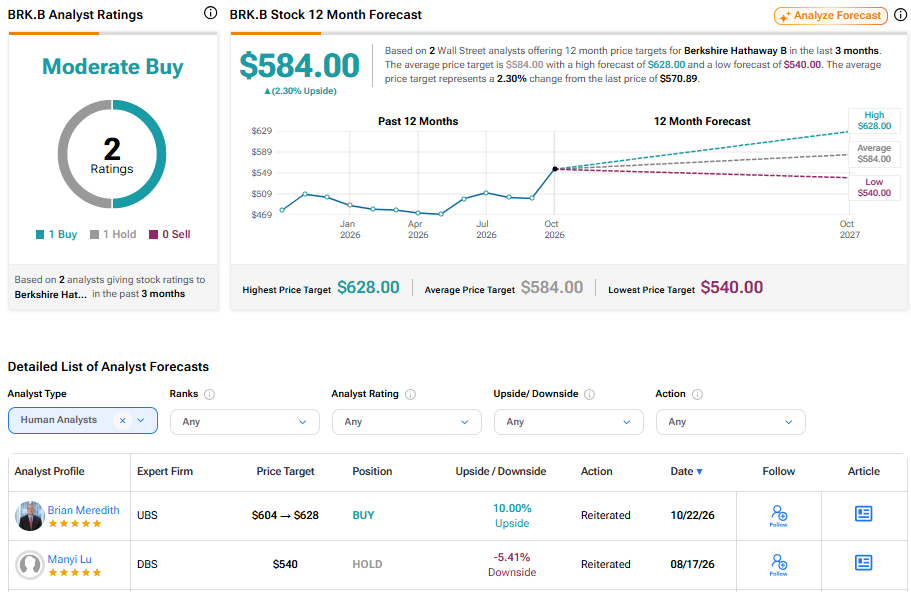
On Wall Street, there are not many analysts tracking Berkshire Hathaway. In the past three months, there have only been two ratings, which ultimately led to a consensus expectation of "moderate buy." The average target price for BRK.B stock is $584, which is 2.30% higher than the previous closing price.