


With the increasing demand for crypto assets, mainstream cryptocurrencies with stronger fundamentals gained bullish momentum on Monday, November 9, 2026, while those with a more bearish structure continued to decline.
As of press time, among the top 100 cryptocurrencies by market capitalization, the one that has performed the best in the past 24 hours is Pieverse ( PIEVERSE ). This is a Web3 payment compliance infrastructure project. PIEVERSE has a market capitalization of 597.5 million US dollars, with nearly 80 million US dollars in trading volume over the past 24 hours, and it has risen by 48.7% to reach 2.21 US dollars.
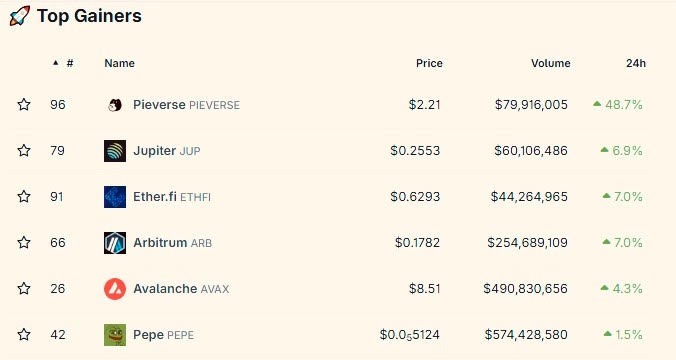
Top 100 Cryptocurrencies by Market Capitalization: Today's Gain List. Source: CoinGecko
Jupiter ( JUP ) is the governance token of the decentralized exchange ( DEX ) aggregator on the Solana ( SOL ) network. It has risen by 6.9% in the past 24 hours, trading at $0.2553. Other cryptocurrencies that performed well today include Ether.fi ( ETHFI ), Arbitrum ( ARB ), and Avalanche ( AVAX ).
Meanwhile, among the top 100 cryptocurrencies by market capitalization, the most prominent meme coin is Pepe ( PEPE ), which features a frog as its theme.
Monday Cryptocurrency Loss List
Within the past 24 hours, Rain ( RAIN ) fell by 11.5%, trading at $0.0046. Rain is a decentralized prediction market protocol. Pearl ( PEARL ) fell by 12.4%, trading at $1.54. Pearl is a blockchain driven by the consensus mechanism of Proof-of-Useful-Work ( PoUW ), known as Layer.
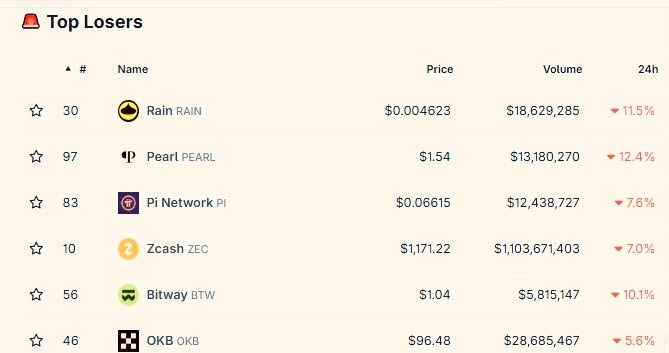
Top 100 Cryptocurrencies by Market Capitalization: Today's Decline List. Source: CoinGecko
Pi Network ( PI ) is a mobile-first blockchain platform that fell by 7.6% upon release, trading at $0.06615. Zcash ( ZEC ), as a cryptocurrency that emphasizes privacy, fell by 7% today, despite its generally positive macroeconomic prospects.
Bitway ( BTW ) and OKB ( OKB ) fell by approximately 10.1% and 5.6% respectively.
What will happen to cryptocurrencies next?
With the rise in mainstream demand, the volatility of cryptocurrencies is expected to continue to increase. In addition, the Bitcoin Volatility Index – a forward-looking 30-day annualized indicator used to measure the expected price fluctuations of BTC – has gradually risen over the past two months.
Therefore, leading cryptocurrencies may experience more intense fluctuations in the short term.