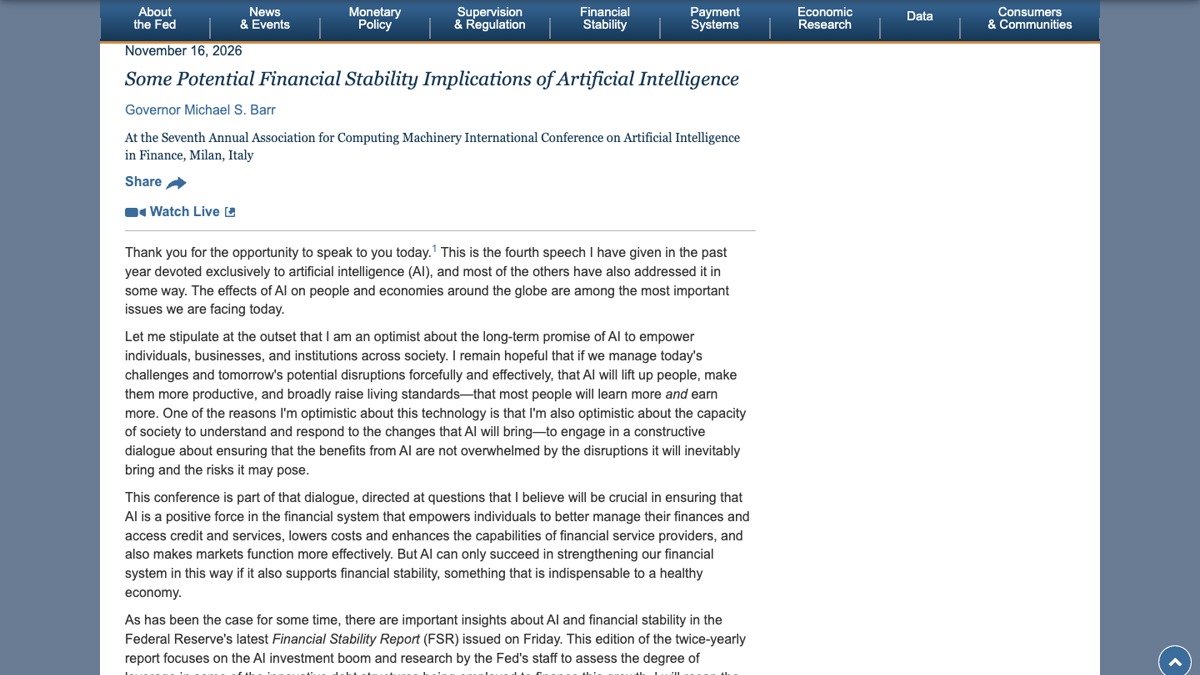


On November 16, Federal Reserve Board member Michael Barr discussed AI financial risks and compared two sets of figures: the on-balance-sheet debt of the seven largest AI companies is expected to exceed $800 billion by the end of the year, while the potential maximum notional value of related off-balance-sheet obligations has already surpassed $3 trillion.
The two sets of figures cannot be added directly. Bar cited the latest Federal Reserve 'Financial Stability Report', which clearly notes in a footnote that companies usually report off-balance-sheet obligations before discounting, while the figures on the balance sheet are discounted. The larger figure includes long-term contracts, leasing commitments, and residual value guarantees, and does not represent actual loans or losses that have already occurred.
Buyers, shareholders, and guarantors are all linked together.
In this speech at the Milan Artificial Intelligence Finance Conference, the financing risks of the AI data center were broken down into three parts: rapid debt growth, a circular financing network, and other complex financial obligations. Bal discussed the pathways of risk amplification when earnings fall short of expectations; however, he did not announce any defaults on these obligations, nor did he provide any loss forecasts.
In the off-balance-sheet arrangements he described, ultra-large cloud enterprises with stronger credit and other large companies indirectly support project financing for enterprises with weaker credit, or support investments in public utilities. Energy supply contracts, long-term data center and computing power leasing, as well as various off-balance-sheet financing structures, were all discussed. As a result, the risk exposure may exceed that of a single debt statement.
Another form of investment is equity investment. Cloud companies and large GPU manufacturers have made cumulative equity investments of over $100 billion in large language model laboratories and cloud startups. After receiving funds, smaller companies use these resources to rent or purchase the GPU and computing power from their investors, thereby creating a cycle of capital circulation.
Bal pointed out that these investments represent a relatively small proportion of the balance sheets of large companies, but they are crucial for smaller companies that receive payments. To make the construction economically viable in the end, smaller companies need to replace funds from suppliers with income from paying customers. For AI stock investors, this provides a specific checkpoint: what funds are customers using to continuously pay for computing power bills.
Residual value guarantees extend this coverage to the collateral. Enterprises that rely on external financing may shift from corporate bonds to asset-backed financing after being subject to such constraints; companies with higher credit ratings provide guarantees for the resale value of data centers or GPU. In the event of a default or collateral liquidation, these guarantees determine the extent of losses that large enterprises may incur.
The chip is old; how much value does the collateral still have?
Bal said that most of the cost of data centers comes from GPU and other specialized chips. Technological upgrades may lead to rapid depreciation of these chips; however, the current rental prices for older chips still seem to be supported, indicating that there is still a use for them even though they are behind the most cutting-edge computing devices. He also emphasized the need to continuously monitor this trend.
Electric power facilities cannot be generalized either. Substations, high-voltage connections, and grid access may have different requirements in some areas, while in others, they may not be put to use for many years. Bar-Yee compared the idle capacity after previous fiber optic construction, but did not assert that this round of AI investment will definitely lead to the same outcome.
His main concerns also have different levels. Considering that the scale of debt behind the current construction is still limited, his worries about direct losses are relatively small; however, with hedge funds having higher leverage and risk appetite, a sharp reversal could force deleveraging and trigger a mutual reinforcing sell-off. The capital adequacy of large banks serves as a buffer, but the counterparty exposures brought about by their principal brokerage business still need to be monitored.
These are all conditional judgments. The speech did not provide a list of companies, details of each guarantee, or the probability of occurrence. It is not possible to directly allocate the potential maximum nominal obligations of the entire industry to the liabilities of a single listed company, nor can it be claimed based on this that a certain company is insolvent.
Models of the same type may simultaneously perform the same type of transactions.
Bal also turned his attention to the use of AI in securities trading. He said that, as far as he knew, generative AI has not yet been widely used for autonomous trading, but the technical choices for design, training data, testing, and deployment already require prior evaluation.
If traders rely on a small number of similar models and data, their strategies may converge, and their reactions to news may also be synchronized. Malicious actors manipulating quotes, trades, or news could simultaneously mislead similar systems. Some studies discussed algorithms that could conspire on their own and generate fake orders, which are identified as research risks; however, this should not be interpreted as meaning that the entire market is being manipulated by AI.
For ordinary users, another change is even more direct. A report from a major bank found that AI agents attempted to operate retail customer accounts, and the bank was unable to verify the authenticity or whether these actions were in accordance with the customers' instructions. Barr proposed strict authentication, explicit consent for specific actions, and technical controls to limit the capabilities of these agents.
He also reminded that AI investment advice may be tainted with institutional commercial interests, such as promoting their own products, generating handling fees, or encouraging frequent trading. These conflicts of interest may be embedded in the algorithms, and it may not be easy for users to identify them. Just because a piece of advice seems personalized does not necessarily mean that its decisions are made solely for the benefit of the account holder.
Therefore, before granting proxy funding permissions, it is necessary to confirm that the authorization for specific actions can be verified. For those holding AI stocks, it is important to distinguish between the roles assumed by customer income, supplier investments, and guarantee commitments. Barr's personal view is to place these originally dispersed relationships into the same risk map, but they have not yet been transformed into new regulatory rules.